
News
Direct answer: Placement is the bottleneck, the feeder bank is full, and changeovers eat the shift — so the answer must be a second mounter. Sometimes. A second placement machine only pays when three things are true at the same time: placement is the measured constraint on your real product mix (not the slowest number on a datasheet), the feeder slots or the work split genuinely need a second machine (not a faster feeder setup), and the rest of the line can absorb the extra boards. If any of the three fails, the honest answer is faster feeder preparation, a line rebalance, or a faster single machine — not another mounter. This article shows what the numbers have to show, what a second machine fixes and does not fix, how to split the work between two mounters, and how to record the decision so it can be checked later.
The placement station is running flat out, orders are growing, and somebody suggests buying a second mounter. It may be the right move. It may also move the bottleneck to the oven, double the feeder bill, or solve a problem that a faster feeder setup would have solved with no new machine at all. The difference between those outcomes is not decided by the machine’s rated speed. It is decided by three measurements taken on your own line: the placement time per board on your own products, the feeder capacity your product mix actually needs, and the changeover pattern that eats your shift. This article is the decision guide for that purchase, and it is the next piece in our line-economics series — after staffing, changeover cost, turnkey quotes, OEE, the maintenance calendar, board testing, downtime logging, mid-batch substitution approval, throughput, scrap cost, and the end-of-life decision. It is about adding capacity to a running line, not about buying a whole line, and not about whether to repair or replace a single machine: those are different decisions, and the boundaries are stated where they matter.
Three boundaries first, so the rest of the article is read correctly. First, no single “boards per hour” or placement-time number in this article is a trigger line for buying a second machine. The decision changes with the product mix, the feeder load and the changeover pattern, and any threshold quoted as a universal rule would be wrong for the next line. Second, every worked example is marked as an example, with its assumptions stated next to it; none of them is a measurement from a real line, and none of them is a promise about what any machine will do on your boards. Third, this article names no real machine as the one to buy, and presents no placement machine’s speed figure as a guarantee for any customer’s board. Compare candidate machines on your own boards, with your own programs, before deciding.
“Do we need a second placement machine?” is the wrong first question. The right first question is: “What is stopping boards from leaving this line today, on the products we actually run?” A second mounter answers exactly one problem: there is more placement work per board than one machine can do in the time the line needs, and that work cannot be removed by better preparation. Everything else that looks like a placement problem — long changeovers, missing feeders, a program that stops the head, a printer or oven that cannot keep up — is a different problem with a cheaper answer, and a second machine will not fix it. It will hide it for a while, at the price of a machine, floor space, feeders, spares and training.
So the decision has an order. First, prove placement is the constraint. Second, show what the placement time, the feeder capacity and the changeover pattern each say. Third, compare the second machine against its real alternatives. Only then does the purchase question make sense.
Do not decide from a rated speed. Rated placement speeds are measured under test conditions that your boards will never reproduce: a standard test board, a standard component mix, no changeovers, no stops. Our companion article on reading throughput explains how to read those numbers without fooling yourself — this article uses its method and does not repeat it.
Time each station on your main products over a normal week, including changeovers and stops: printer cycle time (including stencil cleaning), placement time per board, reflow acceptance rate, SPI and AOI time per board. Use the downtime log to separate steady running from stops — the method is in our article on logging downtime, cited here and not repeated. The station with the longest time per board, after changeovers and stops are counted, is the constraint. If that station is the printer, the oven or inspection, a second mounter adds little: the line will still run at the slowest station’s pace, and the new machine will wait for boards.
Also check whether the mounter is slow because of the machine or because of how it is used. Long changeovers, missing feeders, poor programs, frequent nozzle or feeder stops and waiting for material can make a capable machine look like a bottleneck. If the head spends its time waiting, the constraint is the waiting, not the head. Fix the waiting first, measure again, and only then judge the machine.
A useful test: pick your highest-volume product and your highest-mix week. If placement is the constraint on both, the case for more placement capacity is real. If placement is the constraint only on one product, or only on the week with the worst changeover pattern, the case is weaker — and the fix may be in the changeover pattern, not in the machine count.
Three measurements decide the case. Each one must be taken from your own line, on your own products. No single “boards per hour” or placement-time number in this article is a trigger line for buying a second machine — the decision changes with the product mix, the feeder load and the changeover pattern, and any threshold quoted as a universal rule would be wrong.
Measure the steady-state placement time per board for each main product: from the moment a board is fixed in the mounter to the moment it is released, excluding changeover and excluding stops. Record it per product, not as one line average, because a line that runs five products has five placement times. Note also how much of that time is placing and how much is board transfer, vision checks and head travel — a program that makes the head travel empty across the board is a program problem, and reprogramming is cheaper than a second machine.
Feeder capacity is often the real reason a second mounter pays, and it has nothing to do with speed. Count unique component lines per product, not placements: a board with 300 placements from 150 unique lines is a supply problem, while a board with 900 placements from 40 unique lines is a speed problem. Count feeder widths, duplicate feeders for high-use parts, blocked positions, and tray and stick positions separately — a tray position is not a tape position.
Then map the product mix against the machine: how many positions does each job need, how many are shared between jobs, and how many positions must change at each changeover? A worked example, with stated assumptions and no claim to be a real line: suppose Job A needs 58 unique lines, Job B needs 64, and 30 lines are shared. Keeping both jobs fully set up needs 92 positions. If the machine holds 72, then 20 positions must change at every changeover between A and B, and the changeover time is set by those 20 swaps. A second machine roughly doubles the positions, so both jobs can stay loaded and the changeover shrinks to a program call. That is a feeder-capacity case, and it can be worth more than any speed gain. But if both jobs already fit, and the changeover is short, the same arithmetic says the second machine buys nothing on feeders.
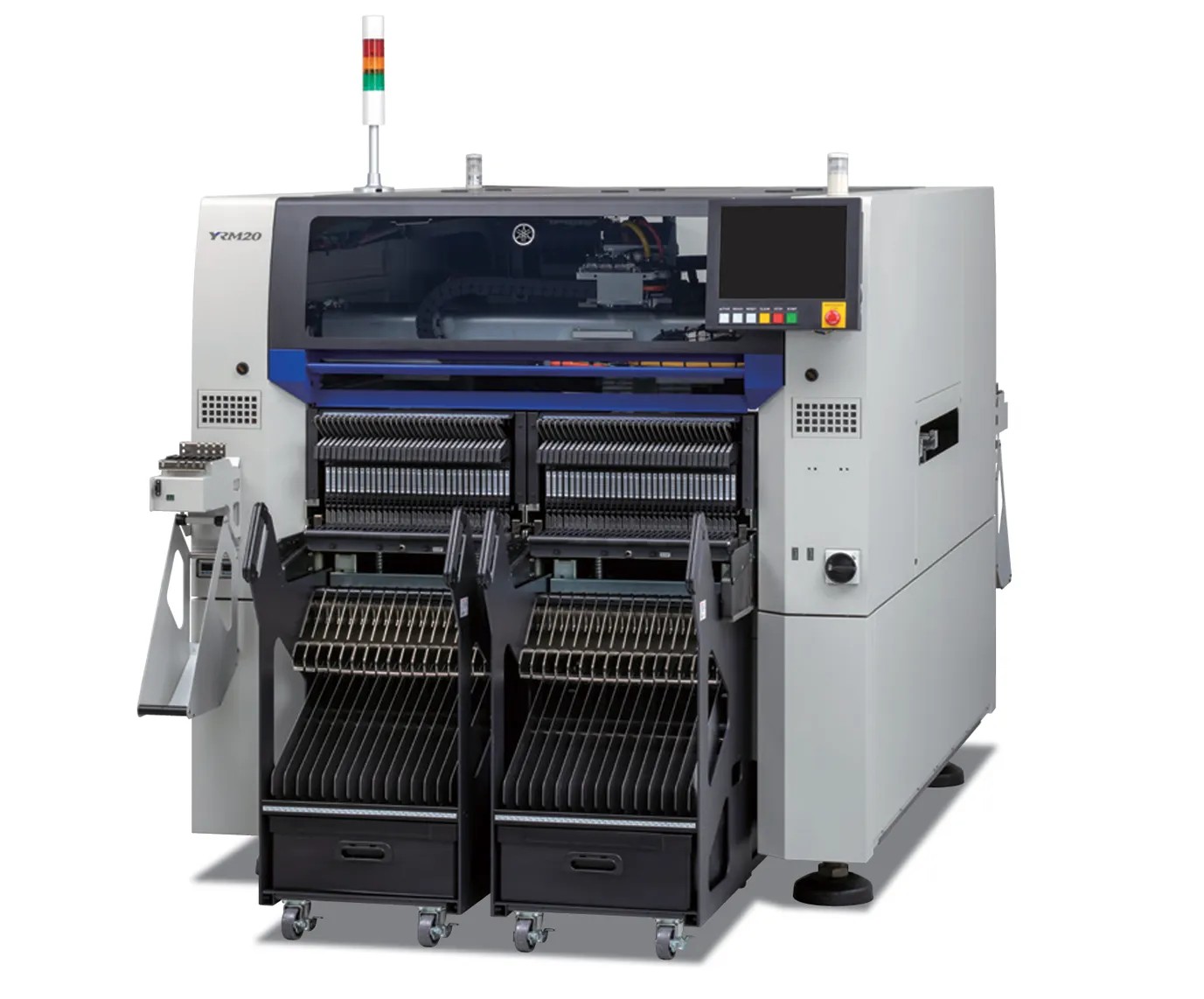
A Yamaha YRM20 pick-and-place machine with its feeder trolleys docked in front. The trolleys carry the tape feeders — and how many different component lines they can hold is often what decides whether a second machine pays. Photograph shows the example station only, not a recommendation for any line.
Record, for a normal month, how often the line changes over, how long each changeover takes, and what the time is spent on: feeder swaps, program load and verification, nozzle changes, first-board approval. Our article on changeover cost gives the cost method; this article uses its finding and does not repeat its table. The pattern matters more than any single changeover: a line that changes over twice a day with an hour of feeder swaps each time loses a different amount — and needs a different fix — than a line that changes over twice a week. If feeder swaps dominate, offline feeder preparation (staging the next job’s feeders on a cart while the current job runs) may recover the same hours a second machine would, without buying one. If program load and first-board approval dominate, a second machine does not shorten them at all.
Once placement is confirmed as the constraint, there are three main paths. They are not three versions of the same purchase; they solve different problems.
| Path | What it does | When it tends to win | What it costs you |
|---|---|---|---|
| Second machine in the same line | Splits each board’s placement work between two mounters in series; feeder capacity roughly doubles. | Feeder slots are running out; the mix is wide enough to split by component type; you want a phased investment; partial redundancy matters. | Floor space, a second set of feeders, spares and training; longer board travel; a second program to balance. |
| Faster single machine (replacement) | One higher-capacity mounter replaces the existing one. | Floor space is tight; boards are dominated by small chips a high-speed head handles well; the current machine is old enough that replacement makes sense anyway. | One set of programs, fewer feeders to maintain, simpler training — but the old machine’s remaining value is given up, and feeder capacity does not double. |
| Dual-lane or dual-head platform | One machine handles two boards at once, or works on one board with two heads. | Limited footprint with a need for more placement capacity; two boards can genuinely run in parallel. | Traversing units where a single-lane line meets a dual-lane machine; in parallel mode only one side of the feeder bank serves each lane, which hurts wide-mix boards. |
No real machine model is named here as the one to buy, and no mounter’s speed figure is presented as a guarantee for any customer’s board. Compare candidate machines on your own boards, with your own programs, before deciding — rated figures are measured under the maker’s test conditions, not yours. The question of what a whole new line should cost, and what a turnkey quote should include, is a different decision: our guide to turnkey SMT line quotes covers it, and this article does not repeat its checklist, because adding one machine to a running line is not buying a whole line.
A second mounter is a precise tool. Its honest job description is short.
It fixes:
A placement-time ceiling. When one machine’s steady placement time per board is the line’s longest station time, and the work can be split, two machines cut that time. A feeder-slot shortage. Two machines carry roughly twice the feeders, so more products stay set up and changeovers shrink. A mix split. One machine can be set up for small, fast-placing chips and the other for large or odd-form parts, each with the nozzles and feeders that suit it. Partial redundancy. If one machine stops, the other may keep simpler products running — “may”, because a product that needs both machines’ feeders cannot run on one.
It does not fix:
A printer, oven or inspection limit. Relieving the placement bottleneck exposes the next-slowest station. Reflow is the usual next limit: the profile has a fixed duration, and no placement speed shortens it. If the mounters are already faster than the reflow cycle, the investment in mounting speed is effectively wasted — the machines will stand idle for seconds every cycle. Program quality. A second machine runs two programs; a bad program becomes two bad programs, and the split between them has to be built and maintained. Feeder preparation discipline. If feeders arrive late, half-loaded or wrong, the second machine waits exactly like the first one. Floor space, power and air. A second machine needs all three, plus access space around it and a longer conveyor path — and a longer path means more board transfer time between stations. Cost per board by itself. A second machine raises output only if the work is split well and the next station can take the extra boards; otherwise it raises the cost of the same output.
The most common disappointment is the moving bottleneck: the line gets faster at placement, the oven becomes the limit, and the second machine’s gain is capped at the oven’s rate. Check the next station before ordering, not after installing.
With two machines in series, the program decides how much each machine does — and the whole purchase stands or falls on that split. The rule is simple: both machines should finish each board in roughly the same time. If one takes much longer, the other waits, and the investment is wasted.
A common approach puts small, fast-placing parts on the first machine and larger, slower parts on the second. Feeder layout, nozzle availability and component sizes all affect the split, and the split that works for one product will not work for another. Before buying, ask the supplier to build balanced programs for your main products and show the expected time on each machine. If the supplier cannot show a balanced split for your boards, that is evidence — not a detail to sort out after delivery.
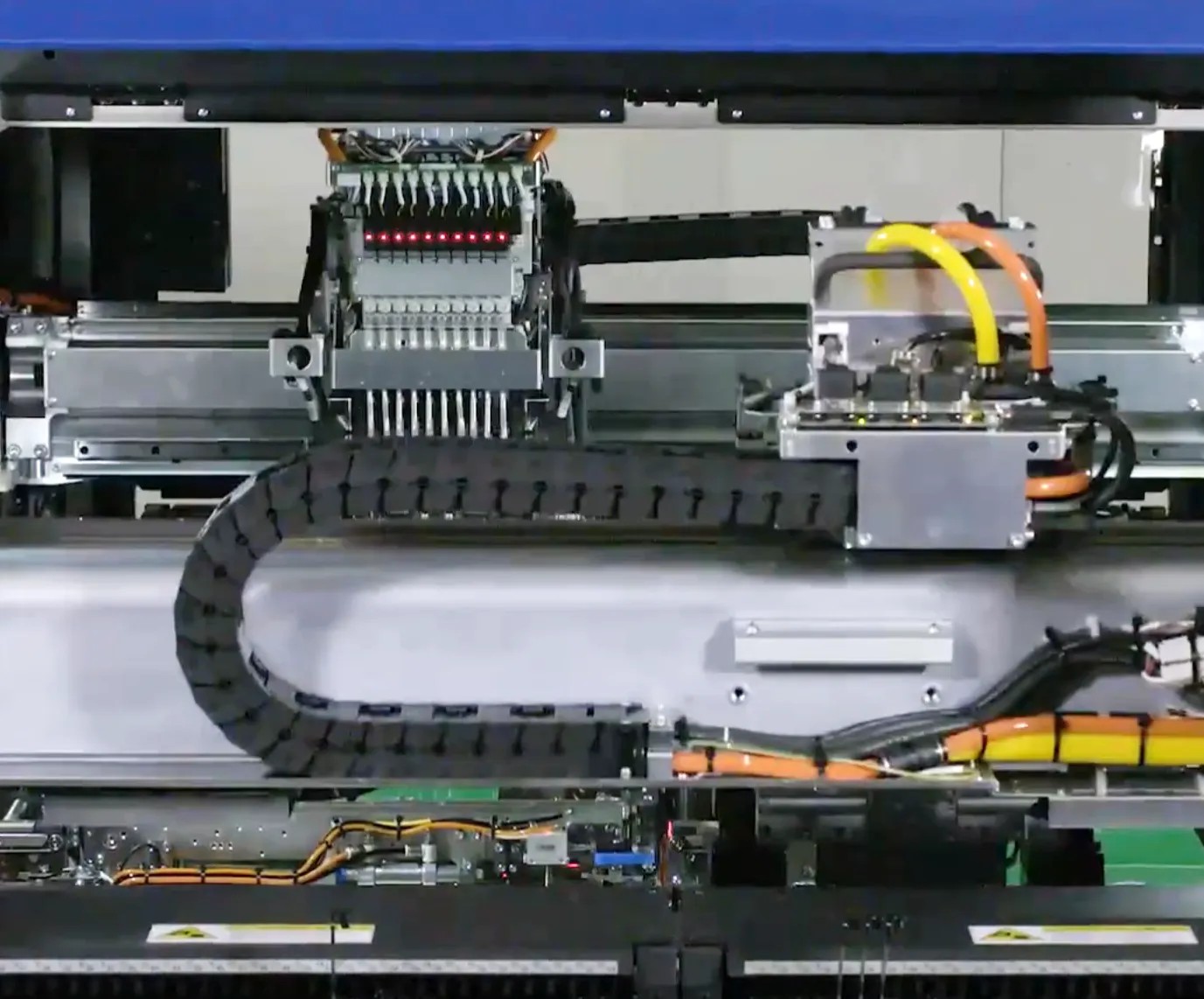
Two placement heads inside a Yamaha YRM20. Whether the heads sit in one machine or in two machines in series, the rule is the same: the work has to be split so neither head waits on the other. Photograph shows the example station only.
An illustrative example, with stated assumptions — not a real line, not a measurement, and not a promise. Suppose a line’s steady station times are: printer 18 seconds per board, placement 46 seconds, reflow accepting a board every 30 seconds, inspection 22 seconds. Placement limits the line at one board every 46 seconds.
Split the placement work so each mounter needs about 25 seconds per board, including its share of board transfer. The line then runs at the slowest remaining station — the oven, at 30 seconds per board — and output rises from one board every 46 seconds to one every 30 seconds, about 53% more boards in the same running time (46 ÷ 30 ≈ 1.53).
Now suppose the split is poor: one machine needs 34 seconds and the other 16. The line runs at 34 seconds per board, and the gain is only about 35% (46 ÷ 34 ≈ 1.35) — most of the second machine’s capacity is idle while the first machine works. Balance matters as much as the purchase. And note what the example also shows: even a perfect split cannot beat the oven’s 30 seconds. The next bottleneck is already visible in the arithmetic.
Two practical consequences follow. First, the split must be re-checked for every main product — a line that is balanced on the highest-volume board may be badly unbalanced on the next one. Second, the split is a program, not a setting: it needs someone who owns it, updates it when the mix changes, and re-measures it when the numbers drift.
A second machine is the most expensive answer to a placement bottleneck. Three cheaper answers deserve a fair trial first, with measurements, not opinions.
Faster feeder preparation. Stage the next job’s feeders offline while the current job runs — on a cart or a second feeder table — so changeover becomes a swap, not a build. Keep shared components loaded between jobs where the material and feeder assignments match. Duplicate the feeders for high-use parts instead of moving one feeder between jobs. If the changeover log shows feeder swaps dominating, this is usually the first fix to try, and its effect is measurable in a week: time the switch from the last good board of one job to the first good board of the next, before and after.
A line rebalance. Move work between stations instead of adding a station. Conveyors and buffers between stations absorb small differences in station times — the sizing method is in our companion article on line balancing (WordPress, 2026-10-26), cited here and not repeated. Rebalancing can also mean moving a slow component family to a different station, or re-sequencing products so that feeder-heavy jobs do not follow each other. Our staffing article is relevant here too: the number of people the line needs changes when the bottleneck moves, and its headcount logic is cited, not rewritten.
A faster single machine — or repairing the one you have. If the current machine is old, unreliable, or short of feeders and nozzles, a single replacement can be cheaper than integrating a new machine with an old one that uses different feeders, nozzles and software. And if the machine is capable but poorly used — long changeovers, missing feeders, poor programs — the repair is in the use, not the machine. The repair-or-replace question for a single machine is a different decision from the capacity question in this article, and the boundary is stated plainly: this article decides whether the line needs more placement capacity; the machine-level repair decision belongs to its own guide and is not answered here.
If none of the three recovers the hours you need, the case for a second machine is stronger — and you will be able to show why, with numbers, instead of asserting it.
When placement gets faster, the next-slowest station becomes the limit. Check each one against the new rate before ordering:
Printer. Will its cycle time, including stencil cleaning, keep up with the new placement rate? Our incoming-inspection article is relevant at this point too: feeders loaded with the wrong or unchecked material will stop the faster line exactly as they stopped the slower one, and its receiving checks are cited, not repeated. Reflow. Can the oven accept boards at the new rate at the conveyor speed the profile needs? The profile duration is fixed; if the oven is already the second-slowest station, it becomes the limit the day the second mounter starts. Inspection. Can SPI and AOI inspect each board within the new cycle time? Inspection that was comfortable at the old rate can become the new bottleneck overnight. Handling. Do the conveyors and buffers between machines have room for the extra unit, and for the longer board path it creates? Floor, power and air. A second machine needs floor space plus access space, electrical supply and compressed air — and the line layout must still let operators reach both machines and the feeder banks. People, spares and software. A second machine means a second set of feeders to maintain, a second program to keep balanced, spares for two machines (or one shared set, if the models match), and operators trained on both. The same model simplifies spares and training; a different head setup covers a wider component range. That trade-off is a real decision, not a detail.
One more boundary: a second machine in the same line is not a second line. A second line adds flexibility for different products but needs its own printer, oven and inspection — a different investment at a different scale, and a different decision. Do not let a second-mounter discussion quietly become a second-line discussion.
A capacity decision that cannot be checked later is an opinion. Write it down before ordering, in eight fields: (1) measured station times per main product, with changeovers and stops included; (2) the feeder map — unique lines per job, shared lines, positions that must change; (3) the changeover log — frequency, duration, and what the time is spent on; (4) the balanced split — expected time on each machine per main product, shown by the supplier before purchase; (5) the next bottleneck — which station limits the line after the second machine, and at what rate; (6) floor, power and air — confirmed available, not assumed; (7) the alternatives tried — feeder preparation, rebalance, single-machine replacement — with their measured results; (8) the review date — when the split and the station times will be re-measured after installation.
The answer is no — or not yet — when any of these is true: placement is not the measured constraint; the feeder map shows both jobs already fit; the changeover log shows the time going to program load and approval rather than feeder swaps; the supplier cannot show a balanced split for your main products; the oven or inspection becomes the limit at a rate below what you need; or the alternatives have not been tried and measured. “Not yet” is a legitimate outcome, and it is cheaper than a machine that waits for boards.
JHIMS lists placement machines on jhims.net, and the photographs in this article show one of them — a Yamaha YRM20 — as the example placement station. It is shown as an example station only: the photographs illustrate what a feeder bank and a placement head look like, and the machine in them is not presented as the second machine any particular line should buy. A second mounter is, plainly, a purchase a placement-machine supplier would like you to make, so the boundary matters: this article is a decision guide, not a recommendation to buy a second machine, and it names no machine as the one to buy. What a placement machine does in this decision is narrow and specific: its feeder bank carries the material to the head, and its vision system checks presence and polarity during placement. Feeders and vision check what is on the board; they do not check whether your line needs a second machine, and no speed figure on a product page is a guarantee for any customer’s board. If the decision record in Section 9 points to more placement capacity, a JHIMS-listed placement machine is one candidate to compare on your own boards, with your own programs — and the comparison should be made the same way for every candidate. For technical details or a quotation, contact [email protected].
How do I know placement is really the bottleneck, and not the printer or the oven? Time every station on your main products over a normal week, including changeovers and stops. The station with the longest time per board is the constraint. If that station is not placement, a second mounter will not raise output. The reading method is in our throughput article; the downtime log method is in our downtime article.
Will a second mounter double my output? Rarely. Output is set by the slowest station after the change and by how evenly the work is split between the two machines. A perfect split still cannot beat the next-slowest station — usually the oven, whose profile duration is fixed.
Should the second machine be the same model as the first? Not necessarily. The same model simplifies spares, feeders and training. A different head setup can cover a wider component range. Decide from the feeder map and the mix split, not from habit.
My feeder bank is full, but placement time is not the problem. Does that still justify a second machine? It can — feeder capacity is a legitimate reason on its own, because two machines roughly double the positions and let more products stay set up. But check offline feeder preparation first: staging the next job while the current job runs may recover the same changeover hours without a second machine.
We added a second mounter and output barely moved. What went wrong? The usual causes, in order: the work split is unbalanced, so one machine waits; the bottleneck moved to the oven or inspection, which now limits the line; or the constraint was never placement — it was changeovers, waiting for material, or program stops, and the second machine inherited all of them. Re-measure the station times and the split before spending more.
Bottom line: A second placement machine pays when placement is the measured constraint, the feeder map or the work split genuinely needs a second machine, and the rest of the line can take the extra boards. When any of those fails, the honest answer is faster feeder preparation, a line rebalance, or a faster single machine. Measure first, split the work on paper before you buy, and write the decision down so it can be checked.
For technical details or a quotation on a placement machine for your line, contact JHIMS at [email protected].


 Teams
 whatsapp
 telegram
