
News
Direct answer: A turnkey SMT line quote is a scope document, not a price. Two quotes for the "same" line can differ by a whole inspection station, a week of installation labour, or a year of warranty — and the headline total will not tell you which. Read the quote in seven blocks — process machines, inspection and software, board handling, engineering and integration, installation and commissioning, training and ramp-up, and commercial terms — and ask, for each block, what is itemised, what is excluded, and what acceptance proves. Compare landed scope at the same delivery point, never headline totals. The rest of this article is the checklist for doing exactly that.
Ask ten suppliers what a turnkey SMT line costs and you will receive ten different numbers, often for ten different scopes. One quote may include feeders, inspection, board handling and on-site commissioning. Another may cover only a printer, a mounter and an oven. Neither number tells you what your project will actually cost, because the difference is not in the machines — it is in everything around them. This article shows you how to read a quote the way an engineer reads a drawing: block by block, line by line, with the exclusions and the acceptance criteria given the same attention as the equipment list.
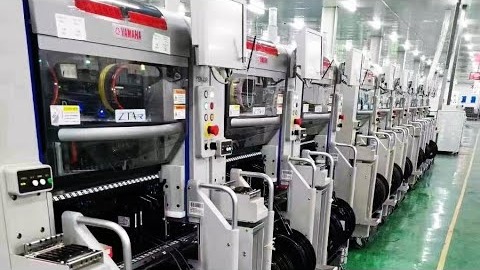
A row of Yamaha YSM40R mounters in a production hall. The quote must name each machine, its configuration and its options — a model name alone is not a specification. Source: JHIMS YSM40R product page.
The word "turnkey" has no standard technical meaning in SMT equipment. It means whatever the contract says it means. A supplier can call a three-machine delivery turnkey, and another can call a nine-station line with installation, programming and training turnkey, and both are using the word correctly — because the word itself promises nothing. The quote is the promise. If the quote does not define the boundary of the project, the word on the cover page is decoration.
So the first thing to ask of any turnkey quote is the boundary, in writing: which operations are inside this project and which stay outside it. A complete SMT line runs from bare board in to inspected board out: loading, solder paste printing, SPI, pick and place, reflow, AOI and unloading. But the wider process around it may also need depaneling, through-hole insertion, selective soldering, cleaning, coating, programming or electrical test. If the quote does not say where its line starts and ends, assume the missing operations are your problem — and your cost.
Three sentences in the quote tell you most of what you need to know about the supplier. First, does it list every machine with model, options and quantities, or does it list model names only? A model name is not a specification. Second, does it state what is included around the equipment — installation, commissioning, training, spares — or does it stop at the machine list? Third, does it define acceptance, or does it end at delivery? A quote that answers all three is a project proposal. A quote that answers only the first is a price list with a turnkey label.
A complete turnkey scope breaks into seven blocks. Not every line needs every item in every block, but any quotation that omits a block should explain why — in writing, not in a sales call. Use this table as the checklist: go through the quote and tick each block off, or write down who provides it if the supplier does not.
| Block | What to look for in the quote | What it costs you if it is missing |
|---|---|---|
| 1. Process machines | Printer, mounter(s), reflow oven — each with model, configuration, options and quantity | You buy the missing station later, at list price, and the line stops while you wait |
| 2. Inspection and software | SPI, AOI, programming software, traceability or MES connection, licences named as included or optional | Defects are found after reflow; the cost moves to rework, scrap and warranty claims |
| 3. Board handling | Loader, conveyors, buffers, unloader, magazine handling — lengths and transfer height stated | Manual board transfer becomes the bottleneck; operators carry boards between stations |
| 4. Engineering and integration | Layout, utility plan, line balancing, and making machines from different vendors communicate as one line | Machines standing in a row, not a line; boards stop between stations |
| 5. Installation and commissioning | Rigging, levelling, connection, calibration, first programs and first thermal profiles | The line arrives and nobody owns making it run |
| 6. Training and ramp-up | Operator, programmer and maintenance training; documentation; first-production support | Your team learns on production boards, and pays for the lesson in scrap |
| 7. Commercial terms | Warranty, spare parts package, service response commitment, payment schedule | The cheapest quote becomes the most expensive line in its second year |
The mounter gets the attention in most quote comparisons, but it is rarely the whole story of what you actually deploy. On a typical mixed-product line, the process machines are the largest share of project scope — and inspection and software, board handling, engineering, installation, training and commercial terms are each meaningful blocks that are easy to under-scope precisely because they do not appear in the headline machine comparison. If a block is missing from the quote, the cost has not disappeared. It has moved — to a later purchase order, to your facilities team, or to your rework bench.
Before judging the quote, fix the line in your mind. A complete SMT line, from bare board to inspected product, has seven stations. The table below shows each station with the JHIMS machine that fills it, and — more importantly — what the quote must state about that machine. The specifications are the checkable facts: use them to test whether the quoted configuration fits your boards, not as a ranking of machines.
| Station | JHIMS machine | What the quote must state |
|---|---|---|
| Board handling | Loader, conveyors, unloader | Lengths, lane count and transfer height — every station must match; the machines JHIMS lists share a 900 mm transport height |
| Solder paste printing | M8 solder paste printer (jhims.com listing) | Board size range, stencil frame size, accuracy, cycle time, squeegee and cleaning configuration |
| Solder paste inspection | S630 3D SPI | Board size range, measurement resolution, programming time, closed-loop feedback to the printer |
| Pick and place | Yamaha YSM40R (jhims.com listing) | Head configuration, feeder count and types, component range, board size, power and air supply |
| Reflow soldering | R10 reflow oven | Zone count and control, temperature range, board width, power supply, exhaust and nitrogen option |
| Automated optical inspection | JUTZE AOI (inline, after reflow) | Board size and resolution limits against your largest, finest-pitch board — demonstrate it on your boards rather than relying on brochure claims |
The numbers that decide whether a quoted machine fits your product are the unglamorous ones. The M8 printer takes boards from 50×50 mm to 650×610 mm, with a stencil frame up to 850×850 mm, print accuracy of ±0.025 mm and repeat accuracy of ±0.01 mm, and an 8-second cycle excluding cleaning (16 seconds including cleaning) — the same figures on both JHIMS sites. The YSM40R mounter is rated at 200,000 CPH with the 4-beam RS head and ±0.035 mm accuracy, covers 0201 components through 45×100 mm parts, takes up to 80 feeder types with the RS head and 88 with the MU head, and handles boards from L50×W50 mm to L700×W460 mm — again the same figures on both sites. But the CPH figure is measured under Yamaha optimum conditions. The YSM40R product page says it plainly: use Yamaha Y.FacT or P-Tool to simulate tact with your specific PCBs before purchase. A quote that promises a catalogue CPH on your boards, without a simulation or a test run, is promising a number it has not measured.
The R10 reflow oven has 20 independently controlled heating zones (10 upper, 10 lower) with PID closed-loop control and ±1°C accuracy, a temperature range up to 300°C, a 3,840 mm preheating tunnel and a 1,260 mm dual-sided cooling section — figures the .net R10 page and our reflow profiling checklist agree on. The .net R10 page also lists a 45 kW startup power against 11–13 kW in normal running, a 5-wire 3-phase 380 V supply, and a maximum PCB width of 460 mm. That gap between startup and running power is exactly the kind of number the quote must carry into your facilities plan: the electrician sizes the supply for the startup figure, not the running figure. For the S630 3D SPI, the .net page lists boards from 50×50 mm to 630×550 mm and programming in under 5 minutes; the measurement set itself — 5-megapixel camera, 16 µm resolution, volume, area, height, XY offset and shape, Gage R&R under 10%, 150 µm minimum pad spacing, 0.4–7 mm board thickness — is confirmed on both JHIMS sites. For how the inspection stations fit together, and which one to buy first, see our buy-order decision guide for SPI and AOI. And for what integration between these stations actually means once the line runs, see our overview of SMT line integration — read it for the architecture, not for the market figures, which are that article's own claims.
Check the fit before the price. Three questions answer most of a quote's fitness: does the smallest station's board-size range cover your largest panel? Does the feeder count cover your widest bill of materials without reload stops? Does the oven's zone count and power supply match your heaviest board? If the quote does not give you the numbers to answer those three questions, it is not yet a specification — it is a brochure with a total at the bottom.
Most of the money a turnkey quote hides is not hidden at all. It sits in the exclusions section, in plain language, in a part of the document most buyers skim. Read that section first. These are the five exclusions that appear most often, and the question that exposes each one.
Freight, insurance, duties and rigging. Is the price ex-works, delivered to your dock, or delivered duty paid? Freight, import charges, broker fees, inland delivery, rigging into the building and any facility modifications are routinely outside the equipment price — and they are the first costs a buyer discovers after signing. Compare every offer at the same delivery point and scope. A quote that ends at the factory gate is not comparable with a quote that ends at your floor.
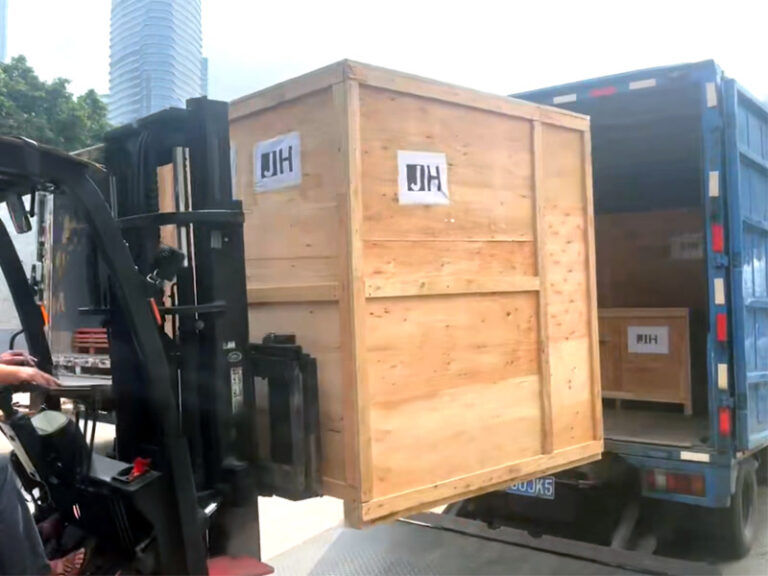
Export crates being loaded for shipment. Freight, insurance, duties and rigging are the first place a "turnkey" quote hides cost — the crate is easy to see, the freight terms are the part that moves money. Source: JHIMS M8 product page gallery.
Installation labour and travel. Who flies in, for how long, and at whose cost? A quote may include "installation" and mean one engineer for three days, or two engineers for two weeks — the difference is the whole commissioning. JHIMS states on its company profile that on-site installation is available at a charge while remote video training and documentation support are free. That is the honest form of the distinction: ask every supplier to state it the same way, so the installation line is comparable instead of assumed.
Utilities and facility work. Electrical work from your distribution panel to each machine, compressed air supply and treatment, exhaust ducting for the oven, floor preparation and floor loading all typically sit outside the equipment supplier's scope. The numbers to collect are on the product pages: the M8 needs AC 220 V at 3 kW and clean air at 4–6 Kgf/cm²; the YSM40R needs a three-phase supply and air at 0.45 MPa or more, clean and dry; the S630 needs 220 V and air at 4–6 Bar, per the .net S630 page. Hand those figures to your facilities team before you sign, not after the machines arrive — the electrician and the air compressor are not in the quote, and their lead time is longer than the shipping time.
Software licences and MES connection. The YSM40R page lists P-Tool as the basic licence and e-Vision as an option; the S630 lists standard MES integration. Options listed next to standard features are the classic quote trap: the page shows the feature, the quote charges for it separately, and the buyer discovers the difference at commissioning. Ask for a written technical agreement that lists every included item and option, and ask whether software upgrades are charged or free.
Stencils, consumables and first spares. A stencil per product, squeegees, nozzles, feeders beyond the base count, cleaning paper and fluid, solder paste for the first runs — none of these are machines, so none of them appear in a machine comparison, and all of them are needed on day one. JHIMS recommends a starter spare parts kit with every machine and states that in-stock parts ship within 48 hours. Ask the supplier for the recommended spares list for your configuration, and ask what is in the quote and what is a separate line.
A quote without acceptance criteria is a delivery note. There are two acceptance moments, and the quote should define both before you sign — because after you sign, the supplier has no reason to agree to a test it has not already accepted.
Factory acceptance test (FAT), before shipment. This is the test that proves the machines work before they leave the factory. JHIMS states on its company profile that every machine goes through a five-stage pre-shipment process — incoming inspection, in-process checks, electrical safety test, a 48-hour production test run with the customer's actual process parameters, and a final inspection of more than 120 checkpoints — and that the buyer receives a signed test report before the machine ships. Whatever your supplier's process is, ask for the same three things in writing: what is tested, what the pass criteria are, and whether you receive the report. A test nobody writes down is a test nobody has to pass.
Site acceptance test (SAT), after installation. This is the test that proves the line works in your factory, on your boards, with your people. Define it in the quote: the representative assemblies, the material readiness, the staffing assumptions, the run duration, the acceptable quality level and the reporting method. Include a changeover in the test if changing products is central to your business case — a line that passes on a single long run and fails on the third changeover has not passed. A reflow profile is only valid when thermocouples on a production-representative board show that every critical point stays inside the solder paste maker's window; our reflow profiling checklist explains how to judge that. And the first boards after any changeover deserve inspection, not trust — which is why the SPI station in the quote is an acceptance tool as well as a production tool.
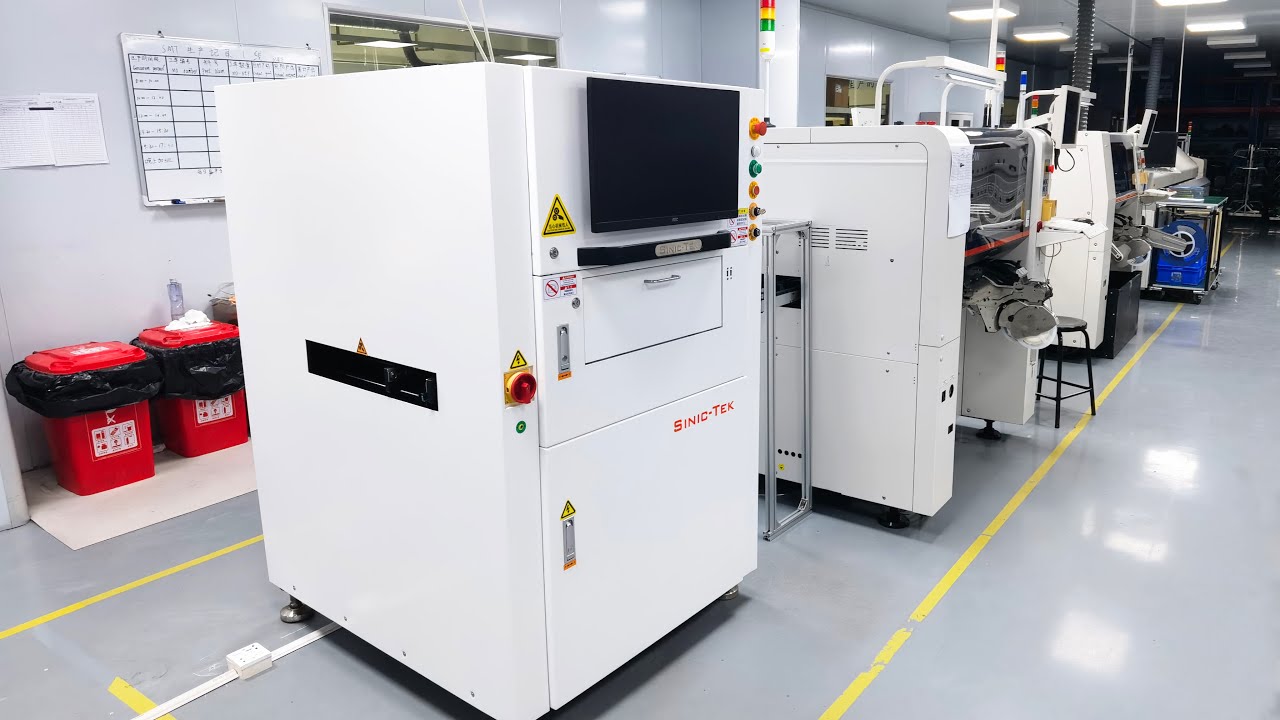
A 3D SPI station in a production line. Inspection belongs in the quote, not in a later purchase order — and the acceptance test is where it earns its place. Source: JHIMS S630 product page gallery.
Link payment to acceptance. Decide the payment milestones before shipment and after installation, with pass criteria based on your boards, and hold a fraction of the price until site acceptance sign-off. The exact fraction is a commercial negotiation, not a technical fact — but the principle is technical: the supplier's incentive to finish commissioning properly ends the moment the last payment clears. A quote that asks for full payment on shipment has told you, in its payment terms, how much it values the acceptance test.
The first year of a line is the supplier's problem. The second year is yours — unless the quote says otherwise. Four questions decide which it is, and all four belong in the quote, not in an email after delivery.
What does the warranty cover, for how long, and from what start date? JHIMS states a 12-month comprehensive warranty covering all mechanical, electrical and electronic components on its company profile, and the R10 page lists one year as standard with extension available. The start date matters as much as the length: a warranty that starts at delivery is shorter, in useful terms, than one that starts at site acceptance sign-off, because the weeks of shipping and installation consume it. Ask for the start trigger in writing, and ask what is excluded — consumables, nozzles, and damage from incorrect operation are commonly outside it.
Who answers, in what language, and how fast? A line stops at 2 a.m. your time, which may be midday at the supplier. JHIMS states a first response typically within 12 working hours, Monday to Saturday, 09:00–23:00 China Standard Time, with diagnosis by video call. Whatever the commitment is, get the hours and the language in the quote — "support included" without hours or a language is not a commitment.
What happens when a part fails? Ask for the recommended spare parts list for your configuration, the lead time for parts that are not in stock, and whether the supplier keeps parts for older models. JHIMS states that in-stock parts are dispatched within 48 hours and recommends a starter kit with every machine. The kit is the cheapest insurance in the whole project: a line waiting three weeks for a feeder part has lost more than the kit ever cost.
Who is trained, and what do you keep? Training should name its audience — operators, programmers, maintenance staff — its length, its language, and the documentation you keep afterwards. JHIMS provides hands-on training during commissioning, English operation manuals and video tutorials, with new operators trainable from the same materials at any time. And remember the two costs the quote never shows: the people and the changeovers. Our staffing method for automated SMT lines shows how to calculate the operators a line actually needs, and our changeover cost guide shows what each product change costs in lost output. Neither number appears in a machine quote — both belong in your business case.
Never compare headline totals. Normalise the scope first, then compare. The worksheet below is the whole method: rewrite each quote into the same columns, and price the missing items before you judge the totals.
| Comparison item | Quote A | Quote B |
|---|---|---|
| Delivery point (EXW / DAP / DDP) | ||
| Machine list with model, options, quantities | ||
| Feeders, nozzles, stencils included — and for which products | ||
| Inspection and software licences (included vs optional) | ||
| Board handling: loader, conveyors, unloader | ||
| Installation days, engineers on site, travel included? | ||
| Training: who, how long, in what language, what documentation | ||
| Spare parts kit included? | ||
| Warranty: period, coverage, start trigger | ||
| Acceptance: FAT and SAT criteria, on whose boards | ||
| Payment milestones and retention until SAT sign-off | ||
| Landed scope total (same delivery point) |
Worked example — illustrative, not a real quotation. Two quotes cover the same YSM40R-based line. Quote A includes 80 feeders — the full feeder capacity of the RS head. Quote B includes 40 feeders, and the headline total is lower. Same machine, different scope: the line in Quote B stops for feeder reloads on every wide bill of materials, and the feeders arrive later as a separate purchase at a separate price. Once the missing 40 feeders, the freight to your dock and the installation days are added to Quote B, the "cheaper" quote is the more expensive line. The example is invented to show the method; the lesson is real — compare landed scope, not headline totals.
If a quote omits a block, do not guess its cost. Ask the supplier to price it, in writing, as a separate line. A supplier that prices the missing block has given you a comparable quote. A supplier that will not has told you something too — just not in the price column.
Print this section and take it into the negotiation. If the supplier cannot answer a question, the answer is not "trust us" — it is a missing line in the quote.
1. Which operations are inside this quote, and which stay outside it? Get the boundary in one sentence: bare board in, inspected board out — and everything beyond that named as yours or theirs.
2. List every machine with model, options and quantities. What is an option and what is standard? A model name is not a specification; an option listed on a product page is not included until the quote says so.
3. How many feeders, nozzles and stencils are included — and for which products? The count decides whether the line runs your widest bill of materials or stops to reload.
4. What are the power, air, exhaust and floor requirements for each machine, and who provides them? Hand the numbers to your facilities team before signing; their lead time is longer than the shipping time.
5. What does installation and commissioning include — who comes, for how long, and at whose cost? Days, engineers, travel, and what "commissioning" covers: first programs, first profiles, first good boards.
6. What acceptance tests run before shipment and after installation, on whose boards, and with what pass criteria? FAT proves the machines work; SAT proves the line works in your factory. Both need criteria written before you pay.
7. What does the warranty cover, for how long, from what start date — and what is the service response commitment? Hours, language, parts lead time, and what is excluded.
8. What fraction of the price is held until site acceptance sign-off? Payment tied to acceptance protects both sides: the supplier is paid for a working line, and you pay for a working line.
What does "turnkey" actually mean?
Whatever the contract says it means. There is no standard definition, so the quote must define the boundary: equipment, tooling, software, documentation and responsibility. If the quote does not define it, the word on the cover page is a label, not a promise.
Why do quotes for the same line differ so much?
Because they describe different scopes: different feeder and stencil counts, different delivery terms, different installation days, different warranty periods, and different lists of what is an option. Two quotes can describe the same three machines and differ by everything around them. Normalise the scope with the worksheet in Section 7 before comparing totals.
Should SPI and AOI be in the quote?
It depends on what a latent defect costs you. For consumer boards with mature processes, a single AOI station after reflow may be enough. For automotive, medical, or any product where a defect becomes a field failure, SPI before placement and AOI after reflow are not optional in any meaningful sense — the cost of skipping them does not disappear, it moves to rework, scrap and warranty claims. Our SPI/AOI buy-order guide covers which one to buy first.
Who pays for installation?
Whoever the quote says. Installation labour, travel, rigging and commissioning are regularly quoted separately from the machines, and on-site installation is commonly charged while remote guidance is free. Ask for the installation line itemised — days, engineers, travel — so it can be compared instead of assumed.
What if the line does not hit the quoted speed?
Catalogue speeds are measured under the manufacturer's optimum conditions, not on your boards. The protection is in the acceptance test: define it on your representative assemblies, your product mix and an agreed run duration, with pass criteria written into the quote before you sign. A speed nobody has to demonstrate is a speed nobody has to deliver.
The cheapest turnkey quote is the one whose scope you have read completely. Ask for the seven blocks, the five exclusions and the acceptance criteria in writing. Price the missing items before you judge the totals. Hold payment until the line proves itself on your boards. A supplier that answers all eight questions in the quote has given you a project; a supplier that answers them in a sales call has given you a conversation. Buy the project.
For a turnkey SMT line quotation with the full scope itemised — machines, inspection, handling, installation, training, spares and warranty — contact JHIMS at [email protected] with your board drawings, bill of materials, volumes and factory layout, and ask for the seven blocks in Section 2 as separate lines.


 Teams
 whatsapp
 telegram
