
News
A planning method, not a magic number — count the operator-minutes, staff positions instead of tasks, and let automation remove tasks one by one.
DIRECT ANSWER: There is no single number. For one SMT line at steady state, the planning answer is usually 1–3 direct positions per shift — one person who stays with the line, plus a second person when feeder work, changeover and rework overlap, and a third only when changeovers are frequent or inspection review is heavy. The exact number comes from a short calculation: list every operator task in minutes per shift, divide by the minutes one person actually has, then add the coverage rules (a position needs a person present for the whole shift, and a changeover needs two people at the same moment). The worked example below uses stated planning numbers you must replace with your own timed observations — it shows the method, not a benchmark for your line.
Ask five factories how many operators their SMT line needs and you will get five different answers — and all five can be right. The machines may look the same, but the staffing is decided by what the people still have to do: who loads boards, who splices reels, who answers the SPI screen, who runs the changeover, and who fixes the boards the inspection stations reject. Automation does not remove "operators" in general. It removes specific tasks, one at a time. Count the tasks and the number follows.
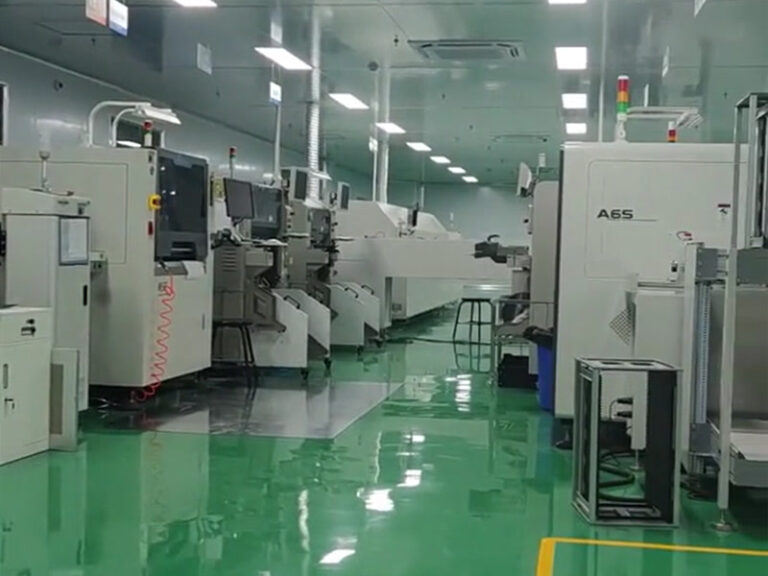
An SMT production floor — printer, placement and inspection machines in line. No operators are visible in this frame; the staffing question is how many people this floor needs per shift, not how many machines it holds. Photo: JHIMS YSM20R product page (Changsha case image).
Most staffing arguments start with three different numbers confused as one. Separate them before you calculate anything.
This article answers the first two: positions per shift, then people per shift. The roster follows from your own absence rate in Section 6. If a supplier quotes you "one operator per line", ask which of the three numbers they mean — the answer is usually the position count, and the roster is larger.
Walk the line for one shift and write down every job a person does, including the ones that happen "between" machines. The table below is the inventory to start from. Cross out the rows your line has automated, and add the rows your line still does by hand.
| Task | Where it happens | What removes it |
|---|---|---|
| Board loading, unloading and line tending | Line entry and exit | Loaders, unloaders and SMEMA conveyors between stations |
| Material preparation and kitting | Stores and feeder setup area | Pre-kitted feeder carriages prepared off-shift |
| Feeder loading, splicing and reel changes | Pick-and-place machine | Nonstop feeder exchange; fewer, larger reels |
| Program loading and changeover | Every machine, in sequence | Stored programs, automatic recall, exchange carriages |
| First-article check after changeover | SPI and AOI review stations | Nothing removes it — automation only makes it faster to verify |
| SPI and AOI false-call review | Inspection review monitors | Closed-loop feedback to the printer; better first-pass inspection |
| Stencil and machine cleaning | Solder paste printer | Automatic stencil cleaning cycles |
| Rework of flagged boards | Rework bench | Fewer defects upstream; nothing removes rework itself |
| Records, traceability and handover | Line-side terminal | MES data capture; barcode scanning instead of handwriting |
Two rows deserve attention because they are the ones most staffing plans forget. The first is first-article check: after every changeover someone must confirm the first boards before the line runs at full speed, and that person cannot be the same person who is still loading feeders. The second is false-call review: SPI and AOI do not only find defects, they also flag good boards. Someone has to look at each flag and decide. On a line with a high false-call rate, review work alone can fill half a position. Our guide to deciding which inspection step to buy first, SPI or AOI first, explains why the two stations create different review loads.
The calculation has three steps, and the order matters. It follows the standard lean staffing method: operators equal total work content divided by takt time, rounded up — and the roster then allows for absence.
Step 1 — Takt. Available minutes per shift ÷ boards required per shift = the target interval between finished boards.
Step 2 — Work content. Add up the operator-minutes of every task in the inventory for one shift, then divide by boards per shift. Operators needed on pure minutes = work content per board ÷ takt, rounded up.
Step 3 — Coverage. Apply three rules that the arithmetic alone misses: (a) a position needs a person present for the whole shift, even if its tasks add up to less than a full shift; (b) tasks that must happen at the same moment — a changeover needs two people at once — set a floor on headcount; (c) breaks need relief, or the line waits.
Step 2 alone almost always under-counts, because it assumes one person can teleport between stations and do two things at once. The coverage rules in Step 3 are what turn a minutes total into a staffing plan. If your Step 2 result is 1 person and your Step 3 result is 2 positions, staff 2 — the second person is not waste, they are the reason the line does not stop every time a reel runs out during a changeover.
All numbers in this section are illustrative planning numbers. They show the method working; they are not measurements from any real line and not a benchmark. Replace every input with your own timed observations before you use the result.
Assumptions: an 8-hour shift is 480 minutes; breaks and a start-of-shift meeting take 30 minutes, leaving 450 available minutes. The target is 600 good boards per shift, so takt is 450 × 60 ÷ 600 = 45 seconds per board. One product family runs all shift, with one changeover.
| Task (per shift) | Minutes |
|---|---|
| Material preparation and kitting | 60 |
| Changeover share (one changeover) | 40 |
| First-article check | 25 |
| SPI/AOI false-call review and disposition | 90 |
| Feeder reloads and splicing | 50 |
| Board loading, unloading and line tending | 45 |
| Rework of flagged boards | 60 |
| Records, handover and housekeeping | 30 |
| Total operator-minutes per shift | 400 |
The arithmetic: work content per board is 400 × 60 ÷ 600 = 40 seconds. Operators on pure minutes = 40 ÷ 45 = 0.89, rounded up to 1 person. That is the floor, not the answer.
The coverage rules change it. The line needs one person present for the full shift to load boards, watch the line and respond to stops — that is one dedicated position. Feeder work, kitting and the changeover happen in parallel with production and cannot wait for that person to be free, and the changeover needs two people at the same moment. So the plan is 2 positions per shift: a line operator and a second person covering material, feeders, changeover support and rework between kitting runs. As a cross-check, one published electronics-manufacturing manpower plan budgets about three fixed SMT staff per line per shift, with kitting, rework and line leadership shared across lines — the same shape as this result, with shared roles counted separately.
The table below applies the same method to three line configurations. The position counts are outputs of the worked example, not benchmarks — change the inputs and the outputs move. What does not move is which roles each configuration keeps.
| Line type | Positions per shift (worked example) | What still needs a person |
|---|---|---|
| Manual-transfer line — manual board handling between stations, manual stencil cleaning, feeder reloads stop the machine | 3 | Line operator, material/feeder technician, rework and inspection review (often a third person because handling and review collide) |
| Semi-automated line — conveyors between stations, automatic stencil cleaning, SPI with closed-loop feedback | 2 | Line operator plus a second person for feeders, changeover and rework; kitting partly shared with the next shift |
| Integrated line — nonstop feeder exchange, sub-30-second changeover, closed-loop inspection, automatic bad-board skipping | 1–2 | One dedicated line operator; feeder, rework and review work shared across lines or covered by a floating technician |
Note what automation never removes: the first-article check after a changeover and the rework bench. A line can run with one operator only if someone else — a shared technician, the next shift, or a supervisor — owns those two jobs when they arise. A staffing plan that counts one operator and assigns nobody to rework has not saved a person; it has hidden one.
Positions per shift are not headcount. People take holidays, fall sick and go on training. The roster formula is simple: people per crew = positions per shift ÷ (1 − absence rate), rounded up.
Using the worked example with an illustrative absence rate of 8%: 2 ÷ (1 − 0.08) = 2.17, rounded up to 3 people per crew. Running two shifts therefore employs 6 people to keep 2 positions filled around the clock — 4 filled slots plus cover. Put your own absence rate into the formula; a line with 15% absence needs a different roster from a line with 5%, even if the machines are identical. And cross-train at least two people per critical position. A position that only one person knows how to run is a single point of failure, and it will fail on the day that person is away — so build the training plan before you need the cover, not after.
Automation earns its place in the staffing table only when it deletes a row from the inventory. Four examples from machines JHIMS supplies show how the test works. Each figure below is the manufacturer's published specification for that model; confirm it against the machine's own datasheet before you plan around it.
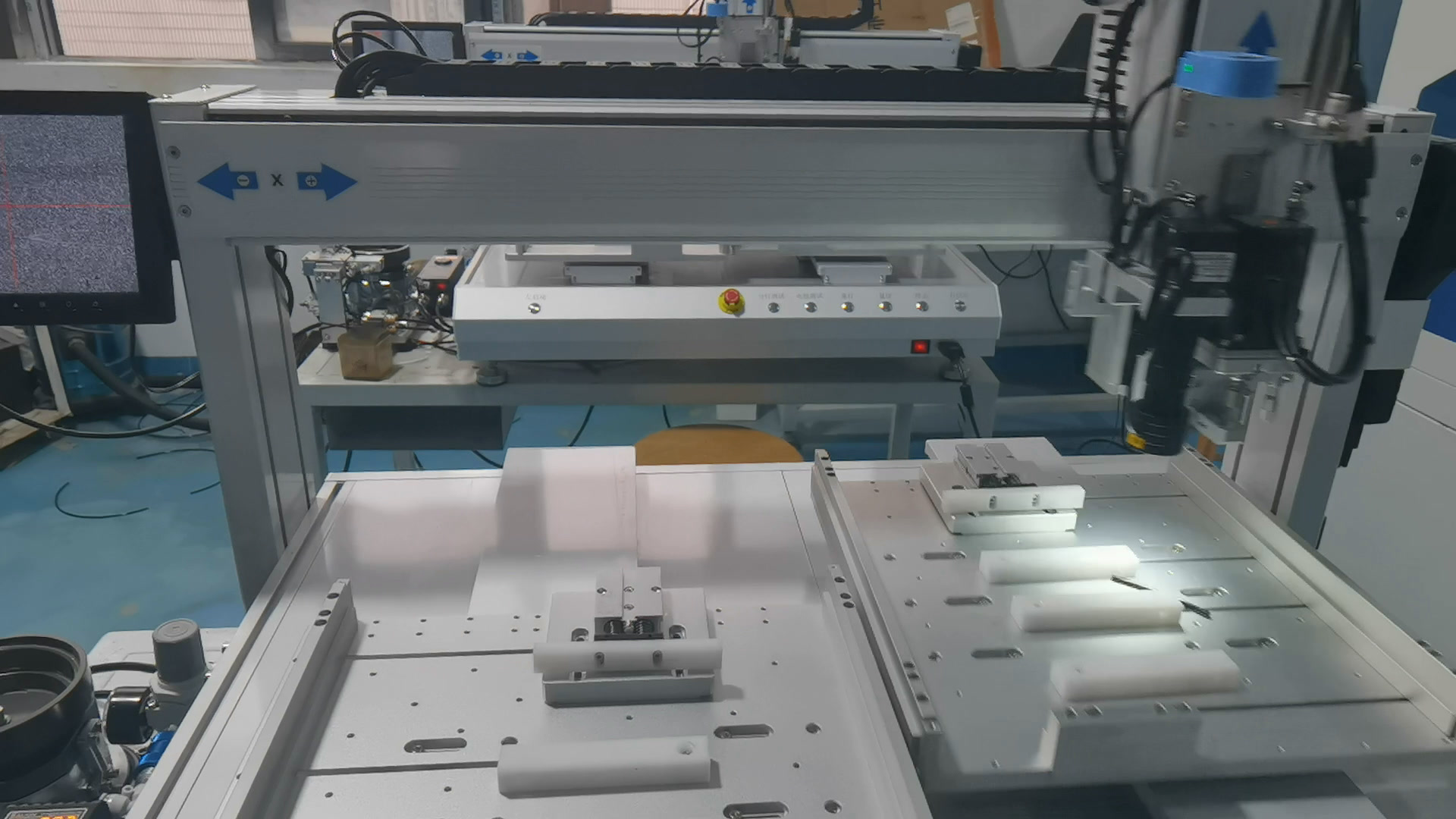
The ZM320 desktop screw fastening machine: gantry beam and dual worktable. Frame from the original ZM320 video supplied by JHIMS — not a YouTube screenshot, and not an SMT placement machine. Shown here as a downstream automated station: it changes the operator's job from driving screws to loading and unloading.
The test to apply to any automation claim is short: name the task it deletes, name the minutes it deletes, and name who still does the rest. If a vendor cannot answer all three, the headcount saving is a sales claim, not a staffing plan. For the wider picture of how these stations connect into one line, see how SMT line integration changes PCB assembly — and treat its headline efficiency figures as that article's claims, not as numbers this article has verified.
Can one operator run a whole SMT line?
On pure minutes, sometimes — the worked example needs 400 operator-minutes against 450 available. In practice, no, not alone: changeover needs two people at once, breaks need relief, and a feeder running out during first-article check needs a second pair of hands. One dedicated operator plus shared support is the realistic minimum for a single line.
Does buying a faster placement machine reduce headcount?
Rarely by itself. A faster mounter shortens the machine cycle, not the operator's task list. Headcount falls when automation deletes tasks — nonstop feeder exchange, automatic stencil cleaning, closed-loop inspection — not when a machine runs faster while the same person still loads, splices and reviews.
How many operators do two lines need — double?
Not quite. Shared roles (kitting, rework, line leadership, maintenance) spread across lines, so two lines need fewer than twice the staff of one. But each line still needs its own dedicated line operator during production. Count shared roles once and dedicated roles per line.
Should the line leader be counted as an operator?
Count them separately. A line leader who also runs a position cannot lead when the position needs them. If the leader covers breaks or changeovers, list that as relief cover in the roster, not as a free operator.
What if our boards change every day?
Then changeover minutes dominate the table and the position count rises with changeover frequency, not with board volume. High-mix lines should staff the changeover pattern first and the steady-state running second — and fast-changeover features (stored programs, exchange carriages, sub-30-second changeover) pay back in headcount, not just in uptime.
Bottom line: Do not ask "how many operators does an SMT line need" as if the line had a fixed answer. Ask how many operator-minutes your line needs per shift, which tasks must happen at the same time, and what your absence rate does to the roster. In the worked example that is 2 positions per shift and 3 people per crew — but the value of the example is the table, not the total. Fill it with your own timed observations and the number will be yours, defensible in a budget meeting, and adjustable the day your product mix changes.
To discuss your line configuration, machine selection or automation options, contact JHIMS at [email protected]. More about the company: JHIMS company profile.


 Teams
 whatsapp
 telegram
