
News
Direct answer: A used SMT line sold as one package has to be checked as a system, not as a pile of single machines. Each machine can pass its own test and the package can still fail you: machines from different generations may not pass boards to each other, the feeder pool may be too small for your product mix, the conveyor width and transfer height may not fit your boards, the software licences and programs may not legally move with the machines, and installation plus revalidation is real work that starts after the truck arrives. Check the package in five places — generation fit, feeder pool, board handling, software and program transfer, and installation with revalidation — and run your own boards through the whole line before you sign. And sometimes the honest answer is to buy machine by machine instead of taking the package, even when the package looks like the cheaper deal. This article shows how to check each of the five places, how to run the line test that proves the package, and how to record the decision so it can be checked later.
A complete used SMT line comes up for sale: printer, placement machines, reflow oven, inspection, loaders and unloaders, feeders, nozzles and programs, all from one seller, one price, one truck. It looks like a shortcut — a whole line in one decision instead of months of buying machine by machine. Sometimes it is. Sometimes it is a set of machines that never ran together as a line, or ran together for somebody else’s boards and will not run for yours. The difference is not decided by how clean the machines look. It is decided by five package-level checks that single-machine inspection does not cover. This article is the decision guide for that purchase, and it is the next piece in our line-economics series — after staffing, changeover cost, turnkey quotes, OEE, the maintenance calendar, board testing, downtime logging, mid-batch substitution approval, throughput, scrap cost, the end-of-life decision, and the second-mounter decision. It is about buying a whole used line as a package, not about buying one used machine, and not about buying a new turnkey line: those are different decisions, and the boundaries are stated where they matter.
Four boundaries first, so the rest of the article is read correctly. First, no price appears in this article, and no single “good price”, discount or payback figure is presented as a standard: whether a package is worth its price depends on the machines, the feeders, the software and the revalidation work, and that judgement belongs to the buyer with the full inventory in hand. Second, every worked example is marked as an example, with its assumptions stated next to it; none of them is a measurement from a real line, and none of them is a record of a real purchase. Third, this article names no real used line, seller or dealer as approved or rejected, and names no real machine model as the one to buy. JHIMS does not sell used complete lines, and nothing here is an offer of one. Fourth, no placement machine’s speed figure is presented as a guarantee for any customer’s board, and no vendor capacity or cost figure is used as a JHIMS fact. Compare candidate machines on your own boards, with your own programs, before deciding.
The first mistake is to inspect a used line the way you inspect a used machine. A single-machine check asks whether that machine runs. A package check asks whether the machines run together, for your boards, in your factory. A printer that prints well, a mounter that places well and an oven that profiles well can still make a bad line if the board cannot travel from one to the next, if the feeder pool cannot hold your product mix, or if the programs that ran the seller’s boards cannot be transferred to you.
So start by writing down what “complete” means in this sale. Ask the seller for an itemised inventory, with serial numbers, and treat anything not on the list as excluded until the seller confirms otherwise in writing. A complete SMT line usually means the stations in the table below, plus the items that make them run as a line. If the seller cannot produce the list, the package is not a package yet — it is a negotiation that has not started.
| Part of the package | What to confirm is included | What goes wrong if it is missing |
|---|---|---|
| Board loader and unloader | Magazines, racks, board handling width range | Boards loaded by hand; the line never runs unattended |
| Solder paste printer | Stencil frames and supports, squeegees, cleaning paper, vision system | Printing stops while you source frames and consumables |
| Inspection (SPI / AOI) | Programs, component libraries, calibration records | Inspection runs blind, or every program is rebuilt from zero |
| Placement machine(s) | Heads, cameras, nozzle set, feeder pool (see section 3) | The machine places, but not your component range |
| Reflow oven | Heater and fan condition, conveyor, profile records, nitrogen option if fitted | Profiles must be rebuilt and re-proven on your boards |
| Conveyors and buffers | Link conveyors, board stops, width adjustment, transfer height | Boards cannot travel between stations (see section 4) |
| Software and programs | Licences, program files, libraries, passwords, controller PCs (see section 5) | Machines that run but cannot be programmed for your products |
| Documents and spares | Manuals, service history, spare feeders, nozzles, filters, board supports | Every fault becomes a search for parts and paperwork |
For the single-machine checks themselves, use the method, not a shortcut: our companion articles on checking a used placement machine before you buy and on checking a used coating machine before you pay set out the walk-around, the live demonstration and the documentation checks for one machine at a time. This article does not repeat those checklists. It covers only what changes when the purchase is a whole line.
A “complete line” is often assembled from machines of different ages and different generations — a newer printer, an older mounter, an oven from another era. That is not automatically a problem. It becomes a problem when the machines cannot work as one line. Check four things before anything else.
Board size and transfer height. Every station has a board-size range and a conveyor transfer height. If the printer accepts boards up to one width and the mounter up to a narrower one, the line’s real limit is the narrower machine, and your widest board decides whether the line works at all. Transfer heights must match across the line, or boards will jam at the handover, or need manual carrying between stations — which is no longer a line. Ask for the size range and transfer height of each machine in writing, and compare them against your own largest and smallest boards, including thin boards that need support.
Conveyor direction and signals. Machines pass boards with a direction (left-to-right or right-to-left) and a handshake signal that says “board ready” and “board received”. Mixed-vintage lines are where these quietly disagree: one machine expects a signal the next one does not send, and the line stops between stations while each machine waits for the other. Confirm the direction and the interface on every machine, and confirm the link conveyors between them are included and match.
Capability spread. The line is only as capable as its weakest station for your products. A fast mounter behind a slow printer, or a fine-pitch-capable printer feeding a mounter that cannot place your smallest parts, is a line that was balanced for somebody else’s mix. List your smallest passives, your finest pitch, your largest and tallest parts, and check each station against that list — not against the brochure of any single machine.
Support life left. For each machine, ask whether the original manufacturer still supports the model, how long spare parts will be available, and what typical lead times are. A line with one unsupported machine is a line with one station that cannot be repaired on a normal schedule. That risk is larger in a package than in a single-machine purchase, because the unsupported station can stop the whole line. Note the answer per machine in the package record (section 9); a package where two or three stations are near the end of support is a different purchase from a package where one station is.
Feeders are where used-line packages most often disappoint, because feeders are easy to count wrong and expensive to buy later. The machines may be a bargain; the feeder pool decides whether the line can run your boards without constant changeovers. Count three things.
How many positions your boards need. Count unique component lines per product, not placements: a board with 300 placements from 150 unique lines is a supply problem, while a board with 900 placements from 40 unique lines is a speed problem. Then map your product mix: how many positions does each job need, how many are shared between jobs, and how many positions must change at each changeover? A second placement machine can double the positions available — the reasoning is in our article on the second-mounter decision, cited here and not repeated — but a package with one mounter and too few feeders has the same problem as a single used machine with too few feeders, only larger.
How many feeders actually work. Ask for an itemised feeder list with tape widths, pitch compatibility and quantities, then sample-test feeders during the demonstration instead of assuming every unit in the package works. Feeders are mechanical devices with moving parts, springs and sensors that wear; a feeder that fails to advance once in a while looks minor on a bench and costs a stop every few hundred boards on the line. Count the working feeders, not the feeders on the shelf.
A worked example, with stated assumptions and no claim to be a real line: suppose your widest product needs 96 unique component lines, so it needs 96 feeder positions loaded at once. The package list shows 80 feeders, and your sample test finds 6 of them faulty, leaving 74 working feeders. The shortfall is 96 − 74 = 22 positions. That means one job cannot stay fully set up: either 22 lines are loaded late, the job is split across changeovers, or 22 feeders must be bought before the line runs that product. The arithmetic is simple; the point is that the shortfall is found before signing, when it can still change the decision, not after installation, when it is your cost. Run the same count for tray and stick positions separately — a tray position is not a tape position, and a package short on trays can still fail a board full of tray parts.
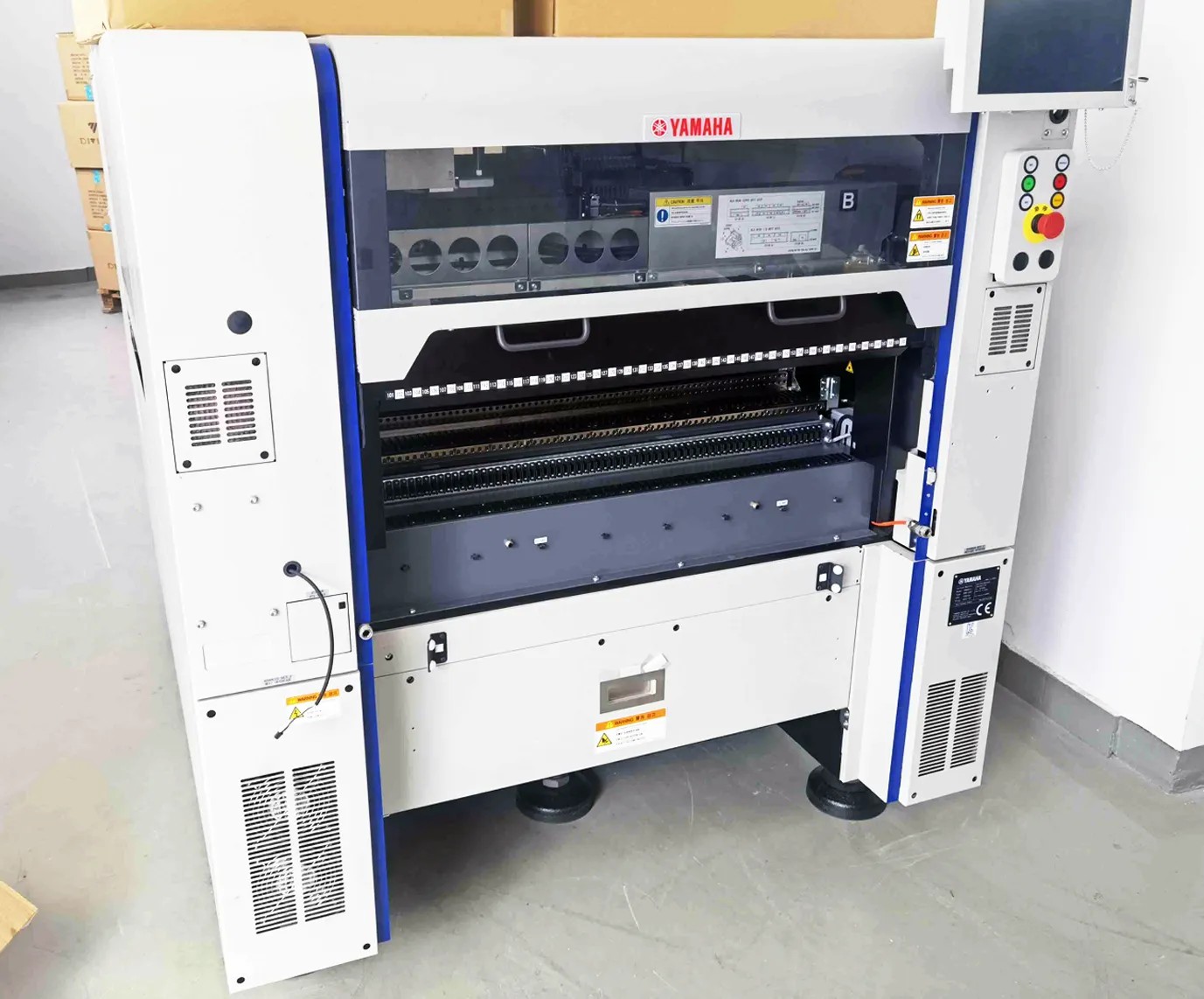
A used Yamaha YSM20 in a warehouse, its feeder slots empty. This is what a used machine looks like when it arrives — the feeder pool is what you bring or buy, not what the photograph shows. Photograph shows a used machine as an example only; it is not a JHIMS offering and not a line for sale.
Nozzles, carts and tooling. Confirm the nozzle set matches the placement heads and your component range, and ask about feeder changeover carts, board support pins, spare filters, manuals and programming accessories. Treat anything not listed in the purchase agreement as excluded until the seller confirms otherwise. The nozzles and carts are small lines on the inventory; they are also the items most often found missing on delivery day.
A line is a transport system with machines bolted to it. If the boards cannot travel, nothing else matters. Check the handling as a journey, board by board, from loader to unloader.
Width and height, station by station. Confirm the conveyor width adjustment range and the transfer height of every station and every link conveyor, and compare them with your boards — your widest, your narrowest, your thinnest and your heaviest. A line that handled the seller’s standard boards may not handle your thin boards without support pins, or your heavy boards without sagging between supports. Thin and irregular boards need support; ask what board supports come with the package and whether they fit your boards.
Stops, clamps and smooth travel. Conveyor belts, board stops, clamps and support mechanisms should move smoothly and hold the board securely. During the demonstration, watch a board travel the whole line, not just through one machine: hesitation, vibration or a board that shifts in the clamp at any station is a handling defect that will return as misprints, misplacements or damaged boards. If the line has been stored for a long time, ask how it was protected and whether it has been powered and tested since storage; belts, seals and lubricants age even when machines sit still.
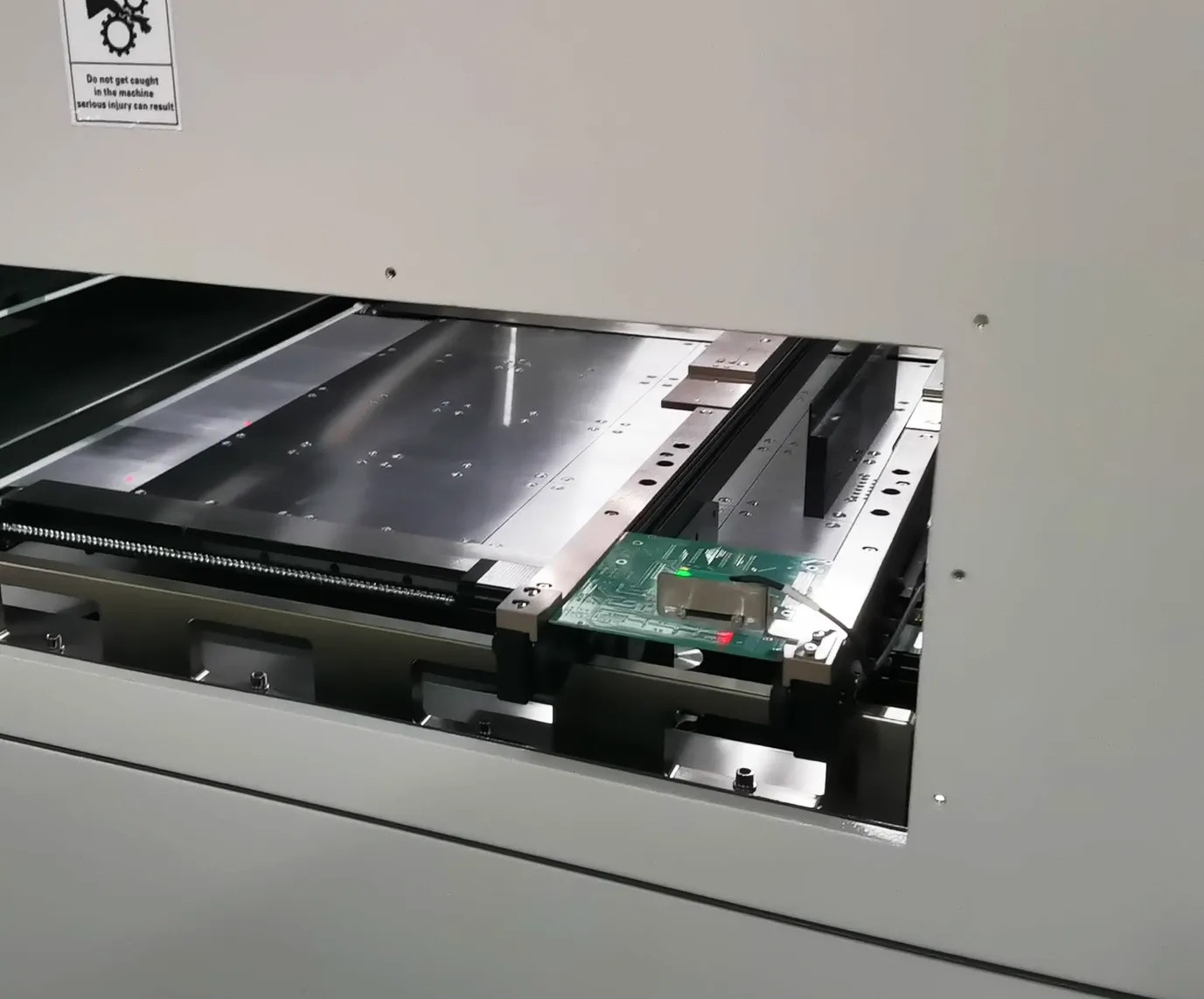
A solder paste printer’s conveyor unit, with a board held at the edge of the rails. Board handling is a line-level check: width, transfer height and clamping have to agree at every station, not just at one machine. Photograph shows one example station, not a whole line.
Buffers and the space between stations. If the package includes buffers or link conveyors, confirm they are included, they fit the floor space, and their length matches the line’s takt. A buffer that is too short cannot absorb the difference between a fast printer and a slow placement cycle, and the line will stop and start instead of flowing. This is the same balance question as reading throughput: our article on reading throughput explains how to read a line’s real output without fooling yourself, and this article uses its method rather than repeating it.
A mechanically sound line can still be difficult to run if its software is obsolete, locked, or licensed to somebody else. This is the check buyers skip most often, and the one that is hardest to fix after signing, so do it before the price is agreed, not after.
Licences must transfer. Confirm that the operating and programming software licences legally transfer to you, and that they run on the controller hardware included in the package. Ask for the controller and software versions of every machine, what options are enabled, and whether any option is a paid licence that stays with the previous owner. A machine whose best features are locked behind a non-transferable licence is a different machine from the one demonstrated.
Programs and libraries must be included, in a usable form. Ask what comes with the line: placement programs, printer programs, SPI and AOI programs, component libraries, board support files, passwords and the controller PCs themselves. A placement program written for the seller’s boards is not your program, but it proves the machine was programmed and shows the library it was built from; a line sold with no programs at all means every job is built from zero, including the component library. Confirm the file formats and whether the programs can be opened and edited on the controllers you will receive. If a program cannot be transferred — because it belongs to the seller’s customer, for example — say so in the record and plan the rebuild time.
Support status and obsolescence. Confirm whether the software is still updated, whether the controller hardware is still supported, and whether the manufacturer still supports each machine model. Older controller PCs running unsupported operating systems are a real risk: they cannot be replaced with a modern PC without also replacing the software that talks to the machine. Note the software version of each machine in the package record; a package where every controller is one generation behind is manageable, but a package where one controller cannot be serviced at all is a station that can stop the line permanently.
A power-on test proves a machine boots. It does not prove a line builds boards. The demonstration for a package has to run your boards through the whole line, end to end, and it has to be agreed in writing before the visit: which boards, which programs, what you will measure, and what counts as a pass. Without agreed criteria, a demonstration is a tour.
Bring your own boards — your highest-volume product and one difficult product, for example a board with fine-pitch parts or a board that changes over often. Watch the whole journey: print, inspect, place, reflow, inspect again. Ask for a profile run on your board in the oven, and for placement accuracy results from that same run, not from a test board. Record the conditions: which programs were used, which feeders were loaded, how many boards ran, and how many stops happened. If the seller cannot run your boards, ask why, and treat the answer as information about the package, not as a scheduling problem.
Also run the changeover during the visit, or at least time the feeder swaps for one product change. A line that changes over in an hour on the seller’s floor and in three hours on yours — because the feeders were not staged, or the programs were not ready — is the same line with a different cost. Our article on changeover cost gives the method for costing that time; this article uses its finding and does not repeat its table.
Finally, check the line’s records, not just its running. Ask for operating history where available, maintenance and repair history, and calibration records and dates. A machine with a service history you can read is a different purchase from a machine with a clean cover and no history at all.
Buying the package is not the same as owning a running line. Installation and revalidation are a second project, and they have to be planned — and their cost counted — before signing, because they start the day the machines arrive and they decide when the first sellable board leaves the line.
Moving and placing. Rigging, transport, unloading, floor loading, levelling and line connection: confirm who does each step, who supplies the rigging and the link conveyors, and whether the floor space, power, air supply and extraction match every machine. Measure the floor space against the line’s actual length, including operator access and feeder carts; a line that fitted the seller’s hall may not fit yours.
Re-profiling and re-qualifying. The reflow profile that worked in the seller’s factory was proven for their boards, their environment and their oven condition. It has to be re-run and re-proven on your boards, in your factory, after the oven is moved and levelled. The same applies to inspection programs: SPI and AOI programs built on the seller’s line have to be verified against your boards, your solder paste and your acceptance rules before they can be trusted. Plan for a first-article run on your own products, with your own inspection criteria, before the line is declared ready.
People and spares. Confirm who trains your operators and maintenance staff on the pre-owned machines, and what training covers: not just running the line, but feeder setup, nozzle changes, program handling and the daily and weekly checks that keep it running. Confirm the spares that come with the package and what must be bought: feeders, nozzles, filters, belts and board supports wear, and a line with no spares stops at the first worn part. Our maintenance calendar article sets out the daily, weekly and monthly checks for a running line; the revalidation plan should include those checks from the first week, not after the first breakdown.
A package is attractive because it is one decision. But one decision can hide four bad ones. The honest answer is to buy machine by machine when any of the following is true.
| Signal | Why the package is the wrong buy | What to do instead |
|---|---|---|
| One station does not fit your boards | The line’s real limit becomes that station, and the rest of the package cannot fix it | Buy the stations that fit; source the misfitting station separately |
| The feeder pool is far short of your mix | Feeder purchases erase the package saving, and changeovers stay long | Price the missing feeders first; compare the true package cost with buying separately |
| Software licences do not transfer | You own machines you cannot program for your products | Walk away from those stations, or price the licences before signing |
| Two or more stations are near end of support | One unsupported station can stop the whole line, and spares become a search | Buy the supported stations; replace the unsupported ones with newer machines |
| Your mix needs a different capability | The package was balanced for the seller’s products, not yours | Specify the line from your boards outward; buy each station to that specification |
| Revalidation cost exceeds the saving | Rigging, re-profiling, re-qualifying and training can cost more than the package saved | Compare the full cost — package plus revalidation — with buying new where it matters |
The comparison to make is total cost, not the package price: feeders and nozzles, missing accessories, repairs and calibration, software licences, freight and rigging, installation and commissioning, operator training, and the revalidation runs. A new turnkey line is the other end of the same comparison: our article on what a turnkey SMT line quote should include lists what a new-line quote has to contain — this article uses that list as the mirror image for the used package, and does not repeat it. If the used package plus revalidation approaches the cost of the stations that actually fit, the package has stopped being a saving.
There is one more honest answer worth stating: sometimes the right move is to buy nothing yet. If the package’s machines are the wrong generation for your boards, the feeder pool is far short, and the software does not transfer, no discount repairs that. A line bought wrong is not a cheap line; it is an expensive project that arrives in one truck.
Write the decision down before signing, in a form the next person can check. Ten fields cover the package; if a field cannot be filled, that is a finding, not a blank to skip.
Package record — fill in before signing:
1. Itemised inventory with serial numbers, per machine — and what is explicitly excluded.
2. Board-size range and transfer height, per station and per link conveyor, against your largest and smallest boards.
3. Feeder list: type, tape width, pitch, quantity — and how many sample-tested as working.
4. Nozzle set, changeover carts, board supports, filters and spares included.
5. Software versions, licence transfer confirmation, and included programs and libraries, per machine.
6. Manufacturer support status and parts availability, per machine.
7. Demonstration record: your boards run end to end, conditions, stops, profile and placement results.
8. Installation scope: who rigs, levels, connects and commissions, and what floor, power and air are needed.
9. Revalidation plan: re-profile, first-article run, inspection re-qualification, training.
10. Acceptance criteria agreed in writing before payment — what the line must do on your boards, and what happens if it does not.
Keep the record with the purchase agreement. If a dispute arises later, the question will not be what anyone remembers about the deal; it will be what was written down before signing.
JHIMS does not sell used complete SMT lines, and this article is not an offer of one. What JHIMS does sell is new SMT equipment that buyers compare against a used package when they decide: placement machines, solder paste printers, inspection equipment and the automation around them. The comparison is only honest if the used package is priced with its feeders, licences and revalidation included, and the new machines are judged on the buyer’s own boards with the buyer’s own programs.
As an example station only, the Yamaha YSM40R on our commercial site is a placement machine of the kind a buyer would check as the placement station of a line: feeder bank, placement heads and vision for placement checks. It is named here as an example of what a placement station is, not as a recommendation for any line, and no speed or accuracy figure from its product page is used as a guarantee for any customer’s board. Compare any candidate placement machine — new or used — on your own boards before deciding. Yamaha YSM40R placement machine (example station).
One boundary, stated plainly so it is not missed: repairing or replacing a single machine is a different decision from buying a whole line, and it is covered by other work, not this article. If the question is whether to repair the machine you have or replace it with another single machine, that is a single-machine decision, and the package checks in this article do not answer it.
Is a used complete line always cheaper than buying machine by machine?
Not always. The package price is only part of the cost. Feeders and nozzles, missing accessories, repairs and calibration, software licences, freight and rigging, installation and commissioning, training and revalidation all add to it. Price the missing items before comparing, and compare the full cost with buying separately.
Can I mix new and used machines in one line?
Yes, if board transfer, conveyor height, signals and data connections are compatible. Check those on every machine before buying; a mixed line adds integration work, and the integration has to be planned, not discovered on installation day.
What if the seller will not run my boards in the demonstration?
Ask why, and treat the answer as information about the package. A seller who cannot or will not run your boards cannot show the line building your products. Agree the demonstration criteria in writing before the visit; without them, the demonstration proves only that the machines power on.
Do the programs come with the line?
Only if the agreement says so. Confirm in writing which programs, libraries, passwords and controller PCs are included, and confirm the licences transfer to you. A line sold with no programs means every job is built from zero, including the component library.
We bought the package and output barely moved. What do we check first?
Check the five places in order: whether the line is balanced for your boards or for the seller’s, whether the feeder pool holds your product mix without constant changeovers, whether boards travel smoothly between stations, whether the inspection programs were re-qualified on your boards, and whether the reflow profile was re-run after the move. The cause is usually in one of those five, not in the rated speed of any single machine.
Bottom line: Judge a used line as a system. Inventory the whole package, check generation fit, count the working feeder pool against your product mix, walk a board through every conveyor handover, confirm the licences and programs transfer, and run your own boards end to end before you sign. Price the revalidation as part of the deal, not as an afterthought. And if one station does not fit, the feeders are far short, or the software does not move with the machines, the honest answer is to buy machine by machine — or buy nothing yet — rather than sign for a package that was somebody else’s line.
To discuss a new placement machine, solder paste printer or inspection station for your line, contact JHIMS at [email protected].


 Teams
 whatsapp
 telegram
