
News
Direct answer: Changeover time runs from the last good board of one job to the first good board of the next. On a high-mix SMT line it is usually the largest single block of lost production time — larger than breakdowns — because the cost is fixed per batch and a short batch amortises it over very few boards. A changeover has five clocks, not one: feeders, stencil and printer, placement program, reflow profile, and conveyor and board handling. The fix is SMED (Single-Minute Exchange of Die): move as much work as possible off the stopped line, so the line stops only for work that cannot be done while it runs. Measure your own changeovers first — ten timed changeovers, split by element — before spending money on faster machines.
High-mix production punishes the line twice. The batch is short, so the line changes over often; and every changeover costs the same whether the batch is 200 boards or 2,000. A line that changes over six times a day at 45 minutes a changeover loses four and a half hours a day — more than a quarter of a two-shift day — to work that produces no boards at all. This article breaks down where that time goes, how to measure it, and which changes actually remove it.
A changeover starts when the last good board of job A leaves the line, and it ends when the first good board of job B leaves the line. The words good matter on both ends. The last board of job A is not finished when the mounter stops; it is finished when it has passed inspection. The first board of job B is not finished when it comes out of reflow; it is finished when first-article inspection passes it.
That definition is what makes changeover honest. If you stop the clock at the first board out of the oven, you hide the first-article check, the program correction, and the rework of the first panel — and those are usually where a bad changeover shows up. A changeover that "took 20 minutes" but produced three bad panels before the first good one took 20 minutes plus the scrap, the rework, and the second setup. Count it all.
Five things change between jobs, and each has its own clock:
| Element | What changes | The usual trap |
|---|---|---|
| Feeders and reels | Reels unloaded and loaded, feeder positions re-mapped, tray supply changed | Loading feeders one by one on the stopped line |
| Stencil and printer | Stencil swapped, squeegee and paste changed, printer cleaned and re-set | The wrong stencil revision, found after the first print |
| Placement program | Program recalled, feeder map and nozzle assignment checked, vision data verified | Editing the program on the stopped line instead of before the changeover |
| Reflow profile | Profile recalled and verified against the new board's thermal mass | Running job A's profile on job B's board |
| Conveyor and handling | Rail width, support pins, board stops and lane settings | Support pins set from memory; the board bows and placement drifts |
Most changeovers are dominated by one or two of these rows. Which ones dominate depends on the product mix: a line that runs many similar boards loses most time to feeders; a line that runs very different boards loses it to stencil, program and profile as well. That is why the first step is always measurement, not purchase.
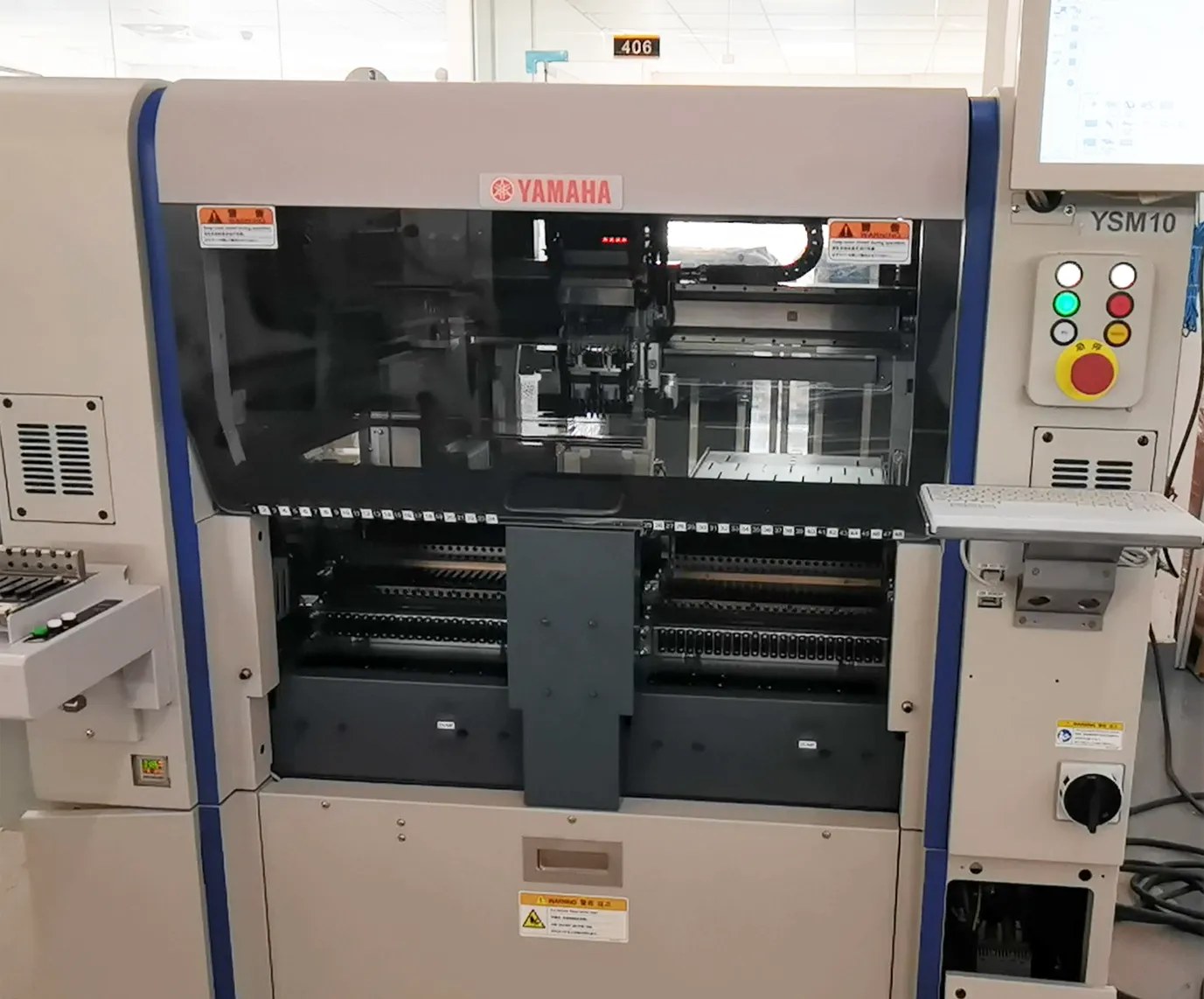
A Yamaha YSM10 mounter on a production floor, with two tape-feeder banks loaded at the front. The feeder bank is where most changeover time is won or lost. Source: JHIMS YSM10 product page.
Changeover cost is fixed per batch. Run time is not. That single fact explains why high-mix lines feel the pain first.
Take a line that places 60 boards an hour while it is running. A 45-minute changeover costs 45 minutes of running time — 45 boards of output — whether the next batch is 200 boards or 2,000. For the 200-board batch, the run itself takes about 3.3 hours, so the changeover adds roughly 22% on top of the run. For the 2,000-board batch, the run takes about 33 hours, and the same changeover adds about 2%. The machine did not get slower. The batch got shorter.
Worked example — illustrative, substitute your own measured numbers. Assumptions: two 8-hour shifts, 960 minutes of available line time per day; 6 changeovers per day; 45 minutes per changeover; line rate 60 boards per hour while running.
Changeover time per day: 6 × 45 = 270 minutes (4.5 hours), or 28% of available time.
Boards not built: 4.5 hours × 60 boards/hour = 270 boards per day.
Cut the changeover from 45 to 20 minutes and the same 6 changeovers cost 120 minutes — recovering 150 minutes, or 2.5 hours of running time, every day. No new machine was bought; the line simply stopped less.
Industry guides describe the same shape in the same terms: an unoptimised changeover commonly takes 30–60 minutes, and a shop that switches products 4–8 times a day can lose 20–40% of its shift time to changeovers. Those are planning figures from industry articles, not measurements from any one factory — your numbers will differ, which is exactly why the next section starts with a stopwatch rather than a catalogue.
There is a second cost that the arithmetic hides: the defect cost of a rushed changeover. A wrong reel, a wrong stencil revision, or an unverified program does not cost 45 minutes. It costs the boards built before the error is found, the rework, and the second changeover to fix it. Section 8 covers how to keep that cost out of the number.
SMED — Single-Minute Exchange of Die — is Shigeo Shingo's method from the Toyota Production System for cutting setup time. "Single minute" means under ten minutes, not one minute. The method has three stages, and they apply to an SMT line exactly as they apply to a press:
Stage 1 — Separate. Split every changeover task into internal work, which can only be done while the line is stopped, and external work, which can be done while the line is still running. Most lines have never made this split, and the first pass alone usually moves a third of the work off the stopped line.
Stage 2 — Convert. Turn as much internal work into external work as possible. Pre-load the next job's feeders while the current job runs. Prepare the stencil, the paste, the program and the profile before the line stops. This is where the time goes.
Stage 3 — Streamline. Shorten whatever internal work is left: standardise the sequence, put tools and parts at the machine, give each person one job, and remove the walk-and-search.
| Task | Before SMED | After SMED |
|---|---|---|
| Pick reels for the next board | On the stopped line | From stores, while the line runs |
| Load and verify reels in feeders | Feeder by feeder, at the machine | On a spare feeder trolley, offline, scan-verified |
| Swap the feeder bank | Not done — each feeder swapped in place | Dock the whole trolley in minutes |
| Placement program | Loaded and edited after the stop | Recalled from storage; edited offline before the stop |
| Stencil and support pins | Fetched and set after the stop | Staged at the line; pins set to a written record, not memory |
One published SMED worked example for an SMT line — explicitly illustrative numbers from a lean guide, not a plant result — shows the shape of the gain: feeder work that used to take 65 stopped minutes becomes 21 stopped minutes plus 47 minutes done while the line runs, with the trolley swap itself taking about 3 minutes. The loading work did not get faster. It moved off the stopped line. That distinction is the whole method: SMED rarely makes any single task faster; it moves tasks to where the line is not waiting for them.
Feeder work is the largest slice of most SMT changeovers, and it is almost entirely convertible to external work. A feeder takes roughly 1–3 minutes to load, thread and barcode-verify — a planning figure used by feeder-setup calculators — so a job that changes 40 feeders carries 40–120 minutes of feeder work before anything else happens. Done on the stopped line, that is the changeover. Done offline, it is not.
The practical form of offline feeder work is the exchange carriage: the next job's feeders are loaded and verified on a spare trolley or bank while the current job runs, and the changeover swaps the whole bank. Industry guides put a cart-based bank swap at under about 10 minutes, against loading dozens of feeders one by one on a stopped machine. The machine architecture decides how far this goes:
Three rules make offline feeder work pay:
Verify before docking. Scan each reel against the bill of materials at the offline setup station — barcode or RFID — and do not dock the trolley until its verification report is complete. A wrong reel loaded offline is a five-minute fix; the same reel found by the placement head after the changeover is a stopped line, a first-article failure, and a second changeover. Count the feeders on the trolley before it moves: a missing feeder found during the run is a note; found at the stop, it is a delay.
Keep common feeders loaded. If two jobs share 60% of their components, the feeders for the shared parts never leave the machine. Only the delta changes. This is the cheapest changeover reduction there is, and it costs nothing but a feeder-map discipline: same part, same lane, every job.
Do not forget the small changeovers. Peripherals change over too. The label feeder on a line we documented earlier changes program in under 3 seconds with 50 stored programs — a changeover designed down to near zero, as described in our label feeder guide for FUJI NXT lines. The point is not the label feeder; it is that every changeover on the line deserves the same question: can this be recalled instead of re-taught, and can it be prepared instead of done at the stop?
The cheapest changeover is the one the machine does not need. On modern Yamaha mounters the head is not a changeover item at all, and that is a deliberate part of the purchase decision for a high-mix line.
The YSM10 carries a single 10-nozzle HM head that covers 0201 chips through 55 × 100 mm components, so no head swap is needed between jobs. The YSM40R carries three head options — RS, MU and FL — on one platform, covering 0201 through 45 × 100 mm without head replacement. The YSM20R pairs HM and FM heads, the FM reaching 28 mm tall components. In each case the head decision is made once, at purchase, and the changeover never pays for it again. The YSM10 product page states the cost of the alternative directly: a head replacement between fine chips and large connectors wastes 15–30 minutes per change.
Nozzles are the smaller version of the same story. The YSM40R's RS head uses 72XX-series nozzles with stamped IDs, and the YSM10 page lists an automatic nozzle exchange station with health monitoring and a blow station that cleans nozzle shafts during long runs. A nozzle set that is exchanged automatically, tracked by ID, and cleaned on a schedule is not a changeover task; a nozzle set that an operator swaps by hand, from memory, is.
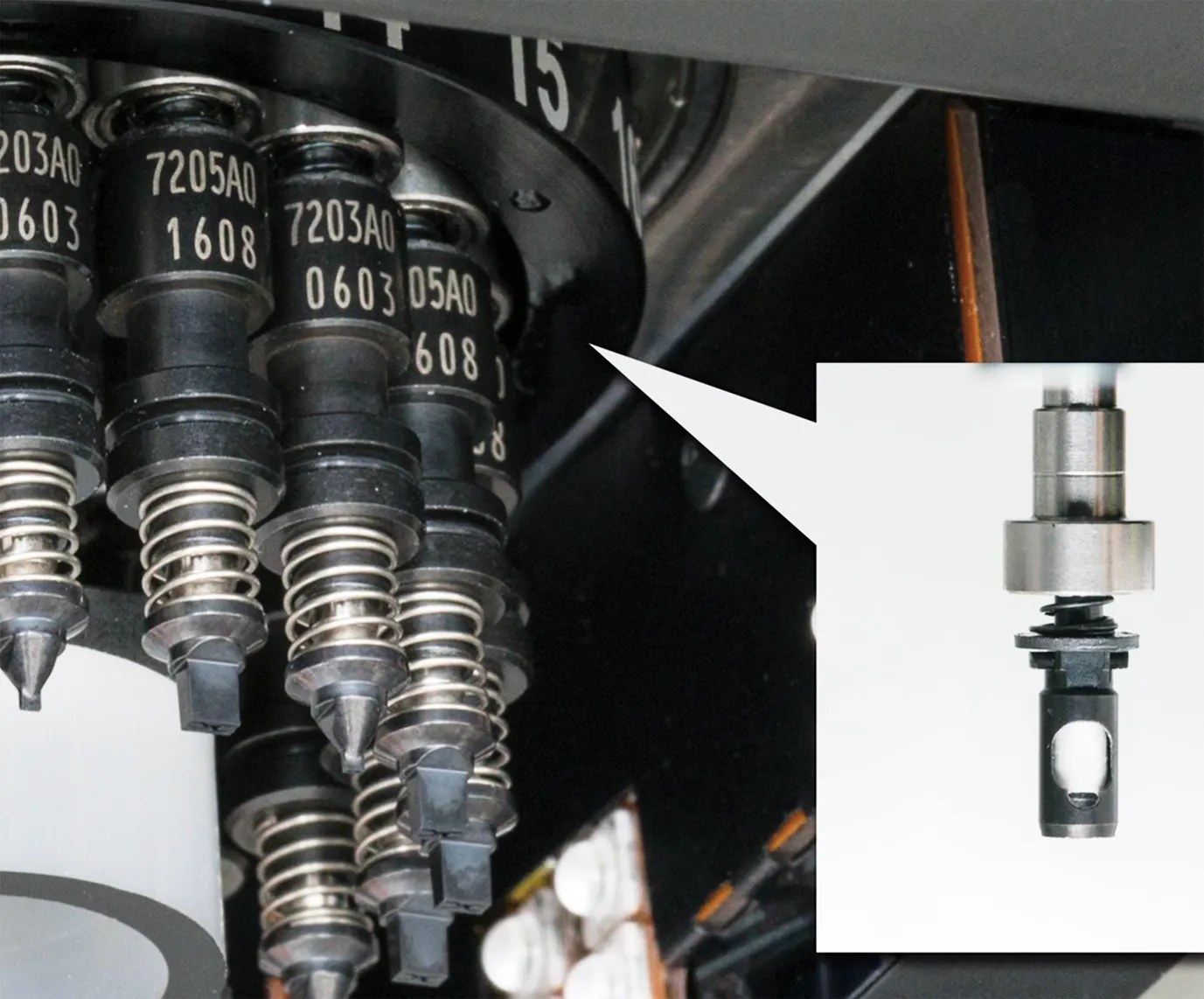
The YSM40R rotary head with 72XX-series nozzles (inset: a single nozzle). Nozzle identity, automatic exchange and health monitoring decide whether nozzles cost changeover time or not. Source: JHIMS YSM40R product page.
Program data is the third non-changeover. The YSM10's e-Vision auto-recognition generates new part data in about a minute per the product page, instead of hours of manual data entry, and the recognition data is transferable between YS-series machines. A part recognised once should never be taught twice. If your line re-teaches the same part on every changeover, the fix is a data library, not a faster operator.
Feeders get the attention because they are visible. The other three clocks are quieter and just as capable of ruining a changeover.
Stencil and printer. The stencil is a physical swap with a version risk. Stage the next stencil at the line before the stop, check its revision against the job card, and clean the outgoing stencil before it goes back to storage — a dirty stencil returned to the rack is the next changeover's first problem. Paste and squeegee change with the stencil; keep the paste for the next job at the line, not in a store two rooms away. Note that we do not quote a changeover time for any solder paste printer here: the figures published for the printers we supply conflict between sources, and an unverified number is worse than no number. Ask the supplier for the changeover figure in writing for your stencil sizes, and time it yourself.
Placement program. Recall, do not rebuild. The program, the feeder map and the nozzle assignment should be stored, recalled and checked offline — during the previous job, not after the line stops. The check that matters is the feeder map against the trolley that is about to be docked: same part, same lane, same program. A program recalled correctly takes seconds; a program edited at the stop takes as long as the edit, plus the first board that proves the edit wrong.
Reflow profile. A new board is a new thermal mass, and the profile that suited job A is not automatically right for job B. Recall the verified profile for the new board and confirm it before volume — a profile check with thermocouples on the first board is cheap; a batch soldered on the wrong profile is not. The same discipline applies downstream: re-validate SPI and the reflow profile before releasing volume. Industry guides commonly attribute the majority of SMT defects to the printing step — one puts the share at roughly 60–75% — which is why the first boards after a changeover deserve inspection, not trust.
For the detail of that inspection step — what SPI checks first, and when AOI pays back instead — see our buy-order decision guide for SPI and AOI. The changeover article stops where that guide starts: the changeover is over when the first good board passes, and passing is an inspection result, not a feeling.
Every number in this article so far is either a manufacturer's specification, an industry planning figure, or labelled arithmetic. None of it is your line's number. Before spending money — on a spare trolley, on software, on a new machine — time ten changeovers and split each one by element. Ten is enough to see the shape; one is enough to be misled by.
Log eight fields per changeover: the job pair (from and to), the clock start and end, minutes per element (feeders, stencil, program, profile, conveyor), the number of operators, the first-article result, any defect found at first article, its cause, and a free note. The field that matters most is minutes per element. It tells you which clock to attack first, and it stops the argument about whether the problem is the machine or the method.
| What the log shows | What to do first |
|---|---|
| Feeders dominate the stopped time | Offline feeder preparation and a spare trolley; keep common feeders loaded |
| Program or profile edits dominate | Move editing offline; store and recall verified programs and profiles |
| First-article failures dominate | Fix verification before the stop: reel scanning, stencil revision check, feeder-map check |
| Waiting dominates (parts, tools, people) | Stage everything at the line before the stop; assign one job per person |
| Times vary wildly between operators | Write the sequence down as standard work; train to it |
Two rules keep the measurement honest. First, time the changeover to the first good board, not the first board — the definition from Section 1. Second, never change two things at once. If you introduce offline feeder prep and a new program library in the same week, you will not know which one helped, and you will not know which one to keep when the next problem arrives.
Staffing belongs in the same log. Changeover work is labour as well as time, and the number of people on the line during a changeover is a decision, not a habit. Our staffing method for an automated SMT line covers how to work that number out from the task list and the line's takt; the changeover log gives it the minutes per element it needs.
1. Counting only the machine-stop time. The changeover is over at the first good board. Stopping the clock at the first board hides first-article inspection, corrections and rework — and rewards the team for rushing the part of the job that catches errors.
2. Skipping first-article verification to "save time". The time saved is minutes. The cost of a wrong reel or a wrong profile found three panels later is the batch. First-article inspection is part of the changeover, not an optional extra after it.
3. No offline preparation area. Offline feeder work needs somewhere to happen: a bench, a spare trolley, a scanner, and reels staged before the stop. Without the space and the spare bank, every feeder task defaults back onto the stopped line.
4. Loading unverified reels. A reel loaded without a scan against the bill of materials is a bet. The bet usually pays off, which is why lines keep making it — until the one time it does not, and the line stops twice: once for the changeover, once for the fix.
5. Changing two things at once. A new trolley and a new program library in the same week, or a new operator and a new sequence on the same day. When the changeover gets faster — or slower — nobody knows why, and the improvement does not survive the next change of staff.
6. Buying speed to fix changeover. A faster mounter raises the line rate while the line runs. It does nothing to the 45 minutes between jobs. If changeover is the bottleneck, the money belongs in feeder architecture, program and profile discipline, and offline preparation — not in CPH. The CPH figure, in any case, is measured under the manufacturer's optimum conditions; the changeover figure is measured on your floor, with your boards.
When changeover time is part of the purchase decision, ask these eight questions and get the answers in writing for your boards, not for the brochure's reference board:
The Yamaha mounters JHIMS supplies answer these questions in different places. The YSM20R (JHIMS product page) is the changeover machine of the three: 128 feeder types on exchange carriages with automatic program recall, the sATS30NS nonstop feeder exchange, and 140 types on a fixed plate — built for a line that changes over often. The YSM40R (JHIMS product page) answers with throughput and dual lanes: 200,000 CPH under Yamaha optimum conditions, automatic program changeover, automatic push-up pin exchange, and two boards at once. The YSM10 answers with simplicity for a smaller high-mix line: one head from 0201 to 55 × 100 mm, 96 feeder lanes, and part data generated in about a minute. All three figures are Yamaha specifications; the changeover figures on the product pages are page statements for the swap step, and the only number that matters for your line is the one you time yourself on your own job pairs.
One honest limit: if you are buying used, the changeover answer depends on the machine's actual condition — feeder wear, nozzle stock, software version — not on the brochure. Our used-machine inspection checklist covers the feeder and program checks that decide whether a used mounter will change over fast or fight you on every job.
What exactly counts as changeover time?
From the last good board of one job to the first good board of the next, including first-article inspection. Anything shorter than that definition hides work and flatters the number.
How long should a changeover take?
There is no universal number. Industry guides describe 30–60 minutes as common for an unoptimised line, and SMED practice targets single-digit minutes for the stopped portion — but both are planning figures. Time ten of your own changeovers, split by element, and that is your baseline. The YSM10 product page lists under 15 minutes as a target for a complete product switch with 60+ component types; treat it as a target to test against, not a result.
Will a faster pick-and-place machine fix my changeover problem?
No. Placement speed changes the run rate, not the time between jobs. Changeover is fixed by feeder architecture, offline preparation, program and profile discipline, and first-article verification. Buy speed when the line is running and slow; buy changeover when the line is stopping and late.
Do I need a second feeder trolley?
If feeder loading dominates your stopped time and your jobs share fewer than half their components, a spare trolley is usually the first purchase — it converts the largest slice of internal work to external work. If most feeders stay loaded between jobs, the money is better spent on verification and staging first.
Can the first board after a changeover go straight to volume?
No. The changeover is not over until first-article inspection passes the first good board. Re-validate the print and the profile before releasing volume; the boards built on an unverified changeover are the most expensive boards the line makes.
Changeover time is the tax high-mix production pays on every batch, and it is charged whether or not anyone measures it. Define it honestly — last good board to first good board — time ten changeovers by element, and attack the biggest slice first. In most lines that slice is feeders, and the fix is not a faster machine but work moved off the stopped line: feeders prepared and verified offline, a bank swapped instead of loaded, a program recalled instead of edited, a profile confirmed instead of assumed. The machines that make that easy — exchange carriages, automatic program recall, no head change, nonstop tray supply — are worth more to a high-mix line than the CPH figure on the brochure. Measure first, convert second, and let the stopwatch, not the catalogue, decide what to buy.
To discuss changeover reduction for your line, or for specifications and availability of the YSM10, YSM20R and YSM40R mounters, contact JHIMS at [email protected].


 Teams
 whatsapp
 telegram
