
News
The short answer: when you buy a used Yamaha pick and place machine, you are buying its history, not just its spec sheet. Three facts frame the whole decision:
Buyers often start with price and operating hours. Start with fit instead. The Yamaha machines you will most often meet on the used market fall into three generations, and each was built for a different production profile:
| Model | Mounting capability (Yamaha, optimum conditions) | Placement accuracy | Head | Feeder capacity | Weight |
|---|---|---|---|---|---|
| YSM10 | 46,000 CPH (HM head, 10 nozzles); 31,000 CPH (HM5, 5 nozzles) | ±0.035 mm (±0.025 mm), Cpk 1.0, 3σ | HM 10-nozzle / HM5 5-nozzle rotary | Fixed plate max. 96 (8 mm basis); tray 15 | Approx. 1,270 kg |
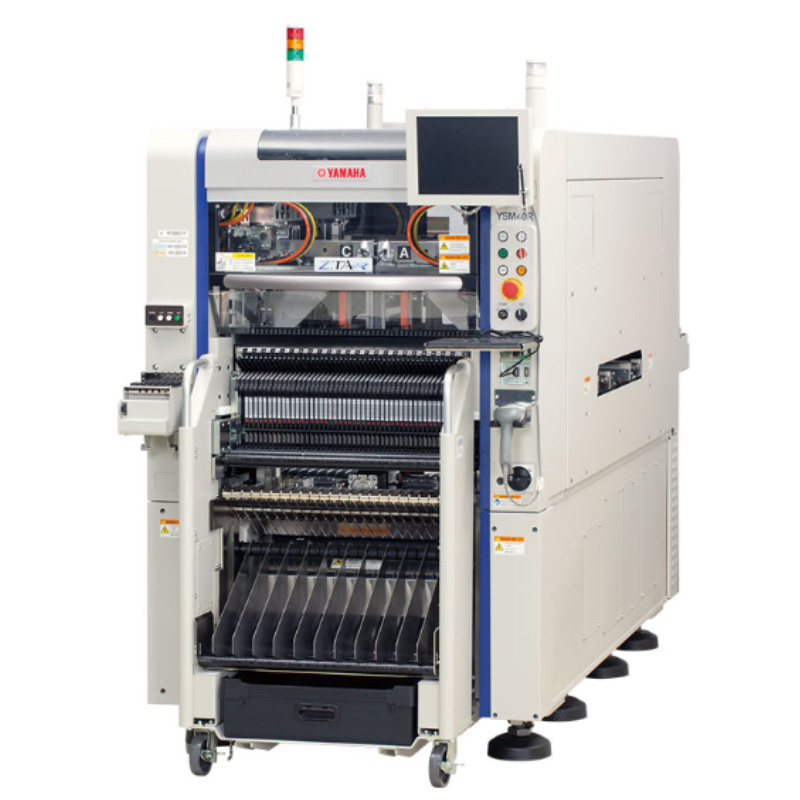
| YSM20R | 95,000 CPH (2-beam, 2 × HM head) | ±0.035 mm (±0.025 mm), Cpk ≥1.0, 3σ | HM / FM (5-nozzle, force control) | Fixed plate max. 140 (8 mm basis); cart exchange 128; tray 30/10 | Approx. 2,050 kg |
| YSM40R | 200,000 CPH (4-beam 4-head, RS head) | ±35 μm (25 μm), Cpk ≥1.0, 3σ | RS dual-arm rotary | Up to 88 (8 mm-tape basis, MU head) | Approx. 2,100 kg |
All figures above are Yamaha Motor's published specifications, measured under optimum conditions as defined by Yamaha Motor, and all three models are marked "Discontinued Product" on Yamaha's official pages. Two consequences follow. First, match the model to your product mix: all three were designed down to 0201/03015-class components, and that ±35 μm accuracy class is the baseline you hold the used machine to when you ask for calibration records. Second, discontinued status makes the parts-and-service question mandatory — see the section below.
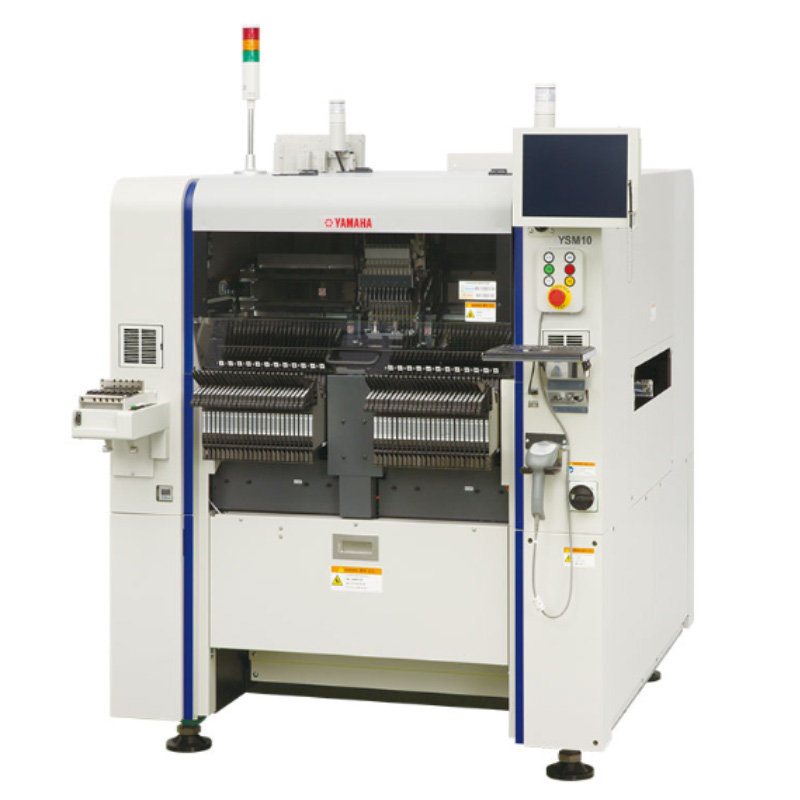
For a reference listing of YSM10 specifications, see the Yamaha YSM10 product page.
IPC-9850 (2002) is the industry's standard procedure for characterizing placement equipment. It defines Net Throughput as the number of components placed on a verification board per hour — the closest thing the industry has to an apples-to-apples measurement. Manufacturers nevertheless prefer to quote the most flattering figure: a "Maximum CPH" measured under ideal conditions, and the standard exists partly because inflated speed claims were once common practice.
Real output is always lower than maximum CPH. It depends on downtime, changeover time, component mix, board complexity and operator skill. For a used machine this matters twice over: the quoted figure was measured on a new machine in a controlled setup, and your machine is neither new nor in that setup.
Rule: never buy throughput from a spec sheet. Ask the seller to run the machine with your components on a test board, count the placements per hour the way IPC-9850 defines Net Throughput, and base your decision on that number — not on the brochure.
Work through these in order. The first item costs you nothing and eliminates bad deals before you travel.
Ask the seller for: full operating manuals, maintenance and service logs, recent calibration records, the machine's operating hours, a complete list of included feeders and nozzles with their types, the software version and license status, and the error history. One honest note: there is no authoritative industry threshold for "too many hours" on a pick and place machine. Hours only mean something in the context of maintenance history and measured current performance — a well-kept machine with high hours beats a neglected one with low hours.
Inspect the linear guides, ball screws and belts for wear, play (backlash) and damage. With the power off, move the axes by hand and feel for roughness or binding. Under power, run repeated Z/θ zero-return tests and watch for drift. Mechanical wear is the hardest thing to fix cheaply — everything else on this list is easier.
Check nozzle wear under magnification and test vacuum integrity at every nozzle: a weak vacuum shows up as dropped or skewed parts long before it shows up in a log. Watch the head move through a full cycle and listen for anything uneven.
Yamaha-specific items to ask about (these are official Yamaha features as quoted by dealers — verify they are actually present and working on the unit, in the machine's own menus, not from a brochure): the automatic nozzle-change station with spare nozzles, the blow station that cleans nozzle shafts, and the nozzle self-diagnosis and self-recovery functions (Nozzle Health Care on the YSM40R). Also confirm pickup-height auto-teach and pickup-position compensation are functional.
Verify the count, type and condition of every feeder: SS electric feeders and ZS intelligent feeders are the Yamaha families you will meet (the YSM20R accepts both ZS and legacy SS feeders, per dealer-quoted specifications), and the feeder must match the machine's interface. Then run each feeder and watch it present components. Experienced buyers test feeders first, because a large share of what looks like "machine accuracy trouble" turns out to be feeder trouble — a machine arriving without enough working feeders is a project, not a purchase.
Test the upward- and downward-looking cameras and their illumination, and ask for recent calibration records. Dirty or dim lighting ruins pickup recognition long before the mechanics fail — camera windows and light sources are cheap to clean and expensive to ignore.
Boot the machine and confirm every system initializes. Review the error history for repeating faults — the same alarm appearing for months tells you what the seller lived with. Confirm the software version, license status and whether upgrades are still obtainable. And make sure a backup of machine data, part libraries and programs comes with the machine: a mounter without its data backup is a much more expensive purchase than it looks.
Yamaha's published requirement is 0.45 MPa or more of clean, dry air, and three-phase power matched to the machine's rating — confirm your factory supply before the truck arrives, not after. Check the footprint and weight for transport and floor loading: a YSM20R is about 2,050 kg, a YSM40R about 2,100 kg.
Ask the seller to run the machine placing actual components — ideally your parts on a test board — and watch pickup, vision recognition, placement and board transfer. Measure the placement results against the machine's factory accuracy class (±0.035 mm / ±35 μm, Cpk 1.0, 3σ). If the seller refuses a test run, treat that refusal as information about the machine.
A true refurbishment means worn parts replaced, the machine thoroughly cleaned, recalibrated, and tested to factory specifications — get this scope in writing. "Tested working" (it powers on and runs a demo program) is not the same thing. Anything between those two poles should be priced and warranted accordingly, and the price difference should reflect the gap in evidence, not the gap in adjectives.
The YSM10, YSM20R and YSM40R are listed as discontinued products on Yamaha's official pages. That does not automatically mean parts are unavailable — but it means you must verify, in your own region, where wear parts (nozzles, filters, feeder parts) come from and who can service the machine, before you commit. Do not infer Yamaha's support policy from the discontinued label; ask directly, and put the answers next to the purchase price when you compare options.
A used mounter usually arrives as a bare machine; the peripherals around it are often where buyers spend next. JHIMS supplies SMT peripherals including label feeders compatible with Yamaha pick and place machines — the JH-FD50 label feeder (label width 2–50 mm, up to 100 labels per minute) is one option when adding automated traceability labeling to a line built around a used mounter. Note the limit: it is a label feeder, not a component feeder, and interface compatibility with your specific machine must be confirmed before ordering. If your line builds LED modules, our guide to choosing an automatic screw tightening machine covers the downstream fastening step.
The hardware does not expire. What you must verify is parts and qualified service access in your region, and price that risk into the deal. A discontinued model with a verified parts channel and service contact can be a better buy than a current model with neither.
There is no authoritative industry threshold. Interpret hours together with the maintenance record and the measured results of a test run — hours alone decide nothing.
Treat it as an optimum-condition figure measured on a new machine. Insist on a test run with your components and judge by the placements per hour you see — the IPC-9850 Net Throughput idea.
Worn parts replaced, machine thoroughly cleaned, recalibrated, and tested to factory specifications — in writing. Anything less is "tested working," and should be priced that way.
Operating manuals, maintenance and service logs, recent calibration records, the operating-hours record, a complete feeder and nozzle list, software version and licenses, the error history, and a backup of machine data and part libraries.
Questions about SMT peripherals or the specifications referenced in this guide?
Email [email protected] — we will point you to the right datasheet or product page.


 Teams
 whatsapp
 telegram
