
News
DIRECT ANSWER
A used GOB coating machine is worth buying only if you can verify three things on the seller's floor: the motion system still holds the accuracy the model was sold with, the glue path is clean and still meters its published mixing ratio, and the control system still runs the programs it claims to store. Everything else — paint, age, brand of the previous owner — is negotiable. Those three decide whether the machine can lay an even coating on a module. If the seller will not let you run a test dispense on a real module, walk away: no discount is large enough to cover a machine that cannot prove it coats.
Buying used makes sense in one situation: you already coat modules, you know your module size and your glue, and you need a second machine — or a first machine for a low-volume line — without waiting for a new build. It does not make sense as a shortcut into a business you have not run yet. A coating machine is not a standalone purchase. It needs the right glue, the right fixture, a stable air supply, and someone who can read a coated module and say whether the layer is good. If none of those are in place, a cheap machine is the most expensive way to learn that.
Two gates decide the question before you travel to see the machine. First, size: the machine's travel and fixture must cover your largest module. A machine that cannot fit your module is not a bargain at any price. Second, glue system: the machine must run the glue you intend to use — a two-component metering machine for a two-component glue, and a glue path whose materials suit that glue. If either gate fails, stop. There is nothing to inspect.
This guide assumes you are buying to coat LED modules with GOB (Glue On Board) encapsulation — the process described in our GOB encapsulation overview. The checks below apply to any second-hand coating or glue-filling machine, but the examples use JHIMS machines because their published specifications give you a concrete baseline to compare against.
Before you inspect anything, get the specification the model was sold with — from the manufacturer's product page or manual, not from the seller's listing. You are not comparing a used machine against a new one. You are comparing it against what its own model promised when it was new. That is the only fair test, and it is the only one the seller cannot argue with.
The table below shows what that baseline looks like for four JHIMS machines. Use it to see the shape of a specification — accuracy, travel, glue system, air supply, program storage — not as numbers to impose on a different brand's machine.
| Item | GOB-LXS330 (GOB coating) | JH-G810 (glue filling) | LM661 (inline GOB dispenser) | JH-D900 (precision dispensing, reference only) |
|---|---|---|---|---|
| Running / repeat accuracy | ±0.05 mm | ±0.03 mm repeat positioning; ±2% glue filling | Automatic X, Y, Z axis calibration | ±0.02 mm repeat accuracy |
| Travel / fixture | 400 × 400 × 200 mm travel; 400 × 400 mm fixture | 800 × 700 × 100 mm travel | Inline machine for GOB/COB module glue dispensing | 860 × 400 mm dispensing area |
| Glue system | 30 L glue capacity; anti-drip valve; liquid-level sensing alarm | A/B metering pumps; mixing ratio 100:100–100:10; tanks A 25 L / B 10 L; dynamic mixing | Inline silicone dispenser for GOB/COB modules | Jet / piezoelectric / screw valves; automatic valve cleaning |
| Air supply | 0.5–0.8 MPa input pressure | 0.4–0.8 MPa input pressure | 0.7 MPa stable air pressure | 0.4–0.6 MPa |
| Control / programs | Panasonic PLC + touch screen; multiple parameter sets stored; teaching program | PLC + touch screen; 99 programs; teach programming | Touch screen setup; nozzle calibration (see the official tutorial videos) | PC + motion card; vision system; program database |
Published specifications from the manufacturers' product pages, checked 8 November 2026. The D900 is a precision dispensing machine, shown here only as a dispensing-accuracy reference — it is not a GOB machine.
If the seller cannot tell you the model, or cannot point you to the specification it was sold with, write that down as an open item. It does not automatically disqualify the machine, but it means you will be judging it without a baseline — and you should price that uncertainty into your decision, not into a number in this guide.
One more note before the walk-around. JHIMS's own pages describe the coating material in two ways: the GOB-LXS330 page describes the coating as an epoxy resin, while the OPT315 glue page describes that glue as a silicone. This guide does not resolve that difference. When you inspect a used machine, resolve the glue question from the glue's own datasheet and from the batch records of the modules the machine coated — never from the machine listing alone.
Start with the machine switched off. A coating machine that has been looked after shows it; one that has not shows that too, and the signs are visible before anything moves.
Walk the frame first. Look for bent or dented sheet metal, cracked welds, and missing covers. Cosmetic damage on a cover is not a defect. Damage to the frame that carries the gantry is. Then look at the linear rails and ball screws: they should be clean, lightly oiled, and free of scoring or rust lines. The GOB-LXS330's own maintenance guidance is to clean the dispensing system regularly and check the slide rails and sensors periodically — if the rails on the machine in front of you are dry, scored, or caked with old glue, that guidance was not followed, and you should assume the same about everything you cannot see.
Check the cables and energy chains for cracked insulation, repaired splices, and crushed sections. Check the cabinet for water marks, dust packed into fans and filters, and any smell of burnt electronics. Look underneath: glue drips on the floor frame and hardened drips on the machine base tell you how the previous owner handled spills. None of these is a pass-or-fail item on its own. Together they tell you whether the machine was maintained or merely used.
Ask to see the machine's own hour count or production log if the control system keeps one. Do not treat the number as a fact — it can be reset — but a seller who can show you a log is a different proposition from one who cannot show you any record at all. What you are really checking is whether the machine's history is documented or anecdotal.
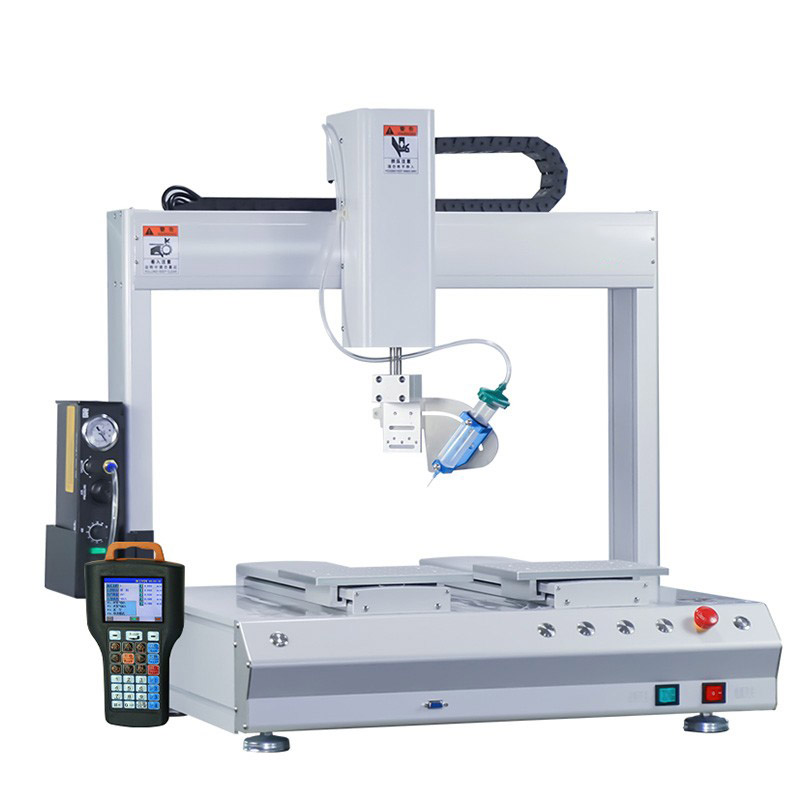
A benchtop dispensing machine: gantry frame, dispensing head with syringe barrel, teaching pendant and pressure regulator all in one view. The walk-around in Section 3 applies to any coating or dispensing machine — frame, rails, cables and cabinet first, power on second. Photo: JHIMS XJT-300 on the JHIMS product page — a benchtop dispensing machine, shown as a dispensing-machine reference, not a GOB coating machine.
The motion system is what you see. The glue path is what decides whether the machine coats. It is also the part that suffers most from neglect, because glue does not forgive being left in a line. A machine that has not been cleaned properly carries its history inside its pipes.
Ask three questions before you touch anything: what glue did this machine run, in what mixing ratio, and when was the glue path last cleaned and with what? Then check the answers against the hardware. On a two-component machine such as the JH-G810, that means the A and B metering pumps, the dynamic mixing device, the back-suction valve, and the A/B tanks with their stirrers. On the GOB-LXS330, it means the 30-litre glue supply, the anti-drip valve, and the liquid-level sensing alarm. On any machine, it means the tubes, the valve, and the nozzle — the places where glue sits and hardens.
What to look for: hardened glue residue at joints and inside the mixing tube; a valve that sticks or weeps; a metering pump that the seller cannot demonstrate; tanks with a skin of old material on the walls; a mixer that has not been changed since the last production run. Any one of these is fixable. All of them together mean the machine was parked with glue in it, and you should assume the whole path needs stripping and cleaning before the first production batch.
The glue question matters beyond cleanliness. The OPT315 glue, for example, is mixed at A:B = 10:1 by weight, supplied as a 22 kg set, and stored for 9 months under 25 °C. If the machine you are buying ran a different glue at a different ratio, its pumps, mixer and settings were set up for that glue — not for yours. That is not a reason to walk away, but it is a reason to ask what it will take to change over, and to get that answer before you pay rather than after the machine arrives. Our guide to stable air pressure for GOB dispensing is a useful reminder here too: the LXS330 expects 0.5–0.8 MPa, and a machine whose air supply was never stable will have coated unevenly for reasons that have nothing to do with its age.
One check that costs nothing: ask the seller to purge the machine in front of you. A clean purge — steady flow, no sputtering, no lumps, no discoloured material — is the cheapest evidence a glue path can offer. A seller who refuses a purge is giving you an answer.
Now switch the machine on and watch it move. Run it through its full travel on each axis, slowly, and then run one of its stored programs. You are watching for four things: smooth motion without judder or binding, no unusual noise from the rails or screws, no drift in the taught positions, and a head that returns to the same place every time.
Do not accept a demonstration that only moves the machine in the air. Ask for a test dispense — Section 8 covers it in full — but even before that, watch the machine run a program dry: the gantry should travel its full range, the head should move to the programmed points, and the program should finish without an alarm. If the machine cannot complete its own stored program, that is a finding, not a negotiation point.
Repeatability is the number that matters, and it is the number you cannot measure with your eyes. The GOB-LXS330 was sold with ±0.05 mm running accuracy; the JH-G810 with ±0.03 mm repeat positioning; the D900 with ±0.02 mm. Your test is not to re-measure those numbers on the seller's floor. It is to confirm that the machine still behaves like a machine that holds its specification: taught points land where the program says they land, the coating lands where the head says it lands, and the result repeats from one module to the next. If the seller cannot state the accuracy the model was sold with, or the machine visibly cannot repeat a position, write it down and treat it as a defect to be priced — or as a reason to stop.
Listen as well as watch. A healthy servo and ball screw run quietly. Grinding, clicking, or a high-pitched whine under load are the sounds of wear, and they do not get better with use.
A coating machine without its programs is a frame with motors. Check the control system as carefully as the mechanics.
Confirm the controller powers up cleanly, the touch screen responds, and there are no standing alarms. On a GOB-LXS330 that means the Panasonic PLC and touch screen, and the parameter sets the machine is supposed to store for different products. On a JH-G810 it means the PLC and touch screen and the 99 programs it is supposed to hold. Ask the seller to open the program list and show you what is stored. Then ask which of those programs were actually used in production, and which are left over from a previous owner's products. A machine whose program memory is empty is not necessarily broken — but it means you will be teaching every program from scratch, and you should know that before you pay.
Ask whether the programs are backed up, and whether the backup comes with the machine. Ask whether the controller needs any licence, dongle, or password the seller does not have. Ask what happens if the controller battery dies — on many machines the stored programs depend on a battery, and a dead one can take the programs with it. None of these questions has a single right answer. All of them have a wrong one: "I don't know, it worked when we switched it off."
Check the alarms too. The GOB-LXS330's liquid-level sensing alarm is there to tell the operator the glue is running low. Trigger it, or ask the seller to show it working. An alarm that never sounds is not a feature — it is a sensor that has not been tested, and the first time you need it will be on your first production batch. The same applies to any door interlock, emergency stop, and pressure alarm the machine carries.

The control system, up close: the I/O signal page on the LM661 touch screen during setup. On a used machine, confirm the controller powers up cleanly, the screen responds, and the stored programs are still there. Frame from JHIMS's official LM661 tutorial video, Part 2 (@jhims) — cropped to remove the video's letterbox bars and subtitle line; the screen text is the machine's own display.
Paperwork is the cheapest insurance in a used-machine purchase, and the most often skipped.
Ask for the manual — the operator manual at minimum, the maintenance manual if it exists. Ask for the service history: what was replaced, when, and by whom. Ask for the maintenance record, and compare it with what a dispensing machine's maintenance schedule is supposed to look like: the D900's published schedule, for example, lists weekly nozzle and valve cleaning, monthly weighing-system calibration and rail lubrication, quarterly full calibration with a program-database backup, and an annual service by a certified engineer. Your machine will have its own schedule, but the shape is the same — regular cleaning, regular calibration, regular backup. If the seller has no record of any of that, assume it was not done.
Ask what spares come with the machine: nozzles, valves, mixers, filters, seals, a spare metering pump if one exists. On a JH-G810 the wear items are the metering pumps, the dynamic mixer, and the valves; on any coating machine the consumables are the parts that touch glue. A machine sold without a single spare is a machine whose next failure will stop your line while you wait for parts.
Ask who services the machine now, and whether that support continues after the sale. And ask the simplest question of all: why is it for sale? A line upgrade and a factory closure are good reasons. "We couldn't get it to coat evenly" is also an answer — and a useful one, if it is honest. The inspection discipline here is the same one we use for any second-hand machine; our used Yamaha pick-and-place buying guide applies the same method to a different machine, and the paperwork section there is worth reading alongside this one.
Everything before this section is preparation. The test dispense is the decision.
Insist on coating a real module, with the glue you intend to use — or, if that is not possible, with the seller's glue on a module of your size. A machine that only runs in the air has not been tested. Bring your own module if you can, and bring the fixture if the machine's fixture does not fit it. Watch the whole cycle: loading, dispensing, and the finished coating.
Inspect the coated module with the same checks you would use on your own production. Our guides cover the method, not the verdict: inspecting the bare module before coating for what the module must look like going in, and why bubbles appear in GOB coating for the most common defect a bad dispense leaves behind. Look for even coverage, clean edges, and no bubbles, thin spots, or bare patches. If the coating is uneven, do not accept "it needs a bit of adjustment" without seeing the adjustment made and the next module coated. One good module after an adjustment is evidence. A promise is not.
Coat more than one module. Three is a minimum: one proves the machine can coat, three start to prove it can repeat. If the seller will only coat one, ask why — and treat the answer as part of the inspection.
Decision table — after the test dispense
| What you saw | What it means | What to do |
|---|---|---|
| Even coating on three modules, programs stored, records available | The machine coats as its model promises | Proceed — put the test result in writing (Section 9) |
| Coating uneven, but improves after the seller adjusts a setting in front of you | The machine can coat, but its setup was not maintained | Negotiate — the adjustment, the cleaning, and a second test are part of the deal |
| Glue path clogged, valve weeping, or metering visibly wrong | The glue path needs stripping before any production | Price the strip-down and new wear parts, or walk away |
| Seller refuses a test dispense, or no module is available to coat | The machine has not been proven to coat | Walk away — no discount covers an unproven machine |
Verbal assurances do not travel with the machine. Before money moves, put the following in writing — in the sale agreement, not in a message thread:
This is not legal advice, and it does not replace a proper sale agreement. It is a list of the points that buyers most often wish they had written down — collected from the same inspection discipline as our other buying guides.
Sometimes the right answer from an inspection is not to buy the used machine at all. Buy new when the used machine cannot cover your module size; when no spares, manual, or service support exists for that model; when the glue system does not match the glue you will run; or when the machine's control system cannot store the programs your production needs. In those cases the used machine is not cheaper — it is a different machine from the one you need.
The same logic applies at the other end of the scale. If you only need a small number of coated modules — prototypes, samples, or a short trial run — a dedicated coating machine, new or used, may be the wrong route entirely. A benchtop dispenser or a glue filling machine such as the JH-G810 may cover the volume at lower cost and with less setup. Compare the routes on the machines' own pages before you commit to any purchase. And once a machine — new or used — is on your floor, treat calibration as part of the purchase: verify the dispensing volume, the positions, and the repeatability before the first production batch, not after the first bad one.
See the GOB coating process running in our official video: GOB LED Module Manufacturing Process (@jhims). For the machines themselves, see the GOB-LXS330 glue dispensing machine for LED displays, the JH-G810 automatic glue filling machine, the LM661 inline silicone dispenser for GOB and COB LED modules, and the OPT315 potting glue. For precision dispensing context, see the JH-D900 precision dispensing machine — shown here only as a dispensing-accuracy reference, not as a GOB machine.
Can I judge a used coating machine from photos and a video call?
No. Photos show the cabinet. They do not show the inside of the glue path, the state of the rails, or whether the machine can repeat a position. A video call is useful for a first look, but the decision needs a visit and a test dispense.
The seller says the machine was "working when it was switched off". Is that enough?
No. It is the minimum a seller can say. Ask when it was switched off, why, and what has been done to the glue path since. Then run the test dispense in Section 8 and let the coated module answer the question.
What if the machine's programs are gone?
Then you are buying a frame with motors and a control system you must teach from scratch. That is workable if you have the time and the module to teach with — but it should be reflected in the deal, and you should confirm the controller, the touch screen, and the motion system all work before you agree.
Should I bring my own glue to the inspection?
Yes, if the seller allows it. The machine will coat with your glue in your factory, so the test should use your glue on your module. If that is not possible, coat with the seller's glue — and record exactly which glue it was, including the mixing ratio from that glue's own datasheet.
Does a used machine need recalibrating before production?
Yes. Moving a machine, cleaning its glue path, and changing its setup all affect the result. Treat calibration as part of the purchase, not as an optional extra — and run it before the first production batch, not after the first bad one.
A used GOB coating machine is a sound buy when it can prove three things on the seller's floor: it moves as its model promises, its glue path is clean and meters its published ratio, and its control system still holds its programs. Check those with a walk-around, a purge, and a test dispense on a real module — and put the result in writing before you pay. If any of the three cannot be proven, the machine is not a bargain. It is a project.
Talk to JHIMS about a coating machine
If you are weighing a used machine against a new one, or you need the specification of a machine you already own, contact us at [email protected] — tell us your module size and your glue, and we will tell you which machine fits.


 Teams
 whatsapp
 telegram
