
News
The short answer: tape-and-reel feeds components. It does not give each finished board its own identity. If every board leaving your FUJI NXT line must carry a readable serial barcode or QR code — for traceability, for a customer audit, or for warranty — that label has to be placed by something, and a label feeder is the device that presents it to the placement head in the same way a tape feeder presents a component.
You do not need a label feeder because you run out of tape feeders. You need one when manual labeling, or a separate offline labeling step, becomes the slow, error-prone part of an otherwise automated line.
This guide separates the two jobs, lists the five signs that point is approaching, and gives you the checks to run before you order — including one check most buyers skip: the two JHIMS listings for this kind of feeder do not describe the same specification sheet, so confirm which model sheet you are buying against.
Confusion between these two feeder types is the most common reason a label-feeder purchase goes wrong. Both sit on a feeder bank. Both present something to a placement head. What they present is completely different.
| Question | Component tape feeder | Label feeder |
|---|---|---|
| What it presents | Electronic components in pockets of paper or embossed carrier tape, sealed by cover tape | Labels, barcodes, QR codes, metal reinforcement plates, foam or protective film, on a roll |
| What it is for | Building the circuit: placing resistors, capacitors, ICs and other parts | Identifying the board: giving each PCB a readable, traceable mark |
| What happens without it | Components cannot be placed at all | Boards can still be built — but labeling falls back to manual work or a separate step |
| Typical failure if it is wrong | Missed or mis-picked components, line stops | Unscannable, missing or misplaced labels, and gaps in traceability records |
That distinction drives the whole decision. A line can be fully equipped with tape feeders and still have no automated way to label a board. Conversely, buying a label feeder does not add component capacity. If your problem is component supply — tubes, trays, or odd-form parts — a label feeder is the wrong purchase, however good it is.
None of these signs, on its own, proves you need a feeder. Two or more together usually mean manual labeling is costing more than it appears — in time, in rework, or in audit risk.
This is the clearest trigger. Automotive, medical and other traceability-driven work commonly requires a unique barcode or QR code on each board, linked to its production record. A tape feeder cannot supply that identity, because components are identical from pocket to pocket. Labels are, by design, different from board to board.
If an operator sticks labels on finished boards at a separate bench, labeling is decoupled from the placement record. The board's identity is then only as reliable as that manual step, and any board that skips the bench leaves untracked. Bringing labeling into the placement cycle ties the label to the board at the point of manufacture.
Misplaced, skewed or wrinkled labels fail at scanners, at automated optical inspection, or at a customer's incoming check. Before blaming the printer or the scanner, check placement: a label that lands a fraction of a millimetre off its intended position, or with an air bubble under it, reads inconsistently even when the print itself is good. Placement precision is therefore a feeder specification, not a detail — see the comparison table below.
High-mix production punishes slow changeover. A feeder that stores label profiles and recalls them from a touch screen shortens that step to seconds rather than a manual re-setup. The LMFD-LB page, for example, states up to 50 stored product profiles with changeover in under 3 seconds. Treat that as a page-stated figure for that model, and ask any supplier for the same figure in writing for the model you are actually buying.
Some boards need a metal reinforcement plate, a foam pad, or a protective film placed in the same way as a label. A general-purpose manual step handles these awkwardly; a feeder designed for multi-material rolls handles them as part of the normal cycle. Both JHIMS listings describe multi-material handling, but their material lists differ — check the exact list for your model before assuming your material is covered.
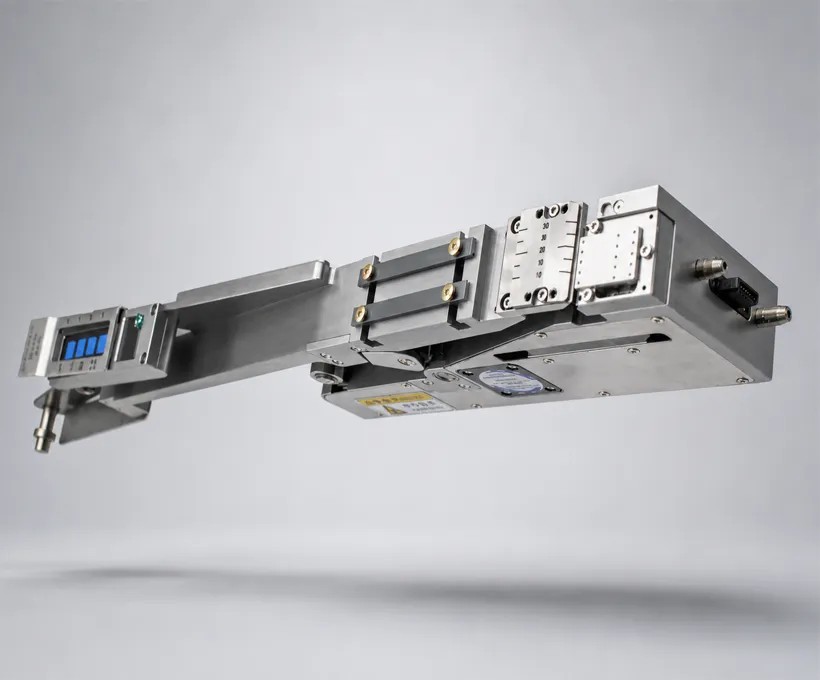
JHIMS states that the LMFD-LB occupies one standard feeder slot on the FUJI NXT feeder bank, alongside the tape feeders. The sequence, as described on that product page, runs as follows:
Two parts of that sequence deserve a buyer's attention. First, positioning is a closed loop of sensor plus mechanical alignment: the LMFD-LB page describes dual-pin positioning with rail guidance and wedge locking, intended to prevent drift at speed.
Second, the interface matters as much as the mechanics: the LMFD-LB page specifies a 14PIN standard interface to the NXT feeder bank, with Hand, Auto and ID operating modes. A feeder with the right mechanics but the wrong interface or mode for your machine configuration will not integrate, however well it feeds on a bench.
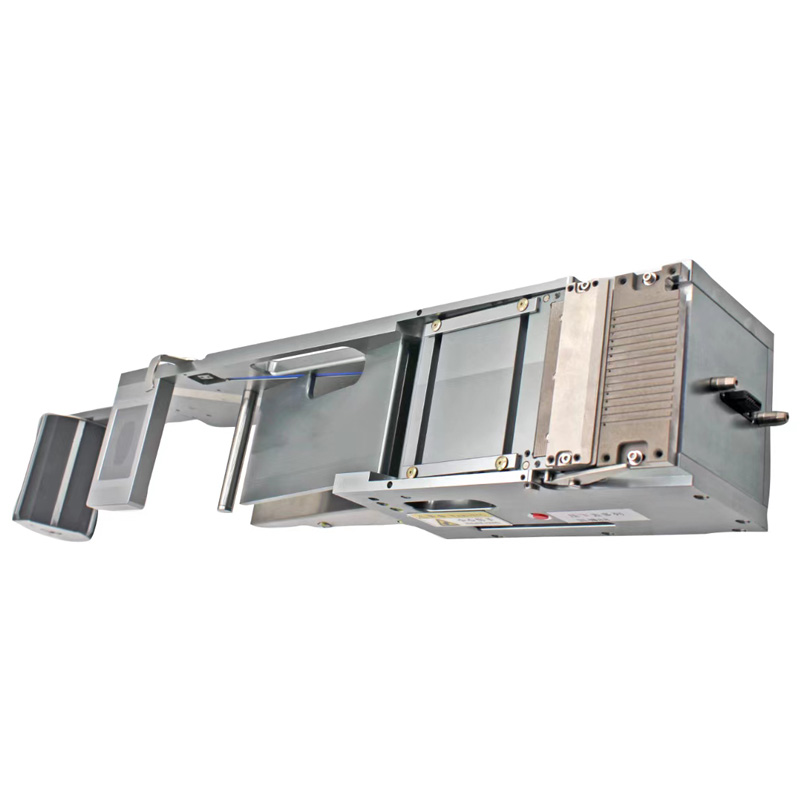
Check before you assume: neither product page describes its feeder as a label printer. The feeders described here feed labels that arrive pre-printed on a roll. If your process needs labels printed on demand at the line, confirm that requirement separately — it is a different device, not a feature of the feeders in this guide.
This table is the reason to read the specification sheet rather than the headline. The jhims.net listing (LMFD-LB series, for FUJI NXT) and the jhims.com listing (JH-FD50, a general SMT label feeder) give different figures for width and speed, and different levels of detail on interface and materials. They may be different generations or different models under different names — the pages do not say — so do not mix their numbers into a single specification.
| Check item | LMFD-LB series (jhims.net) | JH-FD50 (jhims.com) |
|---|---|---|
| Stated fit | FUJI NXT series; page lists NXT III, NXT II, AIMEX, NXTR and XPF | Fuji, Yamaha, Juki and other pick and place machines (general statement) |
| Tape / label width | Four models covering 25–100 mm tape widths; up to 8 labels per row | Label width 2–50 mm |
| Smallest label / thickness | Minimum 2 × 2 mm (single row); maximum label thickness 0.05 mm or less | Not stated on the page |
| Feeding precision | ±0.1 mm in X and Y, by fiber optic sensor positioning with pulse compensation | Described as high precision; no numeric precision figure stated |
| Speed (as stated) | Up to 120 mm/s; page states 5,000+ labels per hour | Up to 100 labels per minute |
| Interface / modes | 14PIN standard interface; Hand / Auto / ID modes; DC 24 V | Interface and modes not stated on the page |
| Materials | Labels, metal pieces, foam, plastic film, protective film | Paper, synthetic, thermal, transparent, self-adhesive, metal |
| Reel limits | Reel outer diameter up to 200 mm; reel load up to 3 kg; material change is stop-and-manual | Not stated on the page |
Read that table as a buying discipline, not as a verdict. Where a cell says "not stated," the correct response is to ask the supplier, not to borrow the other model's figure. Where the two columns disagree on speed, the correct response is to ask at what label size and pitch each speed was measured — a labels-per-hour figure without a label pitch cannot be checked against a millimetres-per-second figure, and neither page states the pitch behind its rate.
If a supplier cannot answer questions 2, 3 and 5 against a single, named model sheet, you do not yet have a comparable offer — you have two brochures that happen to share a product category.
For a FUJI NXT line, the NXT-specific listing is the LMFD-LB series label feeder: four models covering 25–100 mm tape widths, ±0.1 mm X/Y feeding precision, a 14PIN standard interface with Hand, Auto and ID modes, and multi-material handling including metal plates, foam and protective film, as stated on that product page. Its stated limits matter as much as its headline figures: minimum label 2 × 2 mm, maximum thickness 0.05 mm or less, reel load up to 3 kg, and stop-and-manual material change.
The general listing on this site is the JH-FD50 SMT label feeder, described for Fuji, Yamaha, Juki and other pick and place machines, with label width 2–50 mm and speed up to 100 labels per minute as stated on its page. Do not assume the two listings are the same feeder: their width and speed figures differ, and only the LMFD-LB page states an interface, operating modes, and reel limits. Confirm with JHIMS which model sheet applies to your machine before ordering.
No. A tape feeder supplies components; a label feeder supplies labels. They do different jobs on the same feeder bank, and a label feeder occupies a slot that a component feeder could otherwise use.
Only within that model's stated range. The LMFD-LB series, for example, spans four models across 25–100 mm tape widths, and the JH-FD50 page states 2–50 mm label width. Check your label against the specific model's range, including minimum size and thickness.
Only if placement was the cause. Precise placement helps, but print quality, label material, and downstream handling also decide whether a code scans. Trial your own labels and scan them downstream before deciding.
ID mode links the feeder to the machine for traceability. If your reason for labeling is traceability rather than simple marking, that link is part of the system, not an optional extra — confirm your machine configuration supports it.
The two product pages do not say so, and their figures differ. Treat them as separate listings until JHIMS confirms otherwise, and buy against one named specification sheet.
Questions about label feeders, or which model sheet fits your NXT line?
Email [email protected] — send your label size, material, and NXT model, and we will point you to the right specification sheet.


 Teams
 whatsapp
 telegram
