
News
Direct answer: An alternate part may go on the board mid-batch only after four checks clear: the datasheets agree on the values that control the circuit, the footprint, pinout and height fit the board as built, the moisture and solderability state of the new lot is known, and the change is written down and approved by whoever owns the board — which, for most contract builds, means the customer. A reel change is not a part change: splicing a new reel of the same part number is a different decision with a different check. If any of the four checks cannot be answered from the two datasheets and the lot paperwork in hand, the right answer is to stop the line, not to fit the part and hope the test station catches a mistake.
The reel runs out in the middle of a batch. The placement machine is waiting, the boards already built are good, and the exact part number is not on the shelf. Somewhere in the stores there is a part that looks the same: same size, same value printed on the label, maybe even the same manufacturer series with a different suffix. The pressure to fit it is real. Every minute the line stands still is a minute of output lost, and the part in hand is probably fine.
Probably is not a qualification. The difference between a part that works and a part that only looks the same is measured in the parameters that do not appear on the reel label: tolerance at temperature, voltage rating, dielectric behaviour, moisture level, terminal finish, height under a shield. This article explains how to approve an alternate part in the middle of a batch — what to compare, in what order, who signs, and when the correct decision is to stop the line instead. It is written for the engineer or shift lead who has to make that call with the line waiting, not for the design review that should have happened months earlier.
One boundary first, so the rest of the article is read correctly. This is an approval decision for a part change during production. It is not a guide to buying a second source, and it is not a redesign. A second source is approved before the shortage, on a bench, with samples and a pilot run. A mid-batch substitution is the emergency version of that decision, made with the parts and the paperwork already in the building. The checks below are the minimum that keeps the emergency version honest. Where they cannot be completed, the article says so, and the line stops.
The most common mistake in a mid-batch shortage is to treat every change at the feeder as the same kind of change. It is not. There are two different events, and they need two different checks.
A reel change keeps the same manufacturer part number and only changes the reel, the lot or the date code. The part is identical by definition; what has to be checked is the splice and the first pickups after it, because a bad splice stops the feeder, not because the part itself changed. Our guide to splicing SMT tape covers that decision: when to splice, the five checks before splicing, and how to verify the first pickups. That guide is the companion to this article, not a part of it, and none of its checklist is repeated here.
A part change replaces the part number itself — a different manufacturer, a different series, or the same series with a different suffix. The feeder does not know the difference. It will load the new reel, pick the new part and place it exactly where the program tells it to, because the feeder only handles tape. Everything in this article is about the part change. If the reel in stores carries the same part number as the empty reel, stop reading this article and follow the splicing guide instead. If the part number is different in any character, keep reading.
That distinction also decides who is allowed to approve the change. A reel change is normally a line decision: the operator and the shift lead, following the splicing check. A part change is a quality decision, and on most contract builds it is a customer decision as well. The rest of this article assumes the part number changes. If your build has no customer approval step in its contract, say so in the approval record in Section 5 — do not silently assume the step does not exist.
Before opening either datasheet, write down which of the three classes the substitute belongs to. The class decides how deep the approval has to go, and it stops the commonest error in this work: comparing two datasheets line by line before knowing whether the comparison can ever end in approval.
| Class | What it means | Approval depth |
|---|---|---|
| Same part number, new distributor | Identical manufacturer part number bought through a different authorised channel. | Lightest. Check the authorisation, the lot and date code, and the incoming inspection. No datasheet comparison is needed, because the datasheet is the same document. |
| Pin-compatible alternate | Different manufacturer and part number, same footprint and pinout. | Medium. Full datasheet comparison (Section 3), a first-article repeat (Section 6), and a written approval. Bench testing is expected where the circuit is sensitive to the differing parameters. |
| Form-fit-function replacement | Different part that performs the same role, but with a different footprint, pinout or behaviour. | Deepest. Full engineering evaluation, and in most cases a layout or firmware change. This is not a mid-batch decision. If the only candidate is in this class, stop the line. |
Two rules follow from this table. First, a note on the bill of materials that says “equivalent allowed” is not an approval. It is too broad to act on, because it does not say which parameters must match or who decides. The approved vendor list and the bill of materials should state, for each line, whether purchasing may change the distributor, the manufacturer or the part number without further authorisation. If the list is silent, the change needs a signature.
Second, matching datasheets is not qualification. Two datasheets can look alike while the parts behave differently in the actual design, the actual process and the actual operating environment. The comparison in Section 3 is the desk review. It can reject a candidate quickly, and it often should. It cannot, by itself, prove the candidate will work. That proof comes from the first-article check in Section 6 and, where the circuit demands it, from a bench test on a real board.
Compare the two datasheets side by side, parameter by parameter, and write the comparison down. A comparison that lives only in someone’s head cannot be audited, cannot be shown to the customer, and cannot be repeated when the same shortage happens next month. Four groups of parameters matter. If a needed parameter is not published in either datasheet, mark it as an open item. Do not infer it from a similar series, and do not guess it from the part’s appearance.
Electrical values, with margin. Compare the value that defines the part — resistance, capacitance, inductance, voltage and current ratings — at the conditions the board actually sees, not at the headline condition in the datasheet. Tolerance is part of the value: a part rated ±10% is not the same as a part rated ±5%, even when the nominal value matches. Temperature matters twice: the rating at 25°C and the behaviour at the board’s operating temperature, including how the value drifts. For capacitors, the dielectric is part of the electrical value, not a detail: two capacitors with the same capacitance and voltage rating can behave differently under DC bias and temperature if their dielectrics differ. Where the circuit is sensitive — timing, filtering, feedback — a parameter that looks secondary on the datasheet can be the one that decides whether the board works.
Footprint, pinout and height. Compare the package drawings, not the package names. Two parts in packages with the same name can differ in terminal width, pitch, body size or stand-off height, and the land pattern on the board was drawn for one of them. Check pin one orientation and the pinout: a part that is pin-compatible on paper but mirrored in the reel will be placed backwards, and the placement machine will not know. Check height twice — once against the placement machine’s handling limit, and once against the board as built: shields, housings, neighbouring tall parts and the reflow oven’s clearance all see the finished height, not the datasheet’s nominal figure. A part that is a fraction of a millimetre taller than the original can still be unusable if it sits under a shield.
Thermal behaviour and derating. Compare the operating temperature range and the power the part must dissipate. A substitute with the same electrical value but a smaller package may run hotter, and a part that runs hotter ages faster and drifts further. Derating is a design decision, not a datasheet number: the question is whether the substitute still has margin at the board’s worst-case temperature, not whether its headline rating is higher. Where the original part was chosen with margin, the substitute must keep that margin. Where the original was already close to its limit, a substitute with a lower rating is not a substitute at all.
Moisture and solderability. Check the moisture sensitivity level (MSL) of the new lot and how long it has been out of its sealed bag. The floor-life limits below come from IPC/JEDEC J-STD-033, the industry standard for moisture-sensitive devices, at the reference condition of 30°C or below and 60% relative humidity or below. They are the limits for the part as classified, not a property of the reel it arrived on.
| MSL | Floor life out of the bag (≤30°C / 60% RH) | What it means mid-batch |
|---|---|---|
| 1 | Unlimited | No floor-life clock. Moisture is not the deciding factor for this lot. |
| 2 | 1 year | Check the bag seal date and the humidity indicator card. A year is long, but an old lot can still be out of life. |
| 2a | 4 weeks | Track the exposure time. Four weeks passes quickly in a stores queue. |
| 3 | 168 hours (7 days) | A week of floor time. If the lot has been open longer, it needs baking before reflow. |
| 4 | 72 hours (3 days) | Three days. An unlogged lot cannot be cleared — without an exposure record, assume the clock has run out. |
| 5 / 5a | 48 hours / 24 hours | One to two days. A substitute in this class needs its bake and dry-storage plan settled before it is fitted. |
| 6 | Time on the label; bake before use | Must be baked before every reflow. Do not fit a lot whose bake history is unknown. |
Floor life is cumulative: the clock does not reset because the parts went back on a shelf. It pauses in dry storage below the standard’s humidity limit and restarts on exposure. Baking can restore floor life, but the bake time and temperature depend on the package and the part’s own limits, and they are read from J-STD-033 for the specific package — not guessed from another part’s bake. Tape and reel packaging itself limits the bake: tape can distort above 40°C, so a reel that needs a high-temperature bake may have to be removed from its tape first, which is itself a handling decision.
Solderability is the second half of this check. Terminal finish, oxidation and storage history decide whether the part will wet properly, and a part that solders badly will not be saved by a good profile. The incoming inspection at receipt is where the lot’s label, moisture card and visible condition are first checked. Our incoming inspection guide covers those receipt checks in detail; this article starts where that guide ends, with the lot already received and the question now being whether it may be fitted.
It is tempting, once the substitute is in the feeder, to let the machine settle the question. The machine will not. A placement machine checks the physical act of placing: that a part was picked, that it is present, that it is the right shape and orientation as the camera sees it. It does not read datasheets, and it does not know the circuit. No feeder and no vision system checks whether two part numbers are electrically equivalent. That check is done by people, before the reel goes on the machine.
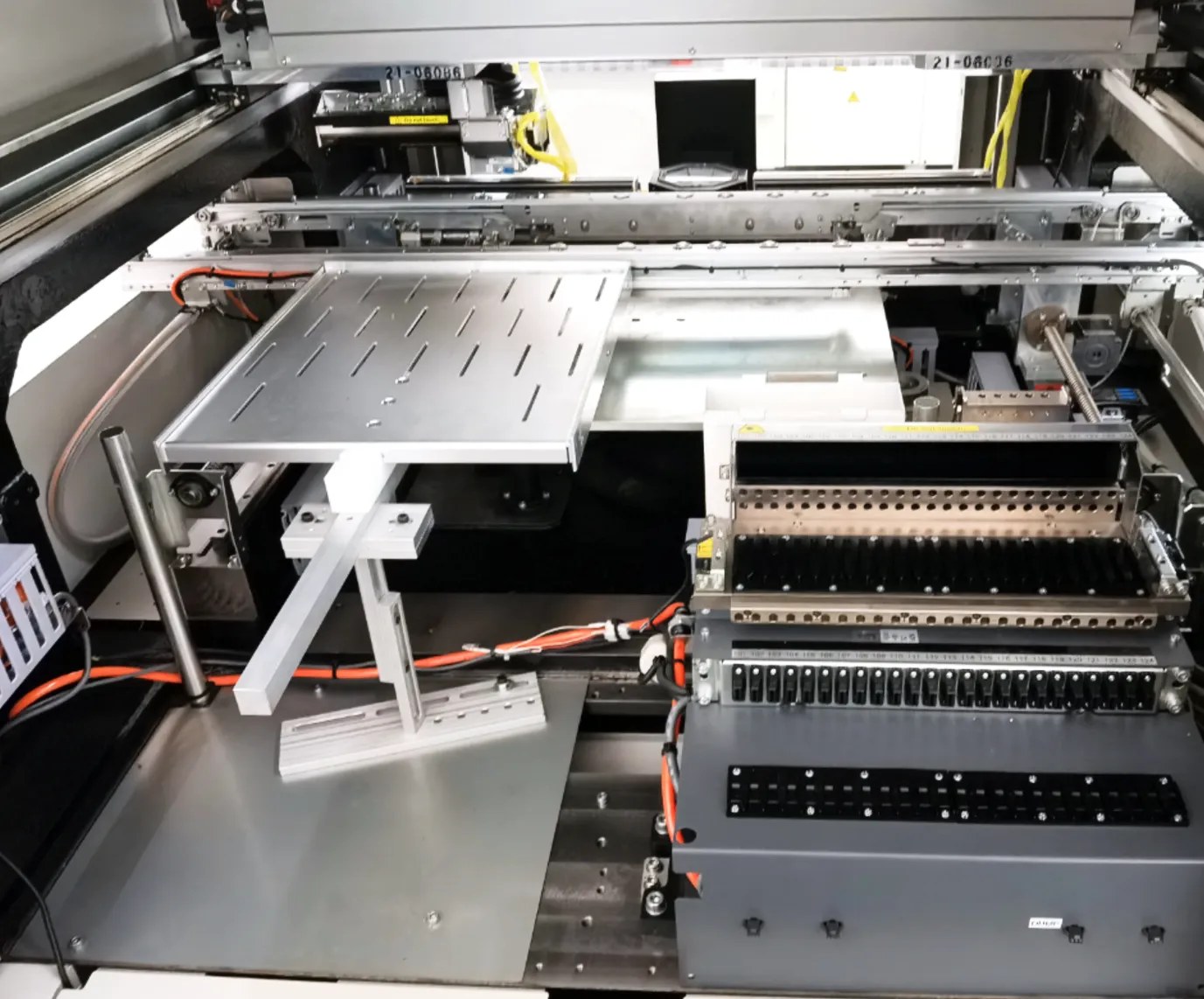
Inside a Yamaha YSM10 placement machine: the tray platform on the left and the tape feeder bank on the right. The substitute part enters the machine here — tape or tray — and everything the machine can check about it is checked from this point on.
What the machine can do is worth stating precisely, because it defines the boundary. On the Yamaha YSM10, as listed on the JHIMS product page, the machine accommodates up to 96 feeder types on its fixed plate, plus 15 tray types when fitted with the automatic tray supply unit, and handles components from 0201 up to 55 × 100 mm. Its e-Vision system generates component recognition data from an image in about a minute, which is how a new part shape is taught to the machine — but teaching the camera a new outline is not approving a new part. Its Side View detection checks component presence, missing parts and pickup status during the transport cycle, and corrects a mispick without stopping production. Presence, shape and pickup: that is the full list. A substitute that is the wrong value, the wrong tolerance or the wrong dielectric passes every one of those checks, because the camera cannot see any of them.
The practical consequence is a division of labour that should be written into the substitution record. The machine verifies that the right pocket was picked, that the part is present, and that its outline and polarity match what was taught. The engineer verifies that the part number in the feeder is the part number that was approved, that its lot and date code match the approval record, and that its datasheet comparison cleared. If the program is not updated to the new part number — new recognition data, new feeder assignment, new tray position where the part comes from a tray — the machine will happily place the old part’s program onto the new part. Updating the program is part of the approval, not an afterthought, and the first board after the change is the first-article check in Section 6, not a production board.
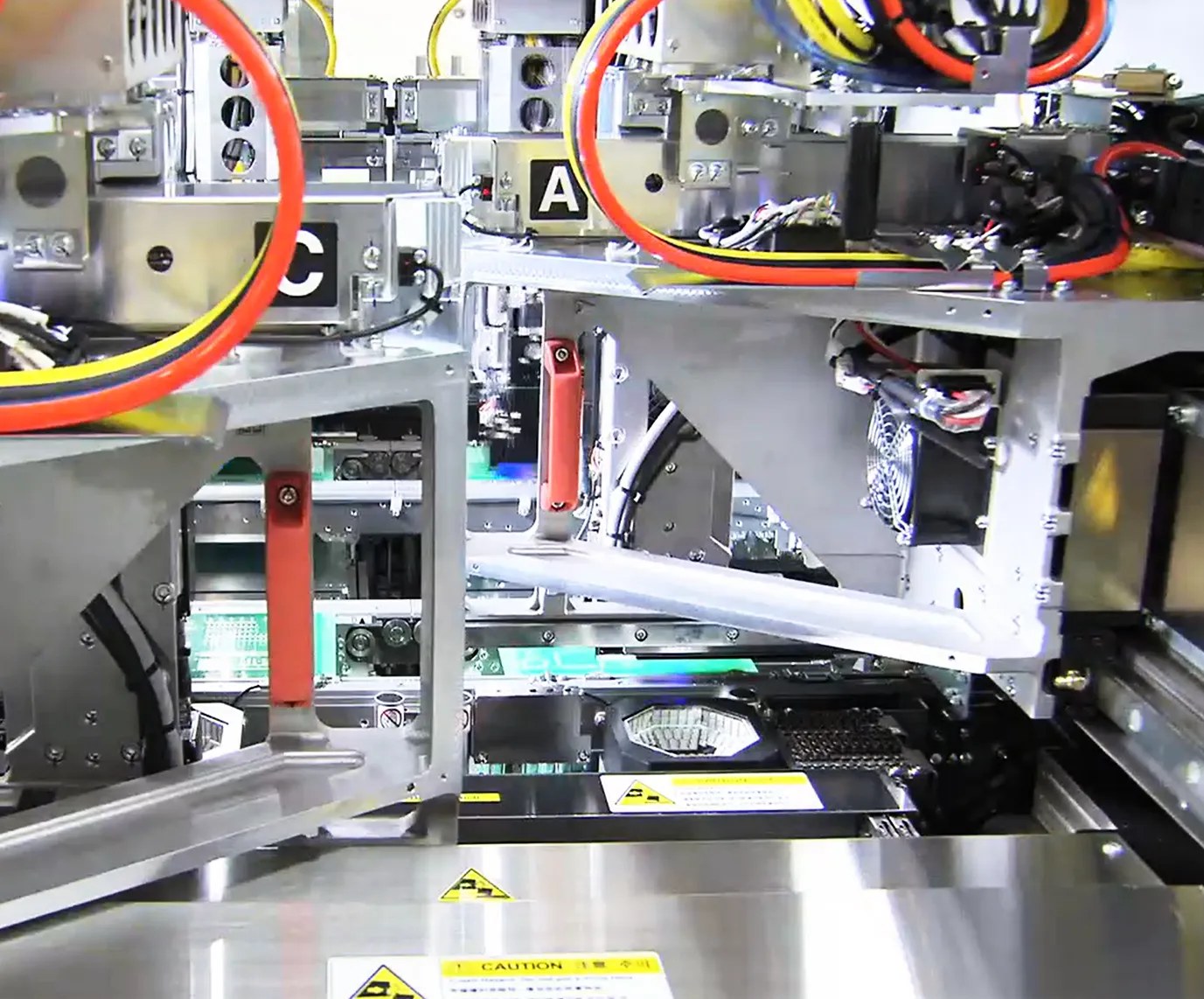
Placement heads inside a Yamaha YSM40R machine, with a board on the conveyor below. The heads and the vision system check presence, shape and pickup — they do not check whether the part on the head is electrically equivalent to the part it replaces.
One more limit belongs here. A part taller than the machine’s handling range, or wider than its camera can recognise in one view, needs a different setup — on the YSM10, parts above 12 mm in size or 6.5 mm in height need the optional multi-camera, as listed on the product page. If the substitute crosses one of those limits and the option is not fitted, the machine cannot place it correctly, and no approval can fix that. Height and size are checked in Section 3 for exactly this reason: a part that fits the board but not the machine is still a stop.
An approval that is not written down did not happen. The record is short — one page — but it must exist before the first substitute board is built, and it must be findable when the batch is traced later. A substitution that cannot be traced is a batch that cannot be recalled narrowly: if the substitute later proves faulty, the factory needs to know exactly which boards carry it, and a verbal approval leaves no way to find them.
The record carries eight items. The original part number and the substitute part number, both in full, including suffixes. The substitute’s manufacturer, lot number and date code. The classification from Section 2. The datasheet comparison from Section 3, with the parameters compared and any open items listed rather than hidden. The moisture state of the lot: MSL, bag seal date, floor-life remaining, and any bake applied, with its time and temperature. The customer’s approval, where the build requires it, with a name and a date — not “customer informed”. The first-article result from Section 6. And the board serial or batch range the approval covers, so the substitution ends where it was authorised to end.
Who signs depends on the build. Engineering signs the datasheet comparison. Quality signs the lot, the moisture state and the first-article result. The customer signs where the contract requires customer approval of part changes — which, for most contract manufacturing, is every part change. Procurement’s job is to record the source: whether the substitute came from an authorised distributor, and whether its traceability paperwork is complete. A substitute bought through an unauthorised channel needs a counterfeit-risk check before any of the above matters, and that check is a reason to stop, not a formality.
The approval also has an expiry: the board range it covers. A substitution approved for the rest of this batch is not an approval for the next batch, and it is not an addition to the approved vendor list. If the substitute is to become a standing second source, it goes through the full qualification afterwards — desk review, bench testing, pilot run, and entry into the list and the bill of materials. The mid-batch record is the evidence that the emergency decision was controlled. It is not a shortcut around qualification.
First-article inspection is the gate before a batch starts: the first board is built, inspected and measured, and only then is the batch released. A mid-batch part change is an exception to that gate, and the question is whether the exception needs a new gate. The answer depends on what changed.
Repeat the first-article check when the substitute changes anything the first article verified. That includes a different footprint or pinout, a different height, a different terminal finish or solderability state, a different moisture state that required baking, a different supplier, or a different feeder or tray position. In practice, a pin-compatible alternate from a different manufacturer always repeats the first article, because the manufacturer changed even if the footprint did not. A same-part-number reel from a new distributor does not, because the part did not change — the splicing check in Section 1 is the verification for that case.
The repeated first article is not a full re-qualification. It is the same checks as the original first article, applied to the boards that carry the substitute: placement accuracy and polarity, solder joint quality at the substitute’s positions, and the functional or electrical tests that would catch the parameters that differ. If the original first article included a measurement that depends on the substituted part — a voltage, a timing, a filter response — that measurement is repeated, not assumed. Our first-article inspection guide lists what the gate verifies before a batch is authorised; the repeated check uses the same list, narrowed to what the substitution touches, and its result is written into the approval record.
Boards built between the reel running out and the approval being signed are not production boards. They are either held for the first-article result or scrapped, and the choice is made before they are built, not after. Building ahead of the approval and then asking the test station to bless the boards afterwards reverses the order of the decision: the test station can only report what it measures, and a board that passes a functional test can still carry a part that will drift, age or fail in the field. The first article is the approval’s evidence. Without it, there is no approval.
Stopping the line feels like failure, and it is usually the correct decision in exactly the cases where it feels worst: the batch is half built, the customer is waiting, and the only part on the shelf is almost right. Almost right is the condition that produces the most expensive mistakes in SMT, because an almost-right part gets fitted, passes the in-line tests, and fails later, when the cost is measured in boards rather than minutes.
Stop the line if any of these is true:
— Either datasheet is missing, or a needed parameter is unpublished and cannot be obtained from the manufacturer.
— The substitute is a form-fit-function replacement that needs a layout or firmware change.
— The footprint, pinout or height does not match the board as built, or the part exceeds the placement machine’s handling range.
— The lot’s moisture state is unknown, its floor life has expired with no bake path, or its bake history cannot be established.
— The source is not an authorised channel and its authenticity cannot be verified.
— The customer’s approval is required and has not been obtained.
— The first-article check on the substitute fails, or cannot be performed.
Stop the line does not mean scrap the batch. It means the batch waits, with the boards already built kept identifiable and the remaining boards unbuilt, while the missing evidence is obtained or a correct part is sourced. A stopped line costs minutes. A batch built on an unapproved substitute costs the batch.
There is one more stop condition that is easy to miss: the substitution is approved, but the quantity on hand does not cover the rest of the batch. Fitting the substitute for part of the batch and the original for the rest creates a mixed batch, and a mixed batch needs its own record — which boards carry which part, and a first article for each variant. If that record cannot be kept cleanly, the honest choice is to stop at the point where the original part runs out and treat the remainder as a separate batch, rather than to mix two part numbers inside one batch number and hope traceability can sort it out later. It cannot, reliably, after the boards have left the line.
The checks above are abstract until they are applied. The example below is illustrative, not a real board: a 10 µF, 16 V, X7R dielectric, ±10%, 0805 ceramic capacitor runs out mid-batch, and the stores hold a 10 µF, 16 V, X7R, ±10%, 0805 capacitor from a different manufacturer. Same printed values, different part number. Walk through the four checks.
Electrical. Nominal value, voltage rating, dielectric and tolerance all match on the two datasheets. That clears the headline comparison — and it is only the headline. The engineer checks the capacitance against DC bias and temperature for both parts, because two X7R capacitors can lose different amounts of capacitance under bias. The datasheets publish these curves; if either one does not, that is an open item, not a pass. If the capacitor sits in a timing or filtering position, the bias behaviour decides the approval. If it is a bulk decoupling capacitor with generous margin, the same difference may be acceptable. The circuit decides, not the label.
Footprint, pinout and height. Both parts are 0805, so the land pattern fits. The engineer still compares the package drawings: terminal width and body height. A taller body under a shield, or a narrower terminal on the same land pattern, would stop the approval. In this example the drawings agree, so the check passes — but it was still performed, and the comparison is written into the record, because the next shortage will not necessarily be so tidy.
Thermal. Both parts are rated for the same temperature range, and the capacitor dissipates negligible power. The check is quick here and the record says so. Quick is not skipped: the record notes that the thermal check was performed and passed, so nobody later has to guess whether it was considered.
Moisture and solderability. Ceramic capacitors are typically MSL 1, and in this example both lots are MSL 1 with intact packaging, so floor life is not the deciding factor. The engineer still checks the lot’s date code and the terminal finish on both datasheets, because a different termination can solder differently even when the part is otherwise identical. The incoming inspection at receipt has already checked the label and the visible condition; the approval record notes that those receipt checks passed.
Decision. This is a pin-compatible alternate: different manufacturer, same footprint and pinout. The approval needs the datasheet comparison above, a repeated first-article check on the first boards carrying the substitute, and the customer’s sign-off where the contract requires it. The machine program is updated to the new part number and its recognition data, the feeder assignment is checked, and the board range covered by the approval is written down. If any single step in that list cannot be done — the bias curves are unpublished, the customer cannot be reached, the first article cannot be run — the line stops. The example passes because every check could be answered, not because the parts looked the same.
Change one fact in the example and the decision changes. If the substitute were a different dielectric, the electrical check would need bench testing. If it were taller, the height check would stop it. If its lot were MSL 3 and open for two weeks, the moisture check would require baking first. The method is the same in every case; only the evidence changes. That is why there is no single rule for what counts as equivalent: equivalence is decided case by case, from the two datasheets and the customer’s approval, and a part that is equivalent for one board is not automatically equivalent for the next.
Can the placement machine tell me whether the substitute is equivalent?
No. The feeder loads tape, and the vision system checks presence, shape, orientation and pickup. None of those checks reads a datasheet or measures an electrical value. A wrong-value part that fits the pocket passes every machine check. Equivalence is decided by people, from the two datasheets, before the reel goes on the machine.
The substitute has the same value printed on the label. Is that enough?
No. The label carries the nominal value, not the tolerance at temperature, the dielectric behaviour under bias, the height, the moisture level or the terminal finish. Two parts with the same printed value can differ in every one of those. The four checks in Section 3 exist because the label is not the datasheet.
Do we need customer approval for every substitution?
For most contract builds, yes. The contract usually requires customer approval of part changes, and the approval record should carry the customer’s name and date. If a particular build genuinely has no customer approval step, write that in the record — with the contract clause that says so — rather than assuming it. An approval step that is assumed away is the one that causes trouble at the audit.
Can we build the boards first and approve the substitute afterwards?
No. Boards built before the approval is signed are not production boards. They are held for the first-article result or scrapped, and the decision is made before they are built. A functional test that passes afterwards does not prove the part will behave over the product’s life, and it does not create an approval record.
What if the substitute is approved but runs out before the batch ends?
Then the batch has two part numbers in it, and it needs a record that says which boards carry which part, with a first article for each variant. If that record cannot be kept cleanly, stop at the point where the approved part runs out and treat the remainder as a separate batch. Mixing part numbers inside one batch number without a clean record is how a narrow recall becomes a full recall.
A mid-batch substitution is a controlled exception, not a shortcut. Classify the change first: a reel change and a part change are different decisions. Compare the two datasheets on the four groups that matter — electrical values with margin, footprint and height, thermal behaviour, moisture and solderability — and write the comparison down, open items included. Let the machine do what it can do, which is presence, shape and pickup, and do not ask it to do what it cannot, which is judge equivalence. Get the approval signed, repeat the first-article check, and record the board range the approval covers. And when any of those steps cannot be completed, stop the line. The boards already built stay good, the batch waits, and the factory keeps the one thing a rushed substitution destroys: a record of exactly what went into every board.
For placement equipment and line configuration questions, contact JHIMS at [email protected]. The Yamaha YSM10 placement machine and the YSM10 product page list the feeder, tray and vision features referenced in this article.


 Teams
 whatsapp
 telegram
