
News
Direct answer: A new lot of solder paste is not the same paste as the last lot until it is proven to print the same — same model, same part number, same supplier, and still a different lot. The proof is five gates in a fixed order, and no gate can be skipped because the previous one passed. First, the paper check: the lot’s certificate of conformance against the paste datasheet and against the last lot that ran clean. Second, conditioning: thawed and stirred exactly as that paste’s own datasheet says, with the cold-chain record checked. Third, a print trial on the real board, stencil and program, with the printer settings left exactly as they were for the last good lot. Fourth, SPI measurement of the printed deposits — volume, height and area on the finest pitch and the largest pad — compared with the previous lot’s baseline on the same board. Fifth, a reflow trial on the production profile, judged on wetting, voids and solder balls. Only then comes the decision: release, conditional release, or reject. And the rule that governs the whole sequence: if the new lot does not print and reflow like the last one, reject the lot — never retune the line to accommodate it. There is no single print, SPI or profile number that qualifies every paste lot, because pass and fail follow that paste’s own datasheet and that board’s own print and profile data, and this article says so wherever the question arises.
A new jar of paste arrives, the label names the model you already use, and the line is waiting. The temptation is to load it and run: the model is qualified, the supplier is familiar, the certificate looks reassuring. That is exactly how a bad lot gets onto a production board. Paste is a process material, not a commodity: the same model from the same supplier varies from lot to lot — the alloy batch, the powder distribution, the flux, the viscosity all drift within the supplier’s window — and a lot that is inside its certificate window can still print differently on your stencil, on your board, at your finest pitch. The certificate is the paste maker’s measurement on their line, not a promise about yours. This article is the qualification sequence for that moment — the next piece in our line-economics series, after staffing, changeover cost, turnkey quotes, OEE, the maintenance calendar, board testing, downtime logging, mid-batch substitution approval, throughput, scrap cost, the end-of-life decision, the second-mounter decision, the used-line purchase, job kitting and the mid-run oven stop. It is about one new lot of an already-selected paste model, and how to prove it prints, places and reflows like the last one before it reaches the line.
Six boundaries first, so the rest of the article is read correctly. First, this article starts after the paste model has been chosen. Choosing the model — alloy, powder size, flux class — is a different decision, covered in our Spanish-language companion piece “Cómo elegir la pasta de soldadura: tamaño de partícula, aleación y fundente” (23 November 2026); that selection is assumed done here and is not re-taught. Second, storage and thawing rules are not re-written here: the Substack piece “Solder Paste Storage and Handling” (24 October 2026) covers cold storage, thawing and shelf-life mistakes, and the Spanish companion on storing and preparing paste before printing (16 November 2026) covers the same ground in our own pages — this article starts from paste that is already thawed and on the machine. Third, reading the paste datasheet itself is not re-taught: the Tumblr piece “How to Read a Solder Paste Datasheet” (26 October 2026) explains particle size, viscosity, slump and tack, and its ten-minute acceptance checklist is cited here as the datasheet step, not repeated. Fourth, no price appears in this article. Fifth, no single print, SPI or profile number is presented as a universal lot-acceptance standard: whether a lot passes follows that paste’s own datasheet and that board’s own print and profile data, and the article says so explicitly wherever the question arises. Sixth, JHIMS sells solder paste printers and SPI machines; it does not sell solder paste and it does not sell a paste qualification service, and nothing here is an offer of either. No real paste supplier or lot is named as approved or rejected anywhere in this article.
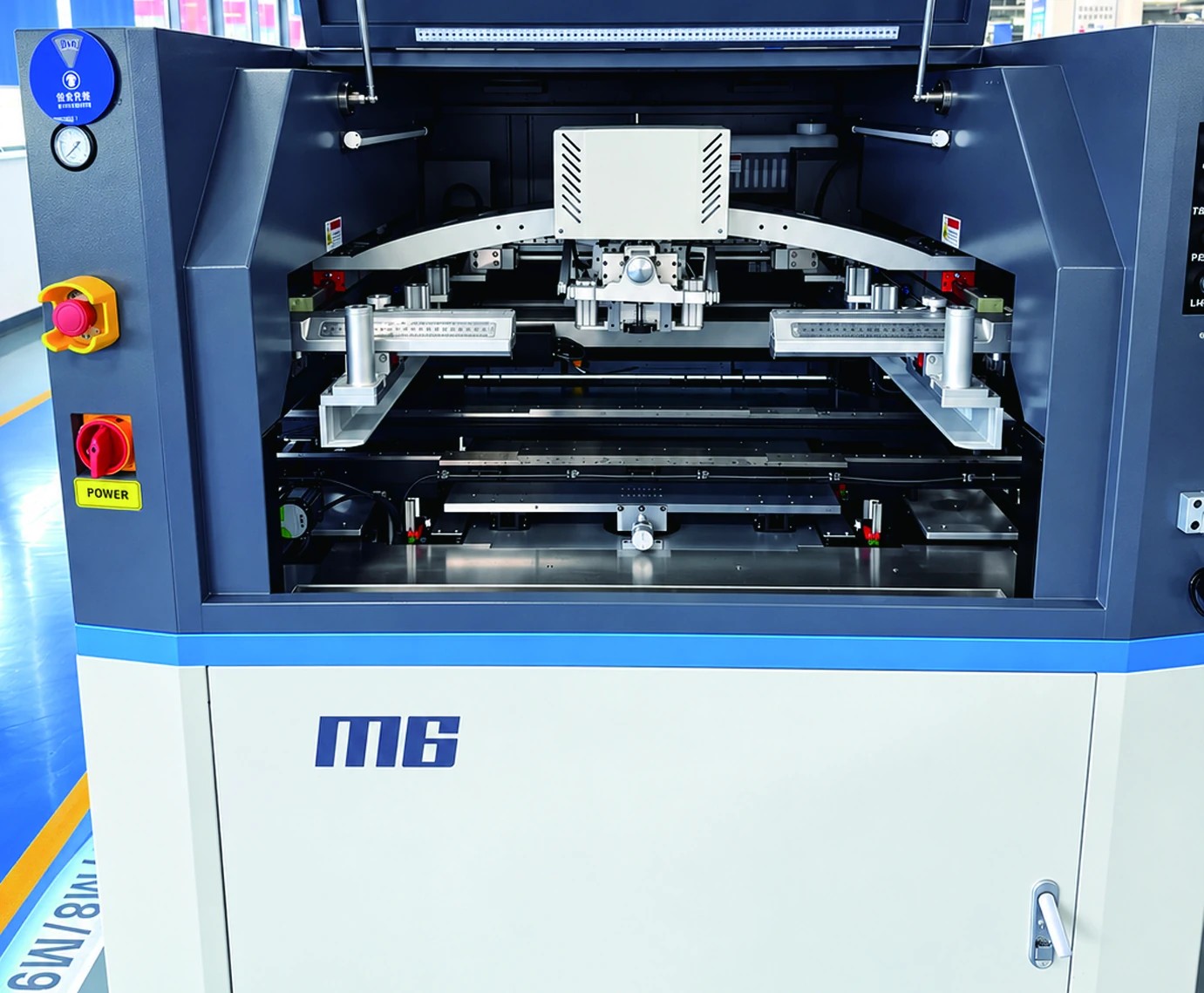
The JHIMS M6 solder paste printer with its front cover open: print head, squeegee gantry, graduated stencil clamp rails and vacuum support table (jhims.net M6 gallery). An empty station, not a print in progress — no paste and no board are visible; the small blue sticker at top left is the machine’s own inspection label.
Lot qualification answers one question: does this specific lot of this specific paste print, place and reflow like the lot that ran clean before it, on this board, with this stencil, on this printer? It is a comparison against a known-good baseline, not a judgement against an abstract standard. The lot is either the same as the last good lot in the ways that matter — same alloy, same powder class, same metal content, same printing behaviour, same reflow behaviour — or it is not, and the difference is found before production, on test boards, not during it.
Four neighbouring checks are often confused with it, so the boundaries matter. First, incoming component inspection is the receiving gate for reels, trays and tubes — label against the order, dry pack, reel condition — covered in “Incoming Component Inspection Before SMT”. It stops at the door, and it inspects components, not paste. A paste lot passes through the same receiving door, but the checks that follow it are different, and they start after the jar is opened. Second, model selection — which alloy, which powder type, which flux — is the decision that comes before any lot exists, and it is the subject of the Spanish selection piece cited above. Third, reading an SPI result is the skill of interpreting a measurement that already exists: the Blogger piece “Reading a Solder Paste Inspection Result” (4 November 2026) teaches what to fix before reflow when the SPI result is already in front of you. This article uses SPI as one gate in the lot sequence — measuring the new lot against the old lot’s baseline — and does not re-teach how to read the result. Fourth, qualifying a second supplier of a different material is the same shape of problem with different content: the WordPress piece “Qualifying a Second GOB Glue Supplier” (9 November 2026) runs the same five-gate logic — paper comparison, machine compatibility, laboratory checks, trial run, phased changeover — for coating glue. The logic transfers; the material does not, and nothing from the glue qualification is re-written here.
Two more distinctions keep the sequence honest. A material test and a board test answer different questions, and neither substitutes for the other. Material testing asks whether the paste itself meets its specification — alloy, powder, viscosity, slump, tack, wetting. A print trial and SPI ask whether the paste forms suitable deposits on the actual board, with the actual stencil and printer. A laboratory sample can pass a viscosity test while a fine-pitch aperture releases too little paste; a single acceptable print cannot establish that a new lot matches its declared alloy, powder class or flux system. Both kinds of evidence belong in the same qualification file, but the decisions about each are made separately. And the qualification is per lot, not per delivery: two jars with different lot numbers in the same delivery are two qualifications, even if they arrived on the same truck. Mixing them silently on one job destroys the traceability the lot number exists to protect — the same rule our incoming-inspection piece applies to reels, applied here to paste.
The first objection to lot qualification is usually that the paste is the same product. It is the same product name, and that is not the same thing. A solder paste is a mixture — metal powder, flux, solvents and additives — and every ingredient is manufactured in batches. The alloy comes from a melt; the powder is atomised and sieved into a size distribution, not a single size; the flux is blended. Each step has its own tolerance, and the finished paste inherits all of them. The supplier’s certificate states that the lot sits inside the product’s specification window. It does not state that the lot sits in the same place inside that window as the last lot you ran.
That distinction is where the failures live. Viscosity is the most commonly quoted number, and the most commonly misread. A viscosity reading is only meaningful with its test method, temperature and shear condition — a typical datasheet figure is measured on a Malcom viscometer at 10 rpm and 25 °C, and a reading taken on a different instrument, at a different speed or a different temperature, is not directly comparable with it. More importantly, a single viscosity number is a weak predictor of printing behaviour on its own: printing involves a range of shear rates, from stencil fill to release, and a paste that measures correctly at one shear rate can still slump or fail to release. The slump test is closer to the behaviour that actually matters, because it measures whether a deposit holds its shape after printing — and slump, tack and wetting are separate tests that investigate different failure mechanisms, not three ways of saying the same thing.
Powder distribution matters more than the alloy name at fine pitch. Two pastes with the same alloy and the same flux percentage can behave differently at a fine-pitch aperture because the largest particles in the distribution determine whether the paste releases cleanly from the stencil. That is why the powder type — Type 3, Type 4, Type 5 and so on under IPC J-STD-005 — is part of the identity that must match, and why the five-ball rule exists: the smallest aperture should be at least five times the largest particle the type allows. A lot whose powder distribution has shifted inside its type can still pass its certificate and still release worse at your finest aperture. The same logic applies to the flux: the flux classification under J-STD-004, for example ROL0, describes the chemistry family, not the exact behaviour of this batch of it.
There is also the journey. Paste travels cold, and a lot that thawed and refroze somewhere between the supplier and your dock can print ragged and slump under the microscope while nothing on the paperwork flags it. Paste warmed past its rated window degrades in ways stirring cannot recover. That is why the cold-chain record is part of Gate 1 and not an afterthought, and why a lot with an undocumented cold chain is treated as suspect and run through the full qualification rather than a shortened one.
The standard that frames all of this is IPC J-STD-005, “Requirements for Soldering Pastes”, currently in its B revision from January 2024. It defines how paste is characterised and tested — powder classification, metal content, viscosity, slump, solder-ball formation, tack and wetting, with test methods from IPC-TM-650 — and it states plainly that it is a quality-control document, not a predictor of how the material will perform in a manufacturing process. That sentence is the whole reason this article exists: the standard gives you the language and the tests for the paper check, and the print, SPI and reflow trials are what prove performance on your board.
Every new lot arrives with paperwork, and the paperwork is the first gate because it is the cheapest place to catch a wrong lot. The mistake is treating the certificate as the qualification. A certificate of conformance — or certificate of analysis, the terms are used interchangeably by suppliers — tells you what the paste maker measured on their line. It is necessary evidence, and it is not sufficient evidence. The gate has three comparisons, and all three must be made.
First, the certificate against the order: the product name, alloy, powder type, flux classification and packaging must be the paste you ordered. A jar of the right alloy in the wrong powder type, or the right powder type with a different flux class, is a different paste for your board even if the alloy matches. Second, the certificate against the paste datasheet: every figure the certificate reports — metal content, viscosity with its method and temperature, slump, tack, solder-ball result — must sit inside the datasheet’s stated range for that product. A figure outside the datasheet range is a fail at this gate, and the lot goes no further. Third, and most often skipped, the certificate against the last lot that ran clean: compare the new lot’s figures with the previous good lot’s figures, field by field. If the metal loading or the viscosity has drifted by more than a few percent from the lot that printed well, the new lot gets a closer look before it touches a stencil — even though both lots are inside the datasheet window. Field experience is consistent on this point: viscosity has been seen to climb enough to cause skipping and bridging on fine-pitch apertures while the certificate stayed inside its stated window.
| Field to compare | Compare against | What counts as a fail |
|---|---|---|
| Alloy, powder type, flux class | Order and datasheet | Any difference from what was ordered — quarantine, do not load |
| Lot number, manufacture date, expiry date | Jar label and certificate | Mismatch between jar and certificate, missing lot number, or expired paste — quarantine |
| Metal content (weight %) | Datasheet range, then last good lot | Outside the datasheet range, or a drift from the last good lot that the print trial cannot explain away — hold for full qualification |
| Viscosity, with method, speed and temperature | Datasheet range for the same method, then last good lot | Outside range, or measured by a different method so no comparison is possible — do not compare numbers from different instruments as if they were the same measurement |
| Slump, tack, solder-ball, wetting results | Datasheet pass criteria (J-STD-005 test methods) | Any reported failure against the datasheet criteria — quarantine |
| Cold-chain and shipping record | Supplier’s stated storage and transport conditions | No record, a temperature-logger excursion, or a shipment that sat warm — treat as suspect, full qualification, no shortened route |
Two habits make this gate work. First, log the lot number, manufacture date and expiry date in the qualification record before the jar is opened — once the jar is open and the paste is on the stencil, the link between the paste and its paperwork is the record alone. Second, photograph the jar label and the certificate together: if the lot is later rejected, the photograph is the evidence purchasing needs to raise the return, and it costs seconds at receipt but may be impossible to reconstruct later. The same discipline our incoming-inspection piece applies to reel labels applies here to paste jars, for the same reason.
One thing the paper check cannot do is verify composition. A certificate cannot show whether the paste in the jar actually matches its declared alloy, powder class or flux system — only the supplier’s own testing and, for a suspect lot, laboratory analysis can do that. That limit is stated here because it sets the boundary of the whole sequence: what follows proves how the lot prints and reflows, not what it is made of. If the paper check raises a composition doubt — a certificate that does not match the jar, a supplier that will not commit to alloy, powder type, flux class and working window in writing — the answer is to hold the lot and ask the supplier, not to print a test board and hope the result clears it.
Paste that has passed the paper check still has to be brought to printing condition, and this gate is where impatience does its damage. The rule is short: thaw and stir exactly as that paste’s own datasheet says, and record the thaw time on the jar. The storage, thawing and shelf-life rules themselves are not repeated here — the Substack storage piece and the Spanish storing-and-preparing piece cited at the top cover them, including the mistakes that print as defects — but the qualification consequences of breaking them belong here, because a badly conditioned lot will fail the print trial for the wrong reason and waste the whole sequence.
Three checks, in order. First, the thaw: the jar must reach room temperature fully before it is opened. Paste opened cold condenses moisture onto its surface, and that moisture is then stirred into the paste. How long thawing takes depends on the jar size and the paste, and the datasheet’s figure is the one that counts — this article gives no thaw time of its own, because no single figure is right for every paste. If the thaw time is unknown — the jar arrived already warm, or nobody recorded when it came out of the refrigerator — treat the lot as suspect: the conditioning is undocumented, and undocumented conditioning is a reason for the full qualification, not a reason to skip it. Second, the stir: mix gently, as the datasheet directs, until the paste is uniform. Vigorous stirring whips air into the paste and changes its printing behaviour; no stirring leaves the flux and powder unevenly distributed, and the first prints come out different from the later ones. Third, the look: before the paste goes on the stencil, look at it. Paste that has separated, formed a dry skin, crusted at the edges, or gone lumpy is not fit to print, whatever the certificate says. A visual check of the jar is no substitute for rheology or powder-size testing — it cannot clear a paste — but it can condemn one, and condemning early is cheaper than condemning after a print trial.
A note on what not to do at this gate: do not warm paste to speed the thaw, and do not return a thawed jar to the refrigerator to “save” it for later without checking whether the supplier supports a re-freeze cycle and how many. Both shortcuts change the paste in ways that do not show on the certificate and do show on the board. If the paste’s working window — the time it may stay at room temperature and on the stencil — is about to run out, the correct action is to plan the trial inside the window or to open a fresh jar, not to stretch the window and hope.
The print trial is the first gate that tests the paste rather than the paperwork, and its design is what makes it a test. A single test board proves almost nothing: one panel, one acceptable print, and the lot is released — that is the pitfall, and it is the most common one. What the trial must show is whether the new lot prints like the last lot across a run, not whether it can print one good board once. The rule is to change nothing except the paste. The same stencil, the same squeegee, the same printer program and the same settings that ran the last good lot, and enough boards to see the trend across a few hours of open time.
Run the trial on the real production board and stencil, not on a test coupon alone. A coupon can show that the paste releases from an aperture; only the production board shows whether it releases from your finest aperture, fills your largest thermal pad, and holds its shape on your densest area at the same time. Measure the deposits at the two ends of the board’s difficulty: the finest pitch and the largest thermal pad on the same panel. Volume consistency across the run matters more than any single good print — a lot that starts well and drifts as the paste warms, dries or works on the stencil is a lot that will drift in production, and the trial is designed to catch that drift while the boards are still test boards.
Watch for the same four failure signs on every board in the trial, in this order. First, release: does the paste leave the finest apertures cleanly, or does it skip, smear or tail? Second, slump: do the deposits hold their shape after printing, or do they spread toward their neighbours before reflow? Third, bridging: is paste connecting pads that should stay separate, especially at fine pitch? Fourth, insufficient deposits: are any pads short of paste, particularly the smallest apertures and the apertures farthest from the squeegee’s start? Any of these, repeated across the trial boards, is a finding against the lot — not against the printer.
That last sentence is the most important rule in this section, and it is worth stating as a rule rather than a suggestion: do not change the printer settings to make the new lot print. If the new lot needs a different squeegee pressure, a different print speed or a different separation speed to print acceptably, then the lot has failed the test — the test is whether it prints like the last lot on the last lot’s settings. Retuning the line to accommodate a new lot hides the difference instead of finding it, and the retuned settings then stay on the line for the next lot, which was qualified against the old ones. Every lot after that inherits a setting that was chosen to rescue one bad jar. The printer settings are the constant in this experiment; the paste is the variable. If the paste cannot meet the constant, the paste is the problem.
Record the trial conditions with the results, or the results cannot be compared with anything: stencil thickness and frame, squeegee type and pressure, print speed, separation settings, cleaning interval, room temperature and humidity, the number of boards printed, and the time the paste spent on the stencil. Without those, a result cannot be compared with the supplier’s own data or with the next lot’s trial, and the qualification file is a story rather than a record.
Eyes are not enough for this gate. A printed deposit can look acceptable and still be short of volume, and the shortage only shows after reflow, when it is too late to fix cheaply. SPI — solder paste inspection — measures what the eye cannot judge: the volume, height, area, position and shape of every deposit on the board. That is why the print trial is measured, not just looked at, and why the measurement is a comparison, not a single reading.
The comparison is the point. Measure the new lot’s deposits on the same board, with the same stencil and the same SPI program that measured the last good lot, and compare the two sets of numbers. The previous lot’s SPI record — kept in the qualification file from its own release — is the baseline: the mean volume and the spread of volumes on the finest pitch, on the largest thermal pad, and across the board as a whole. A new lot whose deposits sit in the same place, with the same spread, has passed this gate. A new lot whose volumes have shifted, or whose spread has widened, has not — even if every individual deposit is still inside the SPI program’s pass window. The program’s window is a defect screen; the baseline comparison is the lot test. They are different questions, and only the second one qualifies a lot.
| What SPI measures | What it tells you about the new lot | What it cannot tell you |
|---|---|---|
| Deposit volume | Whether the lot releases the same amount of paste from each aperture as the last lot did | Whether the paste’s alloy, powder or flux matches its certificate |
| Deposit height and area | Whether the deposits hold their shape — slump shows as low height with wide area | How the joints will wet in reflow — that is Gate 5’s job |
| Deposit position and offset | Whether the print is registered the same way — a shift here is a printer or stencil issue, not a paste issue, and must not be blamed on the lot | Anything about the paste at all, if the shift is mechanical |
| Volume spread across the run | Whether the lot is stable over open time — a widening spread across the trial boards is a drift warning | The cause of the drift without the print-trial record — check stencil condition and paste age on the stencil first |
Two warnings belong here. First, there is no universal SPI number that qualifies a lot. No source publishes a single volume, height or area figure that is a safe pass standard for every paste and every board, and this article does not invent one. The thresholds that judge the new lot come from two places only: the paste’s own datasheet, and the board’s own print data — the baseline the last good lot set on this board, with this stencil. A threshold copied from another board, another stencil or another paste is not a standard; it is a guess with a number attached. Second, the SPI program itself must not be changed for the new lot. Reprogramming the inspection limits so the new lot passes is the same error as retuning the printer: it hides the difference instead of finding it. The program, like the printer settings, is a constant in this experiment.
How to read an SPI result in detail — which defect calls mean what, and what to fix before reflow — is the subject of the Blogger piece cited above, and it is not repeated here. What matters for lot qualification is narrower: the same program, the same board, the new lot against the old lot’s numbers, and the trend across the trial run. For the inspection step that follows placement, and for the question of whether to buy SPI or AOI first, the companion guide “SPI or AOI First?” gives the buying-order decision; it is cited here only for that decision, not re-written. For the printing step itself — what the printer does and where print defects come from — see our overview “How Solder Paste Printing Transforms SMT Assembly in 2026”.
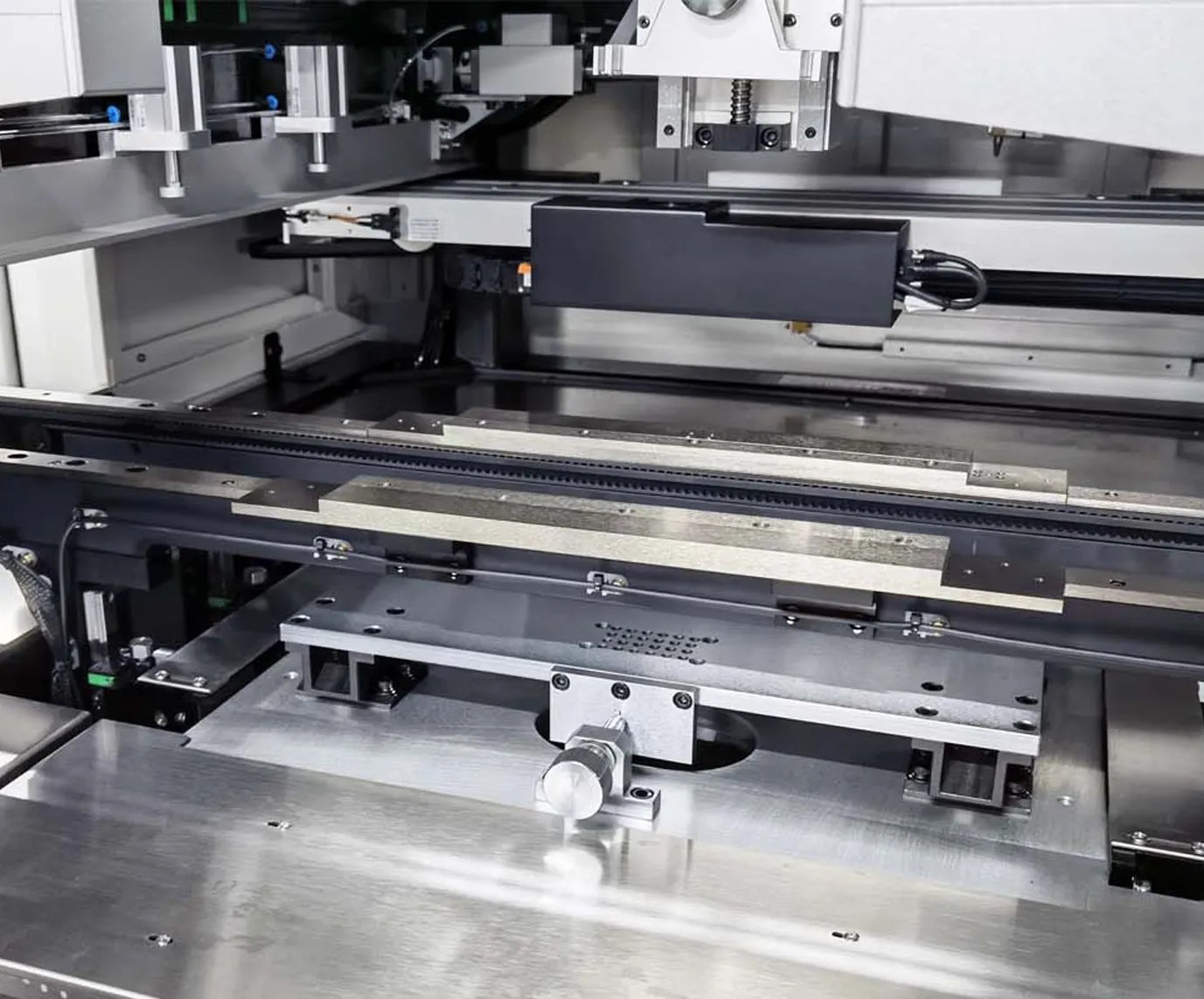
Inside the JHIMS L5 solder paste printer: the vacuum support table with its pin-hole array, conveyor rails and the squeegee assembly above (jhims.net L5 gallery). An empty platform, not a print in progress — the trial boards run on this table, with the same program and settings as the last good lot.
Qualification on the printer alone is incomplete. A lot can print acceptably and still reflow differently: its melting behaviour can shift slightly, its flux can exhaust earlier in the soak, its wetting can be weaker on large ground planes. So the test boards from the print trial are reflowed — on the actual production profile, not a generic one, and not a profile adjusted to suit the new lot. A new lot can expose a marginal soak zone that the last lot sailed through, and the only way to find that is to run the profile the production boards will actually see.
The alloy sets the temperature frame, and the paste datasheet sets the profile inside it. The common lead-free alloy SAC305 — tin 96.5%, silver 3.0%, copper 0.5% — melts across 217–220 °C, so a reflow peak must sit above that range; but the peak, the time above liquidus and the soak for your board come from the paste’s own datasheet and the board’s own measured profile, not from any figure in this article. No single peak temperature, time above liquidus or soak time is a safe standard for every paste and every board, and none is given here. The profile used for the trial is the qualified production profile for this board, unchanged. If the new lot needs a different profile to reflow acceptably, the lot has failed the test — the same rule as the printer settings in Gate 3, applied to the oven.
Inspect the reflowed test boards for three things. First, wetting: do the joints wet the pads and the component terminations fully, or are there joints that look grainy, dull or incompletely coalesced? Paste that never fully coalesces leaves a grainy, ball-like surface and a defective joint, even if a fillet looks acceptable at a glance. Second, voids under thermal pads and large ground planes: a lot that voids acceptably at atmosphere can behave differently on a board with large copper areas, so the trial boards should include the board’s worst case for voiding, not just its easiest joints. Third, solder balls at the edges of deposits and random balling across the board: a lot with a solder-ball problem shows it here, on the test boards, where it costs nothing. The acceptance judge for the joints is IPC-A-610, at the acceptance class your customer agreement specifies — this article cites the standard as the judge and does not reproduce its criteria, which belong to the standard and to your agreement, not to a blog post.
Keep the reflowed test boards. They are the physical evidence that the lot was qualified, and they are the first thing to reach for when a production board later shows a joint defect and the question is whether the lot or the line changed. A qualification without retained evidence is a memory, and memories do not survive a customer audit. Label the boards with the lot number and the trial date, and file them with the record described in section 9.
Every finding in the five gates ends in one of three dispositions, and the decision should be made the same day the trial runs. Delay is itself a failure mode: an undecided jar drifts into stock, and a jar in stock is a jar somebody will load.
| Finding | Disposition | What happens next |
|---|---|---|
| Paper, conditioning, print trial, SPI and reflow trial all match the last good lot | Release | Record the release, enter the lot into stock with its lot number, and file the record by lot and job so any board can be traced back to it |
| All gates pass but with a small, documented drift — for example, SPI volumes slightly shifted but stable, and reflow joints acceptable | Conditional release | Release restricted to named products or a limited quantity, with extra SPI sampling on the first production run, and the restriction written on the record — not a quiet release |
| Print or reflow behaviour differs from the last good lot and the cause is the paste, or any gate fails outright | Reject | Quarantine the lot physically, tag it with the reason, photograph the evidence, notify purchasing the same day, and return it with the photographs and the qualification record — do not retune the line to use it |
| A gate result is unclear — for example, the SPI trend is ambiguous or the reflow trial boards are inconclusive | Hold, do not release | Repeat the unclear gate on fresh test boards, or ask the supplier for the lot’s laboratory data. An unclear result is not a pass, and production is not the place to resolve it |
The reject rule deserves its own paragraph, because it is the rule that gets broken most often under schedule pressure. When a new lot prints or reflows differently and the cause is the paste, the lot is rejected. The line is not adjusted to fit it. The reasons are practical, not philosophical. First, a setting changed to rescue one lot stays on the line for the next lot, which was qualified against the old setting, and the drift compounds lot by lot until nobody remembers what the original settings were. Second, a lot that needs rescue at the printer will usually need rescue at reflow too, and the rescue is never free: it is paid for in yield, in rework, and in joints that pass inspection today and fail in the field. Third, the supplier cannot learn from a rejection that never happens. A lot returned with its qualification record and photographs is information the supplier can act on; a lot quietly absorbed into production is a problem the next customer will inherit.
Quarantine only works if it is physical. A rejected jar with a red tag sitting on the same shelf as released stock will be loaded by the next person in a hurry. The quarantine area should be a separate shelf, bin or room, and the tag on the jar should carry the lot number, the date of receipt, the reason for the hold, and the name of the person who raised it. A tag that says only “hold” tells the next shift nothing. And never mix lots silently on one job: if a job must change lots mid-run, record the change, record where the change happened in the board sequence, and keep the two lots’ boards identifiable. A board whose lot cannot be named is a board that cannot be investigated.
The quietest pitfall in lot qualification is not documenting what “good” looked like. A qualification that lives in somebody’s memory is not a qualification: the next lot has no baseline to be compared against, and the argument about whether the new lot prints differently becomes an argument about who remembers the old lot correctly. The record is what makes the next qualification possible, and it needs ten fields.
The lot qualification record — ten fields
1. Paste model, alloy, powder type and flux class, as ordered. 2. Lot number, manufacture date and expiry date, as printed on the jar and the certificate. 3. Supplier and purchase order number. 4. Certificate figures: metal content, viscosity with method and temperature, slump, tack and solder-ball results. 5. Comparison with the last good lot, field by field. 6. Conditioning: thaw start and end times, stirring method, cold-chain record. 7. Print trial conditions: stencil, program, squeegee, pressure, speed, separation, cleaning interval, room temperature and humidity, boards printed, time on stencil. 8. SPI results: mean and spread of volume, height and area on the finest pitch and the largest pad, against the previous lot’s baseline. 9. Reflow trial: profile used, and the wetting, voiding and solder-ball findings. 10. Disposition — release, conditional release with its restriction, or reject with the reason — and the name of the person who decided it.
Two more habits close the loop. First, keep a sealed reference jar from a known-good lot, with its own record of the print and reflow results it produced. The reference jar is the physical baseline: when a new lot is marginal, the comparison is against a jar that printed well, not against a memory of one. Second, file the record by lot and job, not by date alone. A record filed by lot answers, months later, which lot went onto which job and why a lot was held; a record filed by date answers nothing, and the factory will discover that at the worst possible moment — during a customer audit, or a field failure investigation.
JHIMS builds the two machines this sequence runs on, and it is worth stating plainly what each one does in the qualification and what it cannot do. The M8 fully automatic visual solder paste printer is the machine the print trial runs on: a 1.3-megapixel CCD vision system with geometric matching for stencil alignment, print accuracy of ±0.025 mm and repeat accuracy of ±0.01 mm, a print speed range of 10–200 mm per second, print pressure of 0.5–25 kg, and a three-stage demolding system with independently adjustable release distance and speed — all figures as published on the M8 product page. Its built-in 2D inspection catches insufficient solder, missing prints and bridging before the board reaches placement, which makes it a useful first screen inside the print trial — but 2D inspection is not SPI, and a 2D pass is not a volume measurement. The M8’s role in lot qualification is to hold the print constant: the same program, the same settings, lot after lot, so that any change in the result is the paste changing, not the machine.
The S630 3D SPI machine is the measuring instrument for Gate 4: true 3D volumetric measurement of every deposit — volume, area, height, XY offset and shape in one pass — at 16 µm resolution, with a minimum pad spacing of 150 µm and a Gage R&R below 10%, and an SPC suite with X-bar and R charts and Cp/Cpk analysis, all as published on the S630 product page. The SPC trend view is the part that matters most for lot qualification: it shows the volume trend across the trial run, which is exactly the drift the trial is designed to catch. The S630’s role is measurement, not judgement: it reports the numbers, and the numbers are judged against the previous lot’s baseline and the paste datasheet, not against a figure printed in this article.
The limits matter as much as the capabilities. Neither machine can verify what the paste is made of: SPI cannot determine composition, and a printer cannot tell a good alloy from a wrong one. Neither machine can qualify a paste model — that decision belongs to the selection process, not to the equipment. And the machine figures quoted here are the manufacturers’ published specifications for the machines themselves; they describe what the machine does with paste that is correct, and no accuracy figure compensates for a wrong lot. A printer that prints a bad lot at full rated accuracy has printed a bad lot accurately.
To be explicit about the commercial boundary: JHIMS sells solder paste printers and SPI machines. It does not sell solder paste, and it does not sell a paste qualification service. This article is a method guide for the reader’s own line, not an offer to run the qualification for them. Questions about the M8 printer or the S630 SPI machine — or about setting up a lot qualification check that uses them — are welcome at the contact below; questions about which paste to buy belong to the paste supplier, whose datasheet and certificate are the documents that govern the lot.
1. Treating the certificate as the qualification. The certificate is the paste maker’s measurement on their line. It is the first gate, not the whole sequence. A lot inside its certificate window can still print differently on your board.
2. The one-board spot check. A single test board proves almost nothing. The trial needs enough boards across a few hours of open time to show the trend — volume consistency across the run matters more than any single good print.
3. Retuning the line to fit the lot. Changing printer settings, SPI limits or the reflow profile so the new lot passes hides the difference instead of finding it, and the changed settings stay on the line for the next lot. If the lot cannot meet the constant, the lot is the problem.
4. Judging by eye instead of by SPI. A deposit can look acceptable and still be short of volume. The measurement is the gate; the eye is the screen before it.
5. Skipping the reflow trial. A lot that prints well can still reflow badly — weak wetting, voids under thermal pads, solder balls. Skipping reflow is how a lot passes incoming inspection and still fails at final test.
6. Mixing lots and losing the record. Two lots on one job with no record of where the change happened, and no reference jar from the last good lot, leave the next qualification with no baseline and the next failure investigation with no lot to investigate.
Can I skip the print trial if the certificate matches the last good lot exactly?
No. A certificate that matches the last lot’s figures is a good reason to expect the trial to pass, not a reason to skip it. The certificate is the maker’s measurement; the trial is the proof on your board, with your stencil and your program. The trial is also cheap — a few test boards — compared with the cost of finding the difference in production.
How many test boards does a print trial need?
Enough to see the trend across the paste’s open time on the stencil, not a fixed number. This article gives no board count as a standard, because the right count depends on the board, the paste’s working window and the customer’s quality agreement. The rule is the trend: print across a few hours of open time and watch whether the volumes hold or drift.
The new lot prints slightly differently but the joints look fine. Can I release it?
Only through the conditional-release route in section 8, with the drift documented, the release restricted to named products or a limited quantity, and extra SPI sampling on the first production run. A quiet release — no record, no restriction, no extra sampling — is not a release decision; it is the decision not to decide.
Can I blend the new lot with the remainder of the old lot to use it up?
No. Blending two lots makes a third, unqualified mixture with no certificate, no baseline and no traceability. Finish the old lot or quarantine it; qualify the new lot on its own; record any change of lot mid-job with the board sequence where it happened.
Does lot qualification replace first-article inspection?
No. They are different gates. Lot qualification proves this lot of paste prints and reflows like the last one. First-article inspection proves the first assembled boards from the run are correct. A good first article built from an unqualified lot only proves the line assembled the boards it was given; it says nothing about whether the lot will hold its behaviour across the run.
Bottom line: A new solder paste lot is guilty until proven identical — not in a courtroom sense, but in the practical sense that the cost of proving it is a few test boards and the cost of assuming it is a production run of bad joints. Run the five gates in order, change nothing except the paste, measure the new lot against the last good lot’s baseline rather than against any universal number, and reject the lot when the paste is the cause — never retune the line to accommodate it. The record you keep is the baseline the next lot will be judged against, so keep it as if the next lot depends on it. It does.
Questions about the M8 solder paste printer or the S630 3D SPI machine, or about setting up a lot qualification check on your line? Contact JHIMS at [email protected] for technical information. For the companion pieces cited in this article: the solder paste printing overview and the SPI/AOI buying-order guide on this site, the incoming-inspection checklist, and the Spanish-language paste selection and paste storage guides — see the links in the text above.


 Teams
 whatsapp
 telegram
