
News
Direct answer: If coating thickness varies across a module or from one batch to the next, check the air supply before you blame the glue or the program. The GOB-LXS330 glue dispensing machine is specified for 0.5–0.8 MPa input pressure, and the LM661 inline dispenser needs a stable 0.7 MPa.
Direct answer (continued): Below the window the machine starves — thin coating and starved edges. Above it the machine over-dispenses — thick coating and glue where it should not be. Three checks settle most cases: read the gauge at the machine while it is dispensing, fit a regulator, and write the pressure reading next to the defect record every time a bad module appears.
On most factory floors, compressed air is treated as a utility: it is either on or off. For a GOB dispensing machine, that view is wrong. The machine's product pages specify the air supply in MPa for the same reason they specify positioning accuracy — because the air is part of the process, not just the power behind it.
The mechanism is straightforward. In a pressure-driven dispensing system, compressed air is what pushes the glue out of the valve. The positioning system decides where the glue lands; the air pressure, together with the valve timing, decides how much glue leaves the valve while it is there. The GOB-LXS330 holds its position to ±0.05 mm, but no positioning accuracy can correct a flow problem: if the pressure falls, the same program puts down less glue in the same place, and if it rises, it puts down more.
That is why this guide treats pressure as a coating variable on the same level as glue condition and program settings. It is also why the JHIMS dispensing guide lists pneumatic pressure fluctuation as one of the common causes when dot size varies far beyond the machine's specification — in its words, fluctuation "tied to shop air compressor cycling", fixed by "a dedicated pressure regulator and accumulator tank".
The guide is the process engineer's field guide to glue dispensing in fine-pitch LED module production; this article takes that one cause and works it through in full.
One boundary first. This article is about pressure stability — whether the pressure at the machine holds steady inside its window. The quality of the air itself (moisture, oil, filtration) is a different check, and it belongs to the machine's own startup routine: the D900 startup checklist, for example, pairs the pressure check with a check for moisture in the air lines. Both checks matter; this article covers the pressure one.
Every machine has its own window, and the numbers are not interchangeable. The table below collects the air-pressure figures stated on the JHIMS product pages checked on the day this article was written. Read the row for your own machine and ignore the rest.
| Machine | Stated air pressure | What it is |
|---|---|---|
| GOB-LXS330 glue dispensing machine for LED displays | Input pressure 0.5–0.8 MPa | The GOB coating machine this article is about; 400 × 400 mm fixture, teaching programming, Panasonic PLC, anti-drip valve, liquid level sensing alarm |
| LM661 inline silicone dispenser (GOB solution) | Stable air pressure 0.7 MPa | Inline GOB/COB dispensing solution; the page states the pressure as a single stable value, not a range |
| JH-D900 precision jet dispensing machine | Air pressure required 0.4–0.6 MPa | Precision reference only — not a GOB coating machine; its startup checklist also requires the pressure verified at 0.4–0.6 MPa |
| PTS330 high-precision jet dispensing machine | Minimum drive pressure 0.6 MPa | Jet dispensing reference only — not a GOB coating machine; its troubleshooting guide lists alarms for pressure issues |
Two things in the table deserve attention. First, the LM661 states a single stable value (0.7 MPa) while the LXS330 states a range (0.5–0.8 MPa). A range is not permission to drift: it is the band the machine is designed to work inside, and the coating is most repeatable when the pressure sits steady somewhere inside it rather than wandering from one end to the other.
Second, 0.6 MPa means three different things on three machines: comfortably inside the LXS330 window, below the LM661's stable point, and at the top of the D900's window. Never copy a pressure number from one machine's page to another.
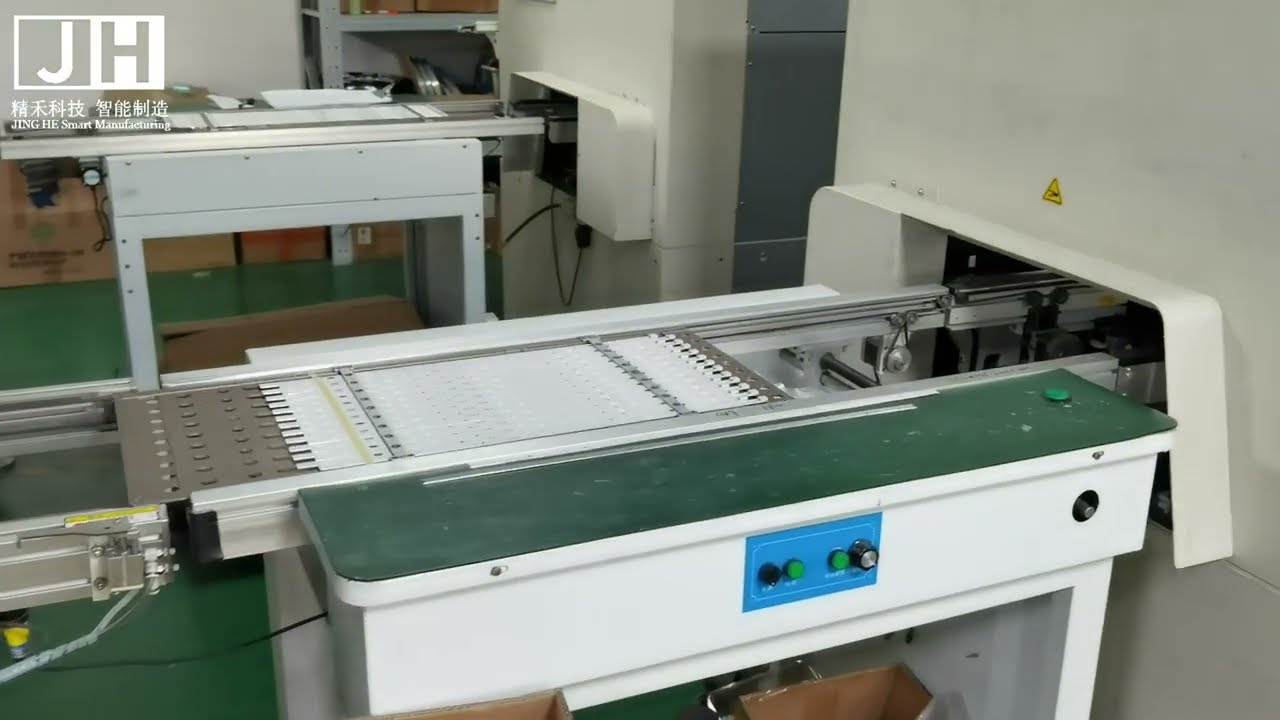
LED light strips on the conveyor of a dispensing line (still from the official @jhims video on LED light strip dispensing). The strips shown are light strips, not GOB modules, and the photograph shows no pressure gauge. The D900 machine discussed in this guide is a precision dispensing reference, not a GOB coating machine.
One more caution about the table. The LXS330 page describes its coating layer as a transparent epoxy resin, while the OPT315 material page describes a silicone sealing material. Those are two different chemistries, and a guide that picked one as "the" GOB material would be guessing.
Take the chemistry from the module's own production record and the material datasheet named on it — never from a general article, and never from a product page written about a different material. The pressure windows in the table are unaffected by that question: they are the machines' own specifications, not the material's.
When the supply pressure falls below the machine's window, the valve still opens and closes on program, but less glue comes out in the same time. The coating gets thinner, and the thinness is rarely even: the places the glue reaches last — the edges and corners of the module, and the far end of a long dispensing path — starve first.
The symptoms to look for are a coating that measures thin against the batch's own first article, visible gaps in coverage near the module edges, and modules that need a second pass to reach the coverage the first pass should have given.
A useful pattern: if the thin modules cluster at particular times of day, or appear when the line is busy and disappear when it is quiet, the air supply is a stronger suspect than the glue or the program. A program fault repeats on every module in the same place; a pressure fault follows the pressure, and the pressure follows the factory's air demand.
Do not answer thin coating by raising the pressure above the window. That trades one defect for another, and Section 4 is what the other one looks like. If the gauge reads below the window, the fix is in the air supply — the regulator, the line, or the compressor — not in the dispensing program.
When the supply pressure rises above the machine's window, the valve puts down more glue than the program asked for. The coating gets thicker, and the excess has to go somewhere: it flows toward the edges, over the keep-out zones, and onto connectors and mounting holes that must stay glue-free.
The LXS330 carries an anti-drip valve, described on its page as preventing glue overflow and dripping. That valve does its job between shots — it stops the glue from dripping when the valve is closed. It does not regulate how much glue flows while the valve is open. A machine can have a perfectly working anti-drip valve and still over-dispense on every shot if the supply pressure is too high. Do not read "anti-drip" as "pressure-proof".
Over-dispensing is also the harder of the two faults to catch at the machine, because a thick coating can look like a good coating at a glance — full coverage, no gaps. It shows up later: at the acceptance check, where the extra thickness is measured against the batch record; at the cabinet, where a thick edge interferes with seating; or at the connector, where glue that flowed where it should not have is found after the module is already assembled.
If thick coating and edge overflow appear together, check the pressure before reworking the program.
Pressure rarely fails all at once. It drifts, sags, and recovers while the line is running, which is why the coating can be right on the first module of the day and wrong by mid-afternoon. The causes below are the ones to check in order, starting with the cheapest.
Compressor cycling. A compressor that switches on and off as demand changes makes the line pressure rise and fall with it. This is the cause the dispensing guide names directly, and it is the reason its fix is a regulator and an accumulator tank rather than a new program. If the defect appears in waves that match the compressor's cycle, this is the first suspect.
Other equipment on the same air line. A GOB machine that shares its air supply with other machines sees a pressure dip every time another machine draws air. The dip is brief and the gauge may already have recovered by the time anyone looks at it — which is why Section 6 says to read the gauge while the machine is dispensing, not between batches.
Leaks at fittings. A slow leak does not stop the machine; it makes the pressure sag under load and recover at idle. The D900 preventive maintenance schedule lists inspecting all pneumatic fittings for leaks every quarter — treat that as the standing routine for any dispensing machine, not as a one-off fix after a bad batch.
A regulator that was never fitted, or was set once and never checked. A regulator set for a different machine, a regulator whose setpoint drifted, or a line with no regulator at all will all pass a casual glance and fail a measurement. The regulator's setpoint is a process setting: it belongs on the same checklist as the program name and the glue batch, not in the category of things that are "probably fine".
The gauge itself. A pressure gauge can read wrong — stuck, slow, or simply misread. If the gauge says the pressure is inside the window while the coating behaves as if it is not, verify the gauge against a known reference before concluding that pressure is ruled out.
These checks take minutes and they belong on the routine, not in the drawer. Run them at shift start, and run them again whenever a coated module fails its check.
1. Read the gauge at the machine, while it dispenses. A reading taken between batches measures the line at rest. The number that matters is the pressure at the machine during a dispensing cycle. Compare it with the machine's own window — 0.5–0.8 MPa for the LXS330, a stable 0.7 MPa for the LM661 — and write the reading down.
2. Watch for swings, not just the number. A gauge that sits at 0.7 MPa and never moves is a different finding from a gauge that swings between 0.5 and 0.8 MPa while the machine runs. The swing is the defect: it means some modules in the batch were coated at one pressure and some at another. If the pressure swings with the compressor cycle, the dispensing guide's fix applies — a dedicated regulator and an accumulator tank on the machine's supply.
3. Check the fittings for leaks. Walk the air line from the supply to the machine and check every fitting, especially after any maintenance. A fitting that hisses, a joint that was disturbed during a changeover, or a hose that was replaced without a leak test are all ordinary causes of a pressure sag that appears "for no reason".
4. Log the pressure next to the defect record. A defect record that says "thin coating, batch 12" is a complaint. A record that says "thin coating, batch 12, gauge 0.42 MPa at 14:20, compressor cycling" is a diagnosis. The batch traceability habit this series has already described — glue batch, program name, module batch range — gains one more field here: the pressure reading at the time the defect appeared. Without it, the next bad batch starts the same argument from zero.
5. Follow the machine's own pressure procedure when the glue is changed. On the LM661, the air-pressure procedure is a safety step as well as a process step: always wait for the barometer to reach 0 before opening valves, and inspect the red sealing ring for any deformation, to prevent glue leaks.
The official LM661 tutorial Part 1: Air Pressure Management & Safety walks through it. A glue change done with pressure still in the line is how a routine change becomes a leak — and a leak becomes the next shift's pressure problem.
One more check belongs to the morning routine and costs nothing: the D900 startup checklist pairs the pressure verification with a check for moisture in the air lines. Moisture is an air-quality problem rather than a pressure problem, but it rides the same air line, and a wet line corrodes the same fittings a leak check is meant to protect. Verify the pressure, then check the line is dry.
Thin or uneven coating has three families of causes, and each one asks for a different fix. The table below separates them by what you observe, so the pressure checks in Section 6 are run only when the pattern points at pressure.
| What you observe | Most likely family | Check first |
|---|---|---|
| Coating varies with the time of day, or changes when other machines start and stop | Air supply pressure | Gauge at the machine while dispensing; regulator; leaks; compressor cycle |
| Coating drifts steadily in one direction through the shift, and the shop has warmed up or cooled down | Glue temperature and viscosity | Glue temperature, stirring, mix ratio, and the time since mixing — the viscosity and temperature checks, not the air line |
| The same defect in the same place on every module, from the first module of the batch | Program or setup | Program name, fixture seating, keep-out zones, and the first coated sample before the batch runs |
| One module is wrong while its neighbours are right | That module | The bare-module inspection before coating: a fault sealed under the coating cannot be fixed by adjusting the air |
| Gauge reads inside the window, and the coating is still wrong | Not pressure — or not the gauge | Verify the gauge itself, then work the glue and program rows of this table |
The last row is the one most often skipped. A gauge inside its window does not end the investigation; it redirects it. And a gauge outside its window does not convict the air supply on its own — it is one reading, and the checks in Section 6 are what turn it into a finding.
Most pressure problems are installed, not discovered. When a GOB coating machine is being set up — a new line, a moved machine, or a machine reconnected after maintenance — the air supply deserves the same written checklist as the program and the glue.
Confirm the machine's own pressure window from its own page, and write it on the checklist: 0.5–0.8 MPa input for the LXS330, a stable 0.7 MPa for the LM661. Do not copy a number from a different machine's page. Fit a dedicated regulator at the machine with a gauge that can be read while the machine dispenses, and add an accumulator tank if the compressor cycles.
Leak-test every fitting before the first batch, and put the fitting check on the quarterly routine. Check the line for moisture at startup. And record the pressure reading with the first coated sample of the first batch, so the batch record has a baseline instead of a guess.
None of this is expensive, and all of it is cheaper than a batch of modules coated at the wrong pressure. A coating station that cannot show a stable pressure reading cannot show that its coating is repeatable — and repeatability is the whole point of automating the step.
For the wider picture of what GOB encapsulation is and where it fits, the introduction to GOB encapsulation in Mini-LED production covers the technology, the comparison with SMD and COB, and the application cases; this guide covers one variable inside it.
Our gauge reads 0.6 MPa and the coating is still uneven. Is air pressure ruled out?
No. First, 0.6 MPa means different things on different machines: it is inside the LXS330 window, below the LM661's stable 0.7 MPa point, and at the top of the D900's 0.4–0.6 MPa window — so check the number against your own machine's page.
Second, a single reading is not a verdict: read the gauge while the machine dispenses, watch whether it swings when other equipment runs, and verify the gauge itself before moving on to the glue and the program.
Can I just raise the pressure to fix thin coating?
No. Raising the pressure above the machine's window over-dispenses: thicker coating, overflow onto keep-out zones and connectors, and a batch that fails acceptance for the opposite reason. Thin coating has several possible causes — pressure, glue temperature and viscosity, mix ratio, program — and the fix is the cause, not a higher number on the regulator.
Do we need a separate compressor for the GOB machine?
Not necessarily. What matters is stable pressure at the machine, not a dedicated compressor. A shared air line is acceptable if the pressure at the machine holds steady inside its window while the machine dispenses — which is what the regulator and accumulator tank are for. If it does not hold, the air supply needs work before the program does.
Where do I find the right pressure for our machine?
On the machine's own product page or manual: 0.5–0.8 MPa input pressure for the GOB-LXS330, a stable 0.7 MPa for the LM661 inline dispenser. Do not take the number from a different machine — the D900 precision dispenser needs 0.4–0.6 MPa and the PTS330 jet dispenser needs a minimum drive pressure of 0.6 MPa, and neither number belongs on a GOB coating machine.
Bottom line: Air pressure is a coating variable, not a utility reading. Know your own machine's window, read the gauge while the machine dispenses, and write the reading next to the defect record. Most pressure problems are cheap to find and cheap to fix — but only if the pressure is measured before the glue and the program are blamed.
For the GOB coating machine, the coating material, or the dispensing equipment behind this guide, contact JHIMS at [email protected].


 Teams
 whatsapp
 telegram
