
News
Direct answer: Set up glue safety before the first GOB batch, not after the first spill. Read the glue supplier's safety data sheet (SDS) first, ventilate the coating and curing area for the ethanol released while a condensation silicone cures, keep the two components sealed and labelled, keep a spill kit and a labelled waste container at the mixing station, and isolate the dispensing machine before anyone reaches into the dispensing area. If any one of those controls is missing, do not start the batch. A clean coating record is worthless if the room, the operator, or the waste stream was not controlled.
This guide covers handling, not coating quality. It does not repeat the dust and humidity controls for coating defects, the surface-preparation checks, or the curing and handling release rules. Those are separate gates, linked at the end.
Every GOB glue has its own handling rules, and the product page alone is not enough. The JHIMS OPT315 page describes the material as a two-component condensation type silicone sealing material that cures at room temperature and releases ethanol molecules during curing. That single sentence already sets three handling duties: the curing area needs ventilation, the components must stay sealed when they are not being mixed, and nobody should assume that "room-temperature cure" means "no vapour, no precautions."
Before the first batch, obtain the supplier SDS for the exact glue in use and keep it at the mixing station, not in an office folder. The SDS, not this article, names the required glove and eye protection, the first-aid steps, the compatible spill absorbent, and any ventilation requirement for that formulation. If the SDS is stricter than anything written here, the SDS wins. If the SDS cannot be produced for the glue on the shelf, that is a stop condition: the batch does not start until the document is in hand.
Two distinctions prevent the most common misreading. First, the OPT315 page states that the product is a non-dangerous good and can be transported as a general chemical. That is a transport statement. It does not decide how waste is classified in the reader's location, and it does not mean the material can be handled bare-handed or poured down a drain. Second, the page's mixing and storage notes are process facts, not a safety assessment: component A needs stirring, component B must be shaken in a sealed container, the general mixing weight ratio is A:B = 10:1, and any ratio change needs a simple test first. Use those facts for the mixing procedure; use the SDS for the safety procedure.
Because a condensation silicone releases ethanol as it cures, vapour control belongs in the coating-room plan from the start, not as a reaction to a smell. Coating and curing are one vapour problem: glue is open during mixing and dispensing, and coated modules keep releasing vapour while they cure. Moving curing modules into a sealed cabinet to "contain the smell" does the opposite of what is wanted — it traps vapour around the modules and the next operator who opens the door.
Set the room up so that air moves through the coating and curing areas and does not stagnate in corners, inside closed cabinets, or over the mixing bench. Do not rely on smell as the control: by the time an operator notices a strong odour, the room has already been running without an effective check. The check that matters is the one written in the SDS and the site ventilation plan — whether the ventilation serving that room is running, whether its intake and exhaust paths are clear, and whether anyone has blocked them with stored modules, cartons, or curing racks.
Three practical rules follow. Keep the mixing bench and the curing racks in ventilated space, not in a closed store. Keep curing modules out of sealed containers until curing is complete and the batch has passed its normal release checks. And treat a ventilation failure as a stop signal: pause coating, finish only the safe shutdown of the machine, and do not start a new batch in a room whose ventilation is not running. This is a people control, not a coating-quality control — it is separate from the dust and humidity checks that protect the coating itself.
The product page says component A needs to be stirred "by hand or machinery." That phrase describes manual stirring as opposed to machine stirring. It does not mean bare hands. Mixing, pouring, and cleaning up uncured glue are gloved work, with the glove type and eye protection taken from the SDS for that formulation. This article deliberately names no glove material: a glove that suits one formulation is not automatically right for another, and guessing the material is exactly the kind of unverified detail that must not be published as a fact.
Make the routine boring and repeatable. Gloves and eye protection go on before a container is opened, not after the first splash. Hands are washed after handling and before eating, drinking, or touching a phone or a module face. Clothing contaminated with uncured glue comes off and is dealt with under the site procedure, not worn for the rest of the shift. An eye-wash point that nobody can find in a hurry is not an eye-wash provision: check its location during setup, before the batch, when the room is calm.
If glue contacts skin or eyes, follow the SDS first-aid section and the site procedure immediately, and record the incident even if it looks minor. Do not improvise a cleaning solvent for skin, and do not use a module-cleaning solvent on a person. The record matters for the same reason as a coating record: the next shift needs to know what happened, what was used, and whether the glue batch, the container, or the procedure needs to change.
Most glue-handling failures are labelling and storage failures, not chemistry failures. A mixing station that cannot answer "which component, which batch, mixed when, by whom" in ten seconds is not ready. The OPT315 facts fix the shape of the station: a set is 22 kg (20 kg of component A plus 2 kg of component B), the components must be stored sealed so as to avoid leakage, storage is in a cool and dry place with a storage period of 9 months under 25°C, and after that period the product should only be used after checking that there is no abnormality. Build the station around those facts.
| Station rule | What "good" looks like | Failure it prevents |
|---|---|---|
| Label every container | Component (A or B), glue batch, date opened, mixed ratio if mixed | A/B swap, wrong-ratio mix, untraceable batch |
| Keep containers sealed when idle | Lids on between pours; B shaken only in a sealed container | Leaks, contamination, vapour build-up, spills |
| Respect the set and the shelf life | 22 kg set kept as A 20 kg + B 2 kg; cool, dry, under 25°C; 9-month check before any use past that period | Expired or degraded glue entering a batch |
| Plan the lift | Trolley or lifting aid for full containers; never carry an open container across the workshop | Dropped open container, large spill, injury |
| No food, drink, or phone at the bench | Eating and drinking areas kept separate from mixing and curing | Ingestion, cross-contamination, dirty module faces |
Keep the ratio discipline visible. The general ratio is 10:1 by weight, more of component B shortens both curing time and working time, and any ratio change needs a simple test first. A ratio written on a scrap of paper that leaves with the shift is not a record. Write the ratio, the batch numbers, and the mix time on the batch record, so that a later adhesion or curing problem can be traced back to a specific mix rather than to "the glue" in general.
A production workshop. The safety setup — ventilation, a labelled mixing station, a spill kit, and a waste container — must be in place in the coating room before the first batch, in the same way a workshop is laid out before assembly starts. This is a workshop context photo, not a GOB coating room.
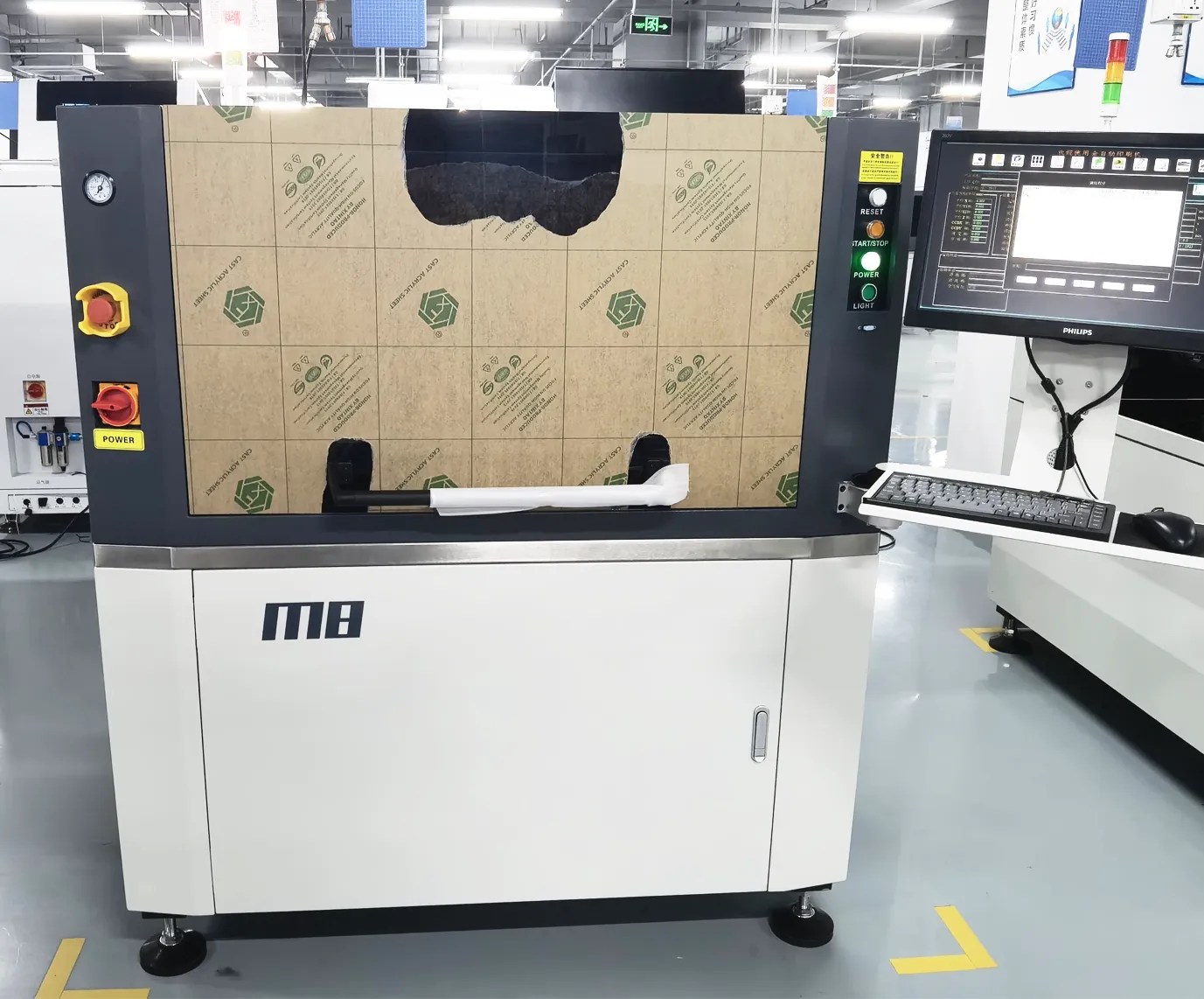
Glue safety and machine safety meet at the dispensing head. The GOB-LXS330 glue dispensing machine is a 590 kg machine with a 30 L glue capacity, an input pressure of 0.5–0.8 MPa, a rated power of AC 220 V, 50–60 Hz, 6,500 W, a running accuracy of ±0.05 mm, and a fixture size of 400 × 400 mm. Its anti-drip valve prevents glue overflow and dripping, and its liquid-level sensing alarm alerts the operator to refill or maintenance needs. Neither feature is a safety interlock, and neither makes it safe to reach under the head while the machine is powered and pressurised.
Before cleaning the head, clearing a drip, or refilling, follow the machine manual's isolation steps for that machine — power and air as the manual specifies — and confirm the head is at rest before hands go near it. The level alarm is a refill signal, not permission to open a pressurised line while a batch is running. If the manual for the machine on site cannot be found, that is a stop condition in the same way as a missing SDS: do not improvise an isolation procedure, and do not let production pressure turn a cleaning task into an unguarded reach into a moving, pressurised area.
Keep the same discipline for stored recipes. The LXS330 stores multiple parameter sets for different products, which is useful — and it is also a trap if the wrong recipe is loaded after a changeover. Loading the recipe is a quality step covered by the glue-path and first-sample gates; from a safety view, the point is simpler: confirm the loaded recipe and the glue in the line match before the head moves, so that nobody has to stop a running head mid-batch to fix a mismatch.
A spill plan that only says "clean it up" is not a plan. The order matters, because uncured glue spreads faster than it is noticed, and a hurried clean-up can push glue onto modules, into a drain, or onto the next operator's shoes. Work in this order, using the SDS-compatible absorbent named in the SDS:
| Step | Action | Do not do this |
|---|---|---|
| 1. Stop the source | Close or upright the container, stop the pour or the machine feed if it is safe to do so | Keep pouring to "finish the batch" while glue spreads |
| 2. Protect people | Gloves and eye protection on; keep others out of the spill area; ventilate | Mop bare-handed, or let foot traffic spread the spill |
| 3. Contain | Bund, dam, or absorb at the edges first so the spill does not reach modules, drains, or walkways | Hose the spill toward a drain |
| 4. Collect and segregate | Used absorbent and uncured waste go into the labelled waste container, not general trash | Mix uncured waste with cured offcuts or general waste |
| 5. Quarantine what it touched | Any module the spill reached is held, not coated over; it re-enters only through the normal pre-coating inspection | Coat over a splashed module and hope the layer hides it |
| 6. Record | Glue batch, amount, area, absorbent used, modules held, and what will change | Clean up silently and leave the next shift to rediscover the problem |
A spill kit is only a kit if it is complete and reachable. Check it during setup: absorbent, bags, gloves, eye protection, and a labelled waste container, all in the coating room, not in a distant store. A kit with no bags, or a waste container with no label, will fail at the exact moment it is needed. If the kit is incomplete, that is a setup failure to fix before the batch, not a note to fix "later."
Segregate waste at the point it is created. Uncured glue, mixed glue past its working time, used absorbent, and contaminated wipes go into the labelled uncured-waste container. Cured offcuts and cured test pieces are a different stream. Mixing the streams makes the whole container harder to handle, harder to describe to a waste handler, and impossible to trace back to a batch if something goes wrong later.
Storage follows the same logic as the mixing station: cool, dry, sealed, labelled, and under 25°C for OPT315, with the 9-month period checked before use. Do not store glue containers where curing racks, heaters, or direct sun can warm them, and do not use heat to "speed up" curing or to deal with slow glue. The product page is explicit that heating curing is generally not recommended, because it can cause pinholes or bubbles on the surface and inside and can affect appearance and sealing. A shortcut that damages the coating and increases vapour release in a warm room helps nobody.
For final disposal, follow the SDS and the waste rules that apply in the factory's location. This article names no waste code and no disposal route, because both depend on the formulation and the jurisdiction, and both must come from the SDS and the local rules — not from a general article. What the article does fix is the factory's own duty: label the waste with the glue and batch, keep it sealed, keep it out of drains and general trash, and keep a record of what left the room and when.
Run this checklist before the first batch of a shift, and again after any spill, ventilation failure, or glue change. Any "no" is a stop, not a warning to carry on carefully.
| Check | Pass means |
|---|---|
| SDS at the station | SDS for the exact glue in use, readable, at the mixing station |
| Ventilation running | Coating and curing ventilation running, paths clear, no blocked exhaust |
| PPE available and correct | SDS-specified gloves and eye protection present, in size, undamaged |
| Containers labelled and sealed | A/B, batch, date opened; lids on when idle; storage cool, dry, under 25°C |
| Spill kit complete | Absorbent, bags, gloves, eye protection, labelled waste container, all in the room |
| Machine manual available | Isolation steps known before cleaning or refilling the dispensing head |
| Waste streams separated | Uncured waste container labelled and separate from cured offcuts and general trash |
Record the checklist result on the batch record, with the operator's name and the time. A checklist that is run but not recorded will not survive a shift change, an audit, or a dispute about a failed batch. The record does not need to be long: seven lines, seven passes, one signature. What it must not contain is a pass that was not actually checked.
Does "non-dangerous goods" for transport mean the glue is safe to handle bare-handed?
No. That phrase on the product page describes transport classification. Handling still follows the SDS: gloved work, eye protection as specified, sealed storage, and no bare-hand mixing or clean-up.
Can we heat-cure to finish faster and reduce vapour time?
No, not on the basis of this product page. Heating curing is generally not recommended for OPT315 because it can cause pinholes or bubbles and affect appearance and sealing. If a faster cure is needed, that is a glue-selection and supplier question, not a heater setting to improvise.
What if glue contacts skin or eyes?
Follow the SDS first-aid section and the site procedure at once, and record the incident. Do not improvise a solvent for skin, and do not delay first aid to finish a batch.
What if a spill reaches a bare module?
Hold the module. Do not coat over the splash. It re-enters production only through the normal pre-coating inspection, which is the gate that decides whether a bare module is fit to coat at all.
Bottom line: Glue safety is a setup discipline, not a reaction. SDS in hand, ventilation running, containers labelled and sealed, spill kit complete, waste segregated, and the machine isolated before cleaning — check all seven before the first batch, and stop on any failure. The coating will still be there after the setup is fixed; an unrecorded spill, an unlabelled container, or an unguarded reach into a pressurised head will not undo itself.
Related JHIMS procedures: inspecting the bare LED module before coating, curing, handling and storage after coating, and reworking a coated module. For the glue itself, see OPT315 LED display potting glue.
For technical advice on the GOB-LXS330 glue dispensing machine or the glue handling setup for your coating room, contact JHIMS at [email protected] with your module size, glue type, and batch size, so the advice can be matched to your actual process rather than given in general terms.


 Teams
 whatsapp
 telegram
