
News
DIRECT ANSWER: A GOB coating does not automatically make a LED module run cooler, and it does not automatically make it run hotter either. Coating adds a continuous layer over the front of the module, while most of a module's heat still has to leave through the board and into the cabinet. Whether a coated module runs hotter than the same module uncoated is therefore a question to be measured on your own module, at your own drive setting, in your own cabinet — not a claim to accept from a product page sentence. Before committing a batch, run one coated module and one uncoated module of the same type side by side, at the same brightness and drive setting, in the same cabinet arrangement, until both reach a steady state, and compare them at the same measurement points. If the coated module runs within the limits in its own datasheet and the customer's acceptance standard, coating has passed its thermal gate. If it does not, the batch does not proceed on the strength of a protection argument alone.
This guide covers only the thermal question that sits between coating and cabinet assembly: what the coating changes, what it does not change, how to compare a coated module with an uncoated one fairly, and what to check in the cabinet before a coated batch is released. It does not repeat the pre-coating inspection of the bare module, the choice of coating material, the coating program, the cure and handling rules after coating, or the repair-or-scrap decision for a coated module. Each of those has its own procedure, and this guide assumes the module entering the thermal check has already passed them.
A LED turns only part of its input power into light. The rest becomes heat at the LED package, and that heat has to go somewhere. On a typical display module the main path is through the package into the board, through the board's copper and substrate, and then into the module frame, the cabinet structure, and the air inside and around the cabinet. The front face of the module — the face the viewer sees — is not, for most modules, the main heat exit. It is the face that coating covers.
That single fact frames the whole thermal question correctly. Coating changes the front surface: it seals the LEDs, the driver components, and the solder joints under one continuous layer, and it changes what air, dust, and moisture can reach on that face. It does not, by itself, change the board, the frame, or the cabinet. A thermal problem that lives in the cabinet — blocked ventilation, a fan that has stopped, a cabinet baking in direct sun — will not be fixed by coating, and a coating problem will not be found by checking the cabinet alone. The two have to be checked separately, and neither check substitutes for the other.
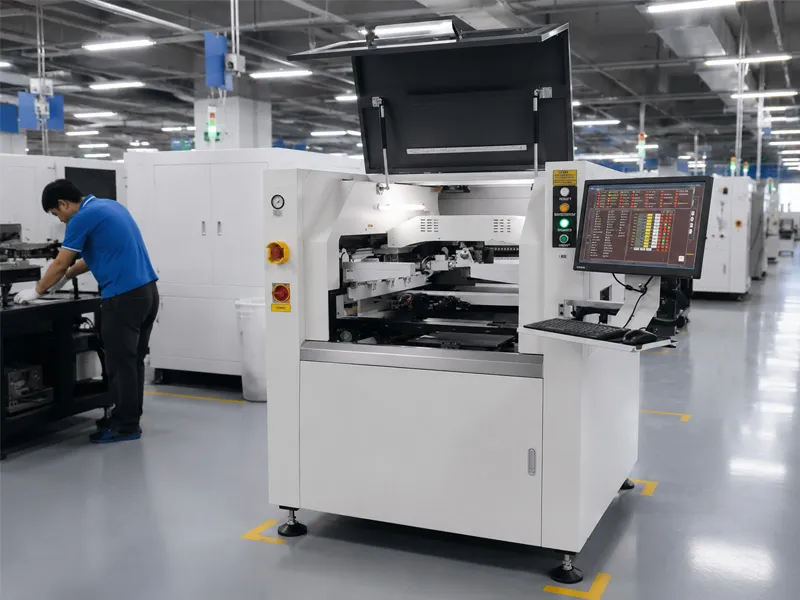
A production workshop where SMT modules are handled. This is a context photo, not a GOB thermal test and not a photograph of a coated module.
Coating can change the thermal picture in three ways, and each one is a question, not a conclusion. First, the layer sits between the LED face and the air in front of the module, so it adds one more interface on the front path. Whether that interface matters depends on how much heat was leaving through the front in the first place, which varies by module design. A guide that declares the effect large or negligible for all modules would be guessing.
Second, coating changes the module's surface condition. A sealed front face is less exposed to dust and moisture, and it is easier to wipe clean, but it also cannot be inspected or repaired by direct access any more. A hot spot that could once be seen and touched on a bare module can now only be inferred from its effect on brightness, colour, or a measurement taken elsewhere. Thermal checking after coating therefore has to rely on planned measurement points, not on handling the face.
Third, coating and board materials respond to temperature change together. Any two materials joined in a layer expand at different rates when heated and cooled, and repeated heating and cooling cycles stress the join. That is a general materials fact, not a prediction about any particular coating: whether it matters for a given module depends on the coating material's own datasheet — its stated operating temperature range and its behaviour over temperature — and on the temperature swings the module will actually see in service. The datasheet, not this guide, sets those limits, and a coating whose datasheet does not state them has not been cleared for a thermally demanding application by this guide.
What coating cannot do is change the module's own power. It does not reduce the heat the LEDs generate at a given drive setting, and it does not increase the cabinet's ability to remove heat. Any claim that a coating, by itself, "dissipates heat" for the module should be treated as an unproven marketing sentence until it is backed by a measurement on the module in question. This guide deliberately does not adopt such a sentence as a fact: the product page for the coating machine used in this series does contain a thermal-management sentence of that kind, and it is listed in the delivery record as a single-source marketing claim, not used as evidence here.
The only comparison that answers the thermal question is a controlled one. Take two modules of the same type, from the same batch if possible: one coated under the normal program, one left uncoated. Run both at the same drive setting and the same displayed content, in the same cabinet arrangement, in the same room, at the same time. Measure both at the same points, and keep running until the readings stop drifting — a reading taken five minutes after switch-on describes warm-up, not operation.
Choose measurement points that the module's own procedure allows and that can be repeated on every later batch: for example, a point on the back of the board, a point in the cabinet air near the module, and a driver area only if the module documentation identifies it as a measurement point. Do not measure on the coated face itself and compare it with the bare face as if the two surfaces were the same thing; they are not, and the comparison would prove nothing about the module's operating temperature. Record the ambient temperature alongside every reading, because a comparison made on two different days, in two different rooms, is not a comparison at all.
| Comparison element | Must be the same for both modules | Why it matters |
|---|---|---|
| Module type and batch | Same model, same batch where possible | Different modules differ before coating is even considered |
| Drive setting and content | Same brightness, same test pattern | A brighter module generates more heat, coated or not |
| Cabinet and position | Same cabinet arrangement, same position type | Top, edge, and centre positions in a cabinet do not share the same air |
| Ambient and run time | Same room, same run, to steady state | Warm-up readings and different ambients hide the coating effect |
| Measurement points | Same points, same instrument, same method | A different point measures a different part of the heat path |
Judge the result against the module's own datasheet limits and the customer's acceptance standard, not against a threshold invented for this guide. This guide sets no temperature number, because the number that matters belongs to the module and its application. What it does set is the decision rule: if the coated module stays within those limits at the intended drive setting, in the intended cabinet, the thermal gate passes. If it exceeds them, or if the comparison cannot be run fairly, the batch does not pass on a protection argument, a supplier sentence, or a single warm-up reading.
Heat is also a process temptation after coating. A batch waiting for cure looks like a batch that could be hurried with warmth, and a module that will run hot in service looks like a module that should be "proven" with heat. Both temptations should be checked against the coating material's own instructions before any heat is applied.
The coating material used as the worked example in this series illustrates why. Its OPT315 potting and sealing material product page states that it cures at room temperature, that a higher ambient temperature speeds curing and shortens working time, and that heating to cure is generally not recommended because it can produce pinholes or bubbles on the surface and inside, affecting appearance and sealing. That is a material instruction, not a thermal test result, and it cuts in one direction only: heat applied to hurry curing can damage the coating it was meant to finish. A cure shortcut that the material datasheet warns against is not a thermal check; it is a defect introduced on purpose.
The same discipline applies to any deliberate heat exposure of a coated module, including a burn-in or a high-temperature run. If the module datasheet and the coating datasheet both allow the exposure, and the acceptance criteria for after the exposure are written down before it starts, the test can proceed. If either document is silent, or if the criteria are to be decided after seeing the result, the exposure is not a test; it is an experiment on a saleable batch, and it should not be run on one.
A coated module does not operate alone. It operates in a cabinet, next to other modules, behind a front surface, and sometimes in direct sun. The cabinet check therefore belongs in the thermal gate, and it has to be done with the coated module in place, not on an empty cabinet.
Check, in order, whether ventilation openings are open and unobstructed in the as-installed arrangement, whether any fan or forced-air path the cabinet design relies on is actually running, whether modules at the top, the edges, and the centre of the cabinet see the same air or different air, and whether direct sun or a nearby heat source changes the cabinet's air temperature from the room temperature recorded in the comparison. A module that passes in open air on a bench and fails in a sealed, sunlit cabinet has not failed its coating; it has failed its installation, and the fix belongs to the cabinet, not to the coating program.
Also check the neighbours. A coated module installed next to uncoated modules, or next to modules of a different type, will not share their thermal behaviour, and a screen judged as one surface can hide a single hot position. When a later fault is reported as "the screen runs hot", the first question should be which position, which module, and whether that module was part of the coated batch that passed the comparison in Section 3. Without that record, a cabinet problem will be argued as a coating problem, and a coating problem will be argued as a cabinet problem.
After coating, certain symptoms should trigger investigation, and none of them should be diagnosed from the symptom alone. A local brightness drop, a colour shift in one area, a driver that shuts down and recovers, a coating that discolours, or a coating edge that lifts after temperature swings are all signals to stop and investigate — not verdicts that coating caused them, and not reasons to recoat, rebake, or replace on sight.
| Signal after coating | First check | What not to do first |
|---|---|---|
| Local brightness or colour change | Compare with the same module's pre-coating record and with a neighbouring module at the same drive setting | Do not adjust drive or recoat before the comparison |
| Driver shutdown and recovery | Check cabinet air, ventilation, and the module's own protection behaviour in its documentation | Do not blame coating before the cabinet check in Section 5 |
| Coating discoloration or edge lifting | Check the coating datasheet's temperature range and whether the module saw heat beyond it, including any hurried cure | Do not heat the module again to "reseat" the coating |
| One hot position in a screen | Identify the position, the module, and its batch record before touching the screen | Do not treat the whole screen as one thermal result |
In each case, the investigation follows the same order used elsewhere in this series: confirm the fault belongs to the module and not to the test setup or the cabinet, check the record for what was known before coating, and only then decide whether the module goes to repair, to hold, or back into service. A thermal symptom investigated in the wrong order — coating blamed before the cabinet is checked, or a module replaced before its position is identified — teaches the line the wrong lesson, and the next batch will repeat it.
A thermal gate without a record is an opinion that cannot be rechecked. Record, for the comparison batch, the module type and batch, the coating material and program, the drive setting and displayed content, the cabinet arrangement and each module's position, the ambient temperature, the measurement points and instrument, the steady-state readings for the coated and the uncoated module, and the datasheet limits they were judged against. Keep that record with the batch record, not in a separate file that no one opens when a screen is questioned in the field.
Also record what was not measured. If no coated-versus-uncoated comparison was run, if the cabinet check was skipped, or if a datasheet limit was missing, write that down as an open item, not as a pass. A batch released with a written open item can still be managed; a batch released with an unwritten gap will be defended, later, as if the gap had never existed.
The thermal gate matters because the coating it judges is applied repeatably. The GOB-LXS330 glue dispensing machine for LED displays, JHIMS's dedicated machine for this coating step, lists a running accuracy of ±0.05 mm, a 400 × 400 mm fixture, teaching programming, parameter storage for different products, a Panasonic PLC with touchscreen control, an anti-drip valve, and a liquid level sensing alarm, with a 30 L glue capacity and an input pressure range of 0.5–0.8 MPa. Those specifications describe the coating step, not the thermal result: a repeatable coating means the comparison in Section 3 is comparing coating against no coating, not one uneven coating against another.
For dispensing precision as a reference point, the JH-D900 precision dispensing machine lists a repeat accuracy of ±0.02 mm with a CCD vision system and a dispensing area of 860 × 400 mm. The D900 is a precision dispensing machine, not a GOB machine, and it is cited here only as a precision reference; its numbers are not transferred to the GOB machine. JHIMS does not currently list a dedicated GOB machine page on its commercial site, so the GOB-LXS330 product page is the single source for that machine's specifications and should be read as such.
Does GOB coating make a LED module run cooler?
Not proven by coating alone. The product page sentence sometimes quoted for this is a marketing claim, not a measurement on your module. Run the coated-versus-uncoated comparison in Section 3 and judge it against the module's own datasheet limits.
Can I cure a coated module faster with heat?
Only if the coating material's own datasheet allows it. For the material used as the example here, heating to cure is generally not recommended because it can cause pinholes or bubbles. Check the datasheet for the material actually used, before applying heat.
Should the thermal check be done on the bench or in the cabinet?
Both, in that order, but the cabinet result governs release. A bench comparison isolates the coating effect; a cabinet check in the as-installed arrangement catches ventilation, position, and sun effects that a bench test cannot see.
What if no datasheet temperature limit exists for my module?
Then the thermal gate cannot pass on numbers, and that gap must be recorded as an open item and resolved with the module supplier or the customer before the batch is committed. Do not invent a limit to close the gate.
Bottom line: Treat coating as a thermal unknown until it is measured, not as a thermal benefit or a thermal penalty. Compare coated against uncoated with everything else equal, check the cabinet in its installed state, do not hurry curing with heat the material datasheet warns against, and record the comparison with the batch. A batch that passes that gate can be defended in the field; a batch released on a protection argument alone cannot.
For related procedures in this series, see the pre-coating inspection guide, the curing and handling guide, and the coated-module rework decision guide on this site. For technical enquiries, contact JHIMS at [email protected].


 Teams
 whatsapp
 telegram
