
News
Direct answer
Automate lens feeding when the placement head waits for lenses, when operators spend their shift hand-feeding and re-orienting lenses, or when a new lens variant forces a long changeover. Size the feeder on the placement line’s sustained lens demand — not on a headline seconds-per-lens figure — and prove it with your own lens samples before you order. On TV backlight strips the job is usually high volume and few variants; on LED lighting panels and bars it is usually more variants and shorter runs, so changeover and multi-channel flexibility matter more than raw speed alone.
Manual feeding rarely fails loudly. It fails as a slow leak: the placement machine pauses, an operator tops up a tray, a lens arrives upside down, and the head rejects it or places it badly. The symptoms below are the practical triggers for automation. If two or more apply to your line, a feeder study is worth doing before the next capacity increase.
None of these symptoms, on its own, proves that a vibratory bowl feeder is the right answer. A tray system, a different pickup routine, or a change in lens packaging can sometimes fix a single symptom. Automation earns its place when the feeding step, not the placement step, sets the line rate — and when the lens mix keeps that problem coming back.
Buyers often ask for “a lens feeder” as if one specification fits both products. The lens is similar; the production job is not. The table below states the usual difference in plain terms. Your own mix may sit between the two columns, which is exactly why the sizing step in Section 4 uses your numbers rather than a generic rating.
| Factor | TV backlight strips | LED lighting panels and bars |
|---|---|---|
| Typical run | Long runs of the same strip; many identical lenses per strip. | Shorter runs; more lens types across orders. |
| What limits output | Sustained feed rate and jam-free running over a long shift. | Changeover time and the ability to switch lens types without rework. |
| Feeder priority | Stable, continuous supply at the pickup point; large bowl capacity. | Multi-channel or quick-change tooling; stored settings per lens type. |
| Orientation risk | One lens geometry repeated, so a single well-tuned track can run for hours. | Several geometries in rotation, so each variant needs its own proven track setting. |
| What to check first | Does the feeder keep up for a full shift without refill stops? | How long does a real changeover take, including first-good-piece checks? |
A feeder that wins a short demo on one lens type can still lose on a lighting line if its changeover is slow. Conversely, a flexible multi-channel feeder is wasted money on a single-variant backlight line if its per-channel rate cannot hold the strip rate. State which column you are buying for before comparing quotations.
Most automated lens feeders for SMT lines follow the same five functions, whatever the brand. Understanding them helps you ask better questions than “how fast is it?”
The weak link is rarely the bowl alone. It is usually the handover: bowl-to-track transition, track-to-pickup alignment, or the sensor logic that advances the queue. When you trial a feeder, watch those three points for a full run, not just the first ten lenses.
A headline figure such as “0.5 seconds per lens” describes one channel under favourable conditions. Your line needs a sustained, oriented supply at the pickup point, including refill, rejects, and placement pauses. Use this calculation with your own numbers:
Step 1 — Lens demand
Lenses per hour = strips or boards per hour × lenses per strip or board.
Step 2 — Single-channel theoretical rate
Lenses per hour per channel = 3,600 ÷ seconds per lens.
Step 3 — Channels needed
Channels = lens demand ÷ sustained rate per channel, rounded up. The sustained rate must come from a trial with your lenses, not from Step 2 alone.
Worked arithmetic (illustrative, not a test result). If a line needs 7,200 lenses per hour, a channel rated at 1.0 second per lens gives 3,600 lenses per hour in theory, so two channels are the theoretical minimum. At 0.5 seconds per lens, the theoretical rate is 7,200 per hour, so one channel is the theoretical minimum. In both cases the theoretical minimum is not an order quantity: allow for refill time, rejected lenses, and the fact that a single channel leaves no margin when it jams. Buyers who order exactly the theoretical minimum are the ones who discover the bottleneck again at full production.
Four questions turn this arithmetic into a real specification:
The table below is general engineering guidance for diagnosis. It does not describe any single supplier’s machine, and it does not replace a trial with your lenses.
| Symptom | Likely cause to check first | Check |
|---|---|---|
| Lenses arrive flipped or rotated | Track tooling does not match the foot pattern or reflecting face; vibration too strong. | Run each lens variant separately; check orientation at the pickup point, not only at the bowl exit. |
| Frequent jams at the track | Track width, bowl level, or mixed lens sizes in one batch. | Check bowl fill level and confirm the batch contains one lens type only. |
| Scratched optical surfaces | Lens-on-lens contact in the bowl; hard track surfaces; dirty tracks. | Inspect track surfaces and cleaning routine; check whether a softer or coated track is offered. |
| Feed rate falls during the shift | Bowl level falling, vibration drifting with load, or sensor fouling. | Log rate against bowl level over a full hour; clean sensors before re-testing. |
| Long changeover between lens types | Track or bowl change needs tools; settings are not stored per lens type. | Time a full changeover, including first-good-piece inspection, not just the mechanical swap. |
| Placement head misses picks | Pickup position drift; queue gap too small; feeder-to-machine alignment moved. | Check feeder mounting and pickup position after a shift, not only after installation. |
Two mistakes repeat across lines. The first is accepting a demo rate measured on the easiest lens in the range. The second is signing off on a feeder before testing the changeover: the machine that feeds beautifully on Monday’s lens and takes an hour to convert to Tuesday’s lens has not solved a lighting line’s problem.
A vibratory bowl feeder is the common choice for loose lenses, but it is not the only method. The comparison below helps you rule methods out for the right reasons.
| Method | Fits best when | Limitation to weigh |
|---|---|---|
| Vibratory bowl feeder | High-volume loose lenses; continuous supply to a placement head. | Track tooling is lens-specific; very fragile or very large optics may need a different presentation. |
| Tray feeding | Low volume, fragile, or large lenses; strict orientation control per piece. | Tray handling and reloading interrupt continuous running; slower for high-volume strips. |
| Manual feeding | Prototypes, very low volume, or one-off lens types. | Rate and orientation depend on the operator; it becomes the bottleneck as volume rises. |
| Vision-assisted flexible feeding | Many lens types in small batches where hard tooling per type is impractical. | System cost and integration effort are higher; validate pick rate on your own mix before committing. |
If your lenses arrive in trays from the supplier and must stay in trays for cleanliness reasons, say so at the start of the discussion. Converting tray presentation to bulk bowl feeding is a process decision, not just a machine purchase.
Ask the supplier to run a written acceptance test on samples you send, covering every lens type you plan to run — not a single showcase lens. Record the results in the same format for every supplier you compare.
A supplier who will only demonstrate on its own sample lenses has not demonstrated your application. The test above costs time before the order; it saves far more time after installation, when a line stop costs production rather than meeting time.
Where the job in Sections 2 to 4 points to a multi-channel vibratory bowl feeder, JHIMS’s DPS-2 is the relevant product in its range. It feeds loose optical lenses to SMT pick-and-place lines, with a circular bowl for bulk movement and a linear track for oriented supply to the pickup point. The specifications below are taken from the JHIMS DPS-2 product page; confirm your lens variant against them, and use the acceptance test in Section 7 for any value that depends on your lens geometry.
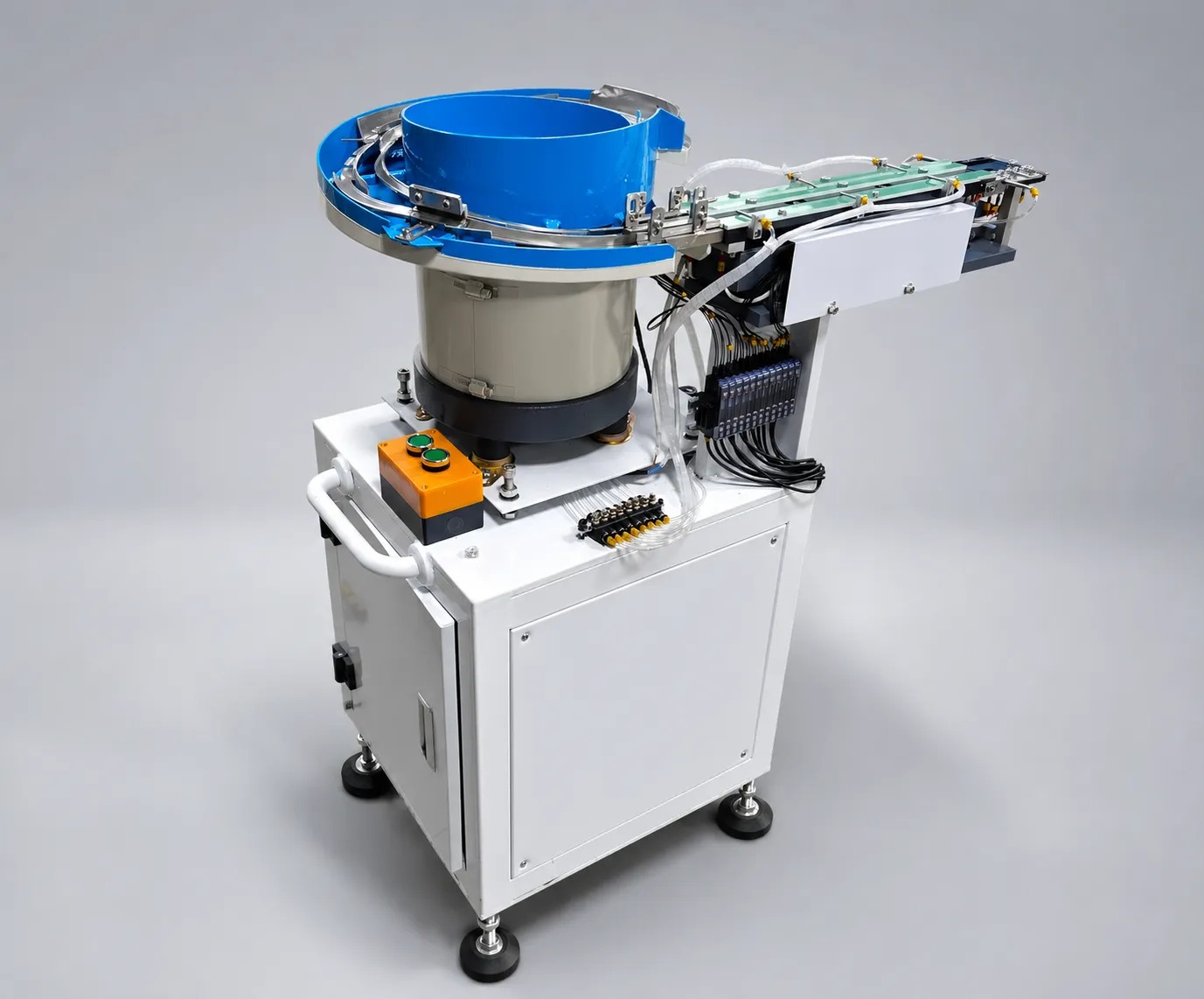
JHIMS DPS-2 lens vibratory feeder: circular bowl, linear track, and control cabinet.
| Specification | DPS-2 product-page value |
|---|---|
| Lens diameter range | 3 mm to 25 mm |
| Lens types supported | Inner/outer three-feet and four-angle reflection lenses |
| Transfer speed | 0.5 to 1 second per lens, per channel |
| Disc tracks | 2 tracks standard, expandable to 10 |
| Bowl alignment tolerance | ±1 mm, based on lens shape and pin dimensions |
| Control | PLC control with 7-inch HMI touchscreen; up to 50 preset profiles |
| Changeover (product page) | Under 5 minutes with preset profiles and tool-less track adjustment |
| Air supply | 0.4 to 0.6 MPa |
| Noise level | Under 65 dB(A) at 1 metre |
| Dimensions / weight | 1050 × 700 × 750 mm; approx. 130 kg |
| Power supply | 220V AC, 50–60 Hz, single phase |
| Compatible placement brands (product page) | Hanwha, Yamaha, JUKI, Samsung, Hitachi, Fuji |
Two limits deserve a direct statement. First, the 0.5 to 1 second figure is a per-channel transfer figure, not a promised line rate: your sustained rate depends on lens geometry, bowl level, and pickup timing, which is why Section 7 insists on a sample trial. Second, a feeder does not fix a bad lens batch. Mixed sizes, damaged feet, or contaminated lenses in one batch will jam or mis-orient in any bowl system; incoming lens inspection stays part of the process. For full specifications, see the JHIMS DPS-2 lens vibratory feeder product page. JHIMS’s related TV backlight lens-feeding case page on jhims.com is here, listed for background reading; this guide deliberately does not repeat that page’s case figures.
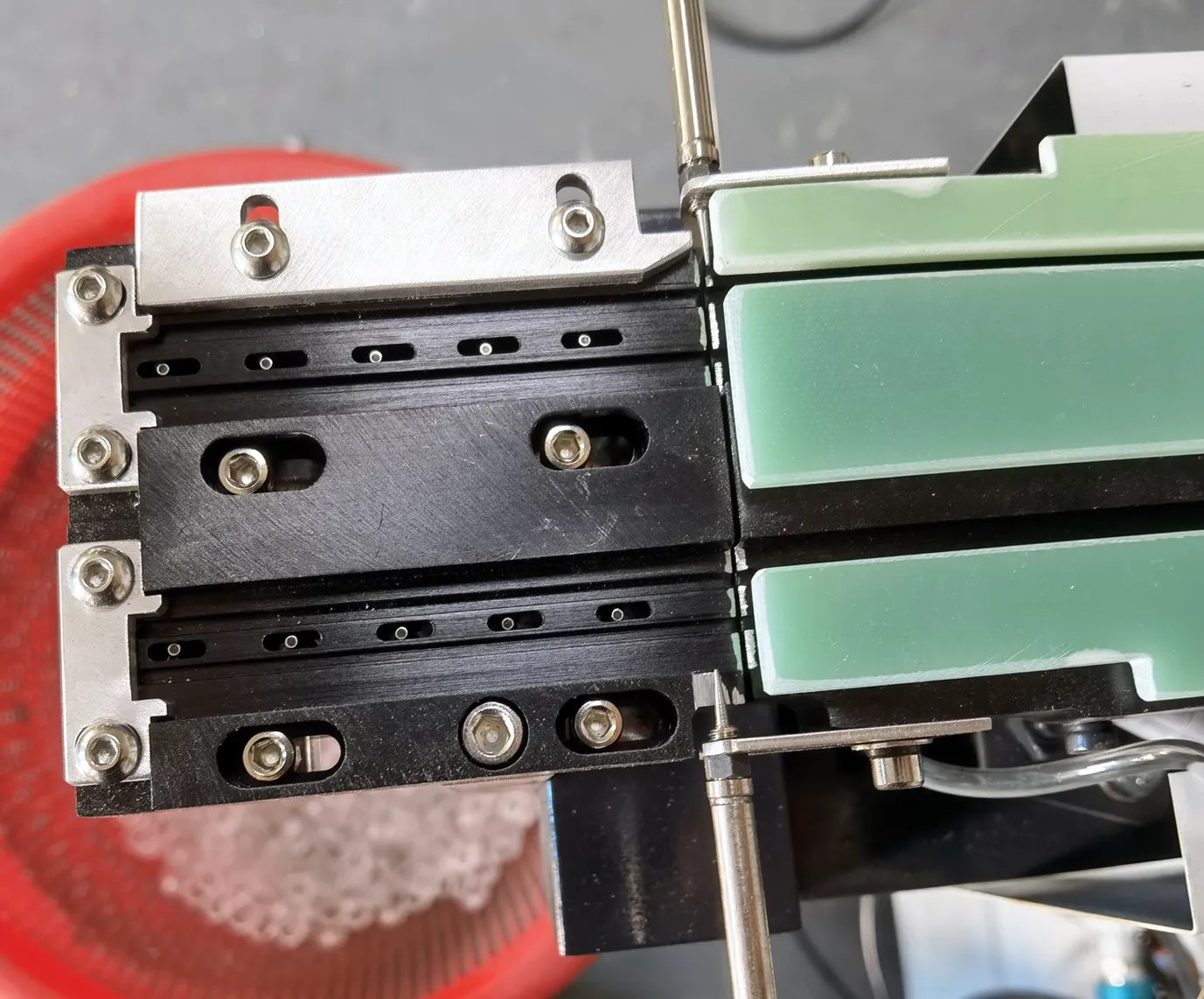
Close-up of the DPS-2 pickup platform and linear track: the point where oriented lenses meet the placement head.
How many channels do I need?
Use Section 4: divide your sustained lens demand by the sustained rate per channel measured with your lenses, then round up and keep margin for jams and refills. Do not order on theoretical rate alone.
Can one feeder handle several lens types?
Only if each type has a proven track setting and, ideally, a stored profile. Test every type you plan to run, including changeover time, before committing.
Will a bowl feeder scratch optical lenses?
Scratching depends on lens material, track surface, bowl level, and cleanliness. Inspect lenses after a full-hour trial run under proper light; do not accept a short demo as proof.
Does a faster feeder always raise line output?
No. If placement, reflow, or inspection limits the line, a faster feeder only moves the bottleneck. Size the feeder to placement demand with margin, then check the next constraint.
What should I send a supplier before asking for a quotation?
Lens drawings or samples for every type, lenses per strip or board, strips or boards per hour, placement machine brand and model, and your target changeover time. Without those, any quotation is a guess.
To discuss lens feeding for a TV backlight or LED lighting line, contact JHIMS at [email protected] with your lens types, lenses per board or strip, and placement machine model.


 Teams
 whatsapp
 telegram
