


How Auto Soldering Technology Transforms PCB Assembly in 2026
As global electronics manufacturing accelerates toward full automation, one critical process continues to demand a smarter approach: post-soldering. With the global SMT equipment market surpassing $4.03 billion in 2025 (QYResearch) and projected to grow at a 4.71% CAGR through 2032, the pressure to eliminate manual soldering bottlenecks has never been greater. This article explores how automatic soldering technology — from desktop soldering robots to inline selective soldering systems — is reshaping PCBA quality, throughput, and cost structure across automotive, industrial, and consumer electronics in 2026.
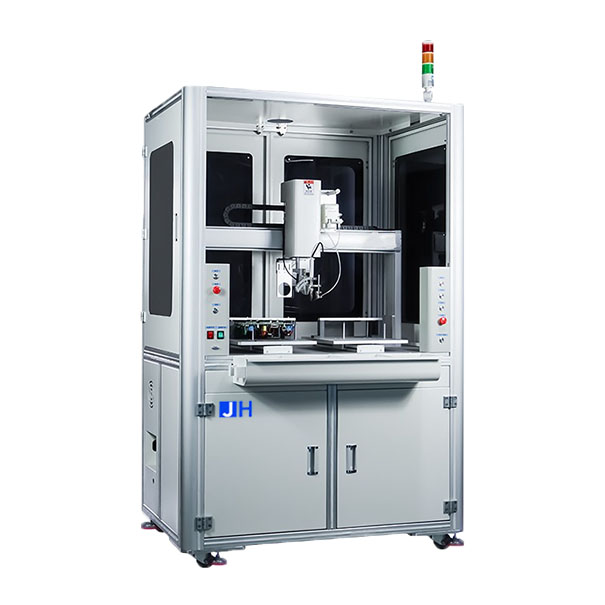
The Current State of PCBA Soldering: Key Pain Points in 2026
The electronics manufacturing industry is under unprecedented pressure from three converging forces: escalating labor costs in traditional manufacturing hubs, tightening quality requirements driven by automotive and medical standards, and the exponential growth of high-density PCB designs driven by AI computing and 5G infrastructure. Within this landscape, the post-soldering station — where through-hole (THT) components such as connectors, electrolytic capacitors, transformers, and power modules are soldered onto mixed-technology boards — remains one of the least automated segments of the SMT line.
Industry surveys and production floor audits consistently reveal five persistent challenges:
- Inconsistent Manual Soldering Quality: Even experienced operators produce variations in solder joint geometry, wetting, and fillet height. In automotive electronics production where zero-defect policies under IATF 16949 apply, manual soldering requires 100% visual inspection and rework rates of 3-8% are not uncommon.
- Health & Safety Compliance Gaps: Prolonged exposure to lead-free solder fumes — particularly flux activators and rosin-based compounds — poses respiratory risks. A growing number of jurisdictions are mandating fume extraction and automated soldering alternatives to minimize operator exposure.
- Throughput Bottlenecks at the Soldering Station: A skilled operator can complete approximately 200-400 solder joints per hour for fine-pitch THT work. By contrast, a modern PCB soldering robot with dual-platform configuration achieves 800-1,500 joints per hour, maintaining identical quality across 24/7 operation.
- Rising Cost of Skilled Labor: The global shortage of certified IPC soldering technicians has driven average hourly rates for experienced operators 25-40% higher compared to 2020 levels across major manufacturing regions, from Shenzhen to Guadalajara.
- Thermal Damage from Wave Soldering: Traditional wave soldering exposes the entire PCB underside to 260°C+ molten solder, risking warpage, delamination, and thermal shock to sensitive SMT components already mounted during reflow. Selective automatic soldering eliminates this risk by targeting only THT pin locations.
Auto Soldering Technology: Breakthroughs Reshaping the Industry
The evolution of auto soldering machines over the past five years mirrors the broader Industry 4.0 transformation: from single-axis mechanical fixtures to multi-axis robotic systems with integrated vision, programmable logic, and IIoT connectivity. In 2026, three technology pillars define the state of the art in PCBA soldering automation.
1. Multi-Axis Precision Motion Control
Modern automatic soldering systems employ high-precision servo or closed-loop stepper motors driving 3-axis, 4-axis, or even 5-axis motion platforms. Repeatability has improved from ±0.1mm (2018-era machines) to ±0.02-0.03mm in current-generation models — a critical threshold for soldering fine-pitch connectors (0.5mm pitch and below) found in automotive ADAS controllers and IoT communication modules. This level of precision virtually eliminates solder bridging and insufficient fillet defects when combined with proper temperature profiling.
2. CCD Vision-Guided Soldering
Integrating CCD cameras with real-time image processing has transformed the PCB soldering robot from a "blind" programmable machine into an intelligent system capable of adaptive correction. Before each soldering cycle, the vision module captures the PCB fiducial marks, compares them against the programmed coordinates, and compensates for:
- Thermal expansion of the PCB substrate during reflow
- Minor fixture misalignment from manual loading
- Board warpage in large-format PCBs (up to 530mm)
Key Technical Parameters: Traditional vs. 2026 Next-Generation
| Parameter | Traditional Manual Soldering | 2026 Auto Soldering Robot |
|---|---|---|
| Positioning Repeatability | Variable (operator-dependent) | ±0.02-0.03mm |
| Temperature Accuracy | ±15°C (unregulated iron) | ±2°C (closed-loop PID) |
| Joints per Hour | 200-400 |
800-1,500 (single tip) 2,500+ (multi-head) |
| Defect Rate (FPY) | 92-96% | >99.5% |
| Operator Skill Requirement | IPC certified, 6+ months training | Basic programming, 2-5 days training |
| 24/7 Continuous Operation | Not feasible (shift limits) | Fully supported |
3. Dual-Platform Architecture & Inline Integration
One of the most significant productivity innovations in 2026 automatic soldering systems is the dual-platform alternating work mode. While one platform executes a soldering program, the operator or upstream conveyor loads/unloads the second platform. This eliminates non-productive time between batches, effectively increasing throughput by 40-60% without additional floor space. For high-mix production environments — common in contract manufacturing — the dual-platform design maintains flexibility while approaching the output of dedicated single-product lines.
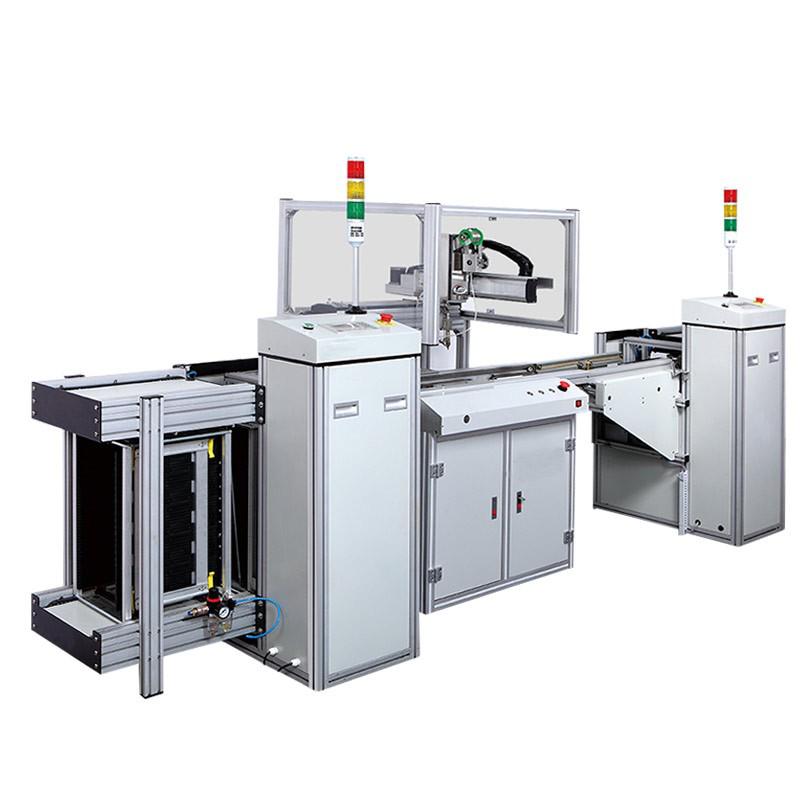
Additionally, inline selective soldering machines now integrate directly into conveyorized SMT lines, receiving boards from upstream AOI inspection and passing completed assemblies downstream to functional test stations — a fully lights-out capable soldering cell.
Productivity Gains: Quantified Impact Analysis
For a mid-volume electronics manufacturer processing 500 mixed-technology PCBs per shift, replacing three manual soldering stations with two automatic soldering machines yields measurable improvements:
- Throughput increase of 65%: From approximately 1,200 joints/hour (3 operators × 400) to over 2,000 joints/hour (2 machines × 1,000+) with dual-platform configuration.
- Rework reduction of 80%: First-pass yield improvement from 94% to >99.5% directly eliminates the majority of rework labor and consumables costs.
- Process capability (Cpk) improvement: Consistent temperature and contact time parameters elevate Cpk values from 1.0-1.2 (marginal) to 1.67+ (excellent) for critical solder joint dimensions, meeting automotive PPAP requirements.
Cost Control & Maintenance Optimization
While the upfront capital investment in an auto soldering machine is higher than a manual workstation, the total cost of ownership (TCO) analysis over a 3-year period demonstrates a compelling return:
- ROI Calculation Example: A desktop soldering robot operating at 1,000 joints/hour replaces 2.5 manual operators. With average annual operator cost of $12,000-18,000 (Shenzhen region, 2026), labor savings alone recover the equipment investment within 14-18 months — before accounting for reduced rework, scrap, and inspection costs.
- Consumable Life Extension: Closed-loop temperature control extends soldering tip life by approximately 30-40% compared to unregulated manual irons, reducing annual consumable expenditure by $400-800 per station.
- Predictive Maintenance: Advanced soldering robots feature self-diagnostic modules that monitor tip resistance drift, motion axis backlash, and flux residue accumulation. Alert thresholds trigger maintenance before quality degradation occurs, minimizing unplanned downtime.
For manufacturers seeking complete PCBA automation, the combination of automatic soldering with upstream processes like precision dispensing creates a powerful closed-loop quality system. Learn more about JHIMS integrated SMT dispensing and conformal coating solutions that complement soldering automation in high-reliability production lines.
Real-World Application Scenarios in 2026
The versatility of modern automatic soldering machines makes them indispensable across a wide range of electronics manufacturing segments:
Automotive Electronics: Meeting IATF 16949 Standards
Automotive PCBAs now represent 50%+ of vehicle electronics BOM cost, with critical modules including engine control units (ECU), battery management systems (BMS), ADAS sensor interfaces, and infotainment gateways. These boards demand traceable soldering parameters and Cpk ≥ 1.67 for safety-critical joints. High-precision soldering robots with integrated temperature logging and CCD verification are now a Tier-1 supplier requirement rather than an optional upgrade. The ability to store and recall unlimited soldering profiles across vehicle platforms adds significant flexibility for contract manufacturers serving multiple OEMs.
Industrial Control & Power Electronics
IGBT modules, high-current bus bars, heavy-gauge transformer windings, and industrial relays require robust soldering with consistent heat delivery — precisely the application where floor-standing PCB soldering robots with higher thermal mass tips excel. The dual-platform configuration is particularly valuable here, as industrial boards often have longer cycle times (3-8 minutes per board) where parallel loading/unloading maximizes equipment utilization.
LED Module & Solid-State Lighting Manufacturing
The LED lighting industry — projected to reach $127 billion globally by 2027 — demands high-speed, repeatable soldering for linear light bars, COB (Chip-on-Board) modules, and driver boards. Multi-head automatic soldering systems can process up to 5,000+ joints per hour, maintaining consistent fillet geometry and thermal profile for every joint. This throughput level is critical for manufacturers competing in the price-sensitive but volume-intensive general lighting market.
Consumer Electronics & IoT Devices
Smartphones, wearables, smart home hubs, and IoT sensor nodes feature increasingly miniaturized PCBs with 0.4mm-pitch and finer connectors. Desktop auto soldering machines equipped with CCD vision systems navigate these tight geometries with precision, eliminating the bridging and tombstoning defects that plague manual soldering of fine-pitch components.
Expert FAQ: Auto Soldering Technology in 2026
Q1: What is the difference between selective soldering and wave soldering?
Wave soldering submerges the entire PCB bottom surface in a molten solder wave, making it suitable for boards populated exclusively with THT components. Selective soldering uses a programmable nozzle to apply solder only to specific through-hole joints, dramatically reducing thermal stress on temperature-sensitive SMT components already placed during reflow. For the increasingly common mixed-technology boards (SMT with THT connectors and electrolytic capacitors), selective soldering achieves over 99.5% first-pass yield while protecting adjacent SMT components — making it the preferred method for automotive, medical, and high-reliability industrial applications in 2026.
Q2: Can automatic soldering machines handle lead-free solder effectively?
Absolutely. Modern automatic soldering machines incorporate closed-loop temperature control systems that maintain tip temperature within ±2°C of setpoint, which is essential when working with lead-free alloys like SAC305 (Sn96.5Ag3.0Cu0.5). SAC305 has a melting point of 217°C — approximately 34°C higher than traditional Sn63Pb37 (183°C) — and slower wetting characteristics. Advanced machines compensate for these differences with programmable preheat ramps and optional nitrogen (N₂) atmosphere enclosures that reduce surface oxidation and improve wetting. Data from production audits shows that nitrogen-assisted auto soldering reduces lead-free defect rates by up to 30% compared to ambient-air soldering.
Q3: What PCB sizes can an automatic soldering robot accommodate?
The working envelope varies by machine class. Desktop soldering robots typically accommodate PCBs up to 300×300mm, making them well-suited for prototyping labs, small-batch production, and educational/training environments. Floor-standing automatic soldering machines extend the working area to 530×530mm or larger, covering the vast majority of industrial, automotive, and telecommunications PCB formats. For oversized boards (e.g., LED backlight bars exceeding 1,000mm in length), manufacturers offer custom extended-axis configurations and specialized fixturing solutions.
Q4: How does CCD vision improve soldering accuracy?
CCD (Charge-Coupled Device) vision systems mounted on the soldering head capture real-time images of PCB fiducial marks before initiating each soldering cycle. The vision processor compares the actual fiducial positions against the programmed coordinates and calculates offset correction vectors — compensating for thermal expansion, minor fixture misalignment, and natural board warpage. This closed-loop correction achieves positioning accuracy of ±0.01mm, which is critical for fine-pitch connectors (0.4-0.5mm). Vision-guided soldering robots also enable automated first-article inspection (FAI), verifying that all joints on a sample board meet profile specifications before starting full production.
Q5: What maintenance does an automatic soldering machine require?
Routine maintenance for an automatic soldering system includes: (1) soldering tip inspection and replacement every 3-6 months under normal lead-free operation at 380-400°C, (2) weekly cleaning of flux residue from the motion platform and tip cleaning station using isopropyl alcohol, (3) monthly lubrication of linear guide rails and ball screws, (4) quarterly calibration of temperature sensors and CCD vision alignment, and (5) annual replacement of timing belts and pneumatic seals. Modern systems feature self-diagnostic modules that track tip resistance drift and motion axis parameters, alerting maintenance teams before quality degradation occurs — significantly reducing unplanned downtime compared to reactive maintenance approaches.
Q6: Is auto soldering suitable for small-batch and high-mix production?
Yes — this is one of the strongest use cases. Desktop soldering robots with teach-pendant programming allow operators to create a new soldering program in 30-60 minutes for a PCB with 20-50 joints, simply by manually guiding the tip to each location and recording coordinates. For machines with CAD import capability, programming time drops to under 15 minutes. Quick-change fixture plates enable changeover between different PCB designs in under 2 minutes. This flexibility makes automatic soldering highly effective for contract manufacturers (CMs) and OEMs running 50-200 different board types per month — a production profile where dedicated wave soldering pallets and fixtures become cost-prohibitive.
Q7: How does dual-platform soldering increase production efficiency?
Dual-platform automatic soldering machines physically separate the soldering zone from the loading zone, allowing the operator or upstream conveyor to load a fresh PCB onto Platform B while Platform A executes its soldering program. Once soldering completes on Platform A, the motion system immediately transitions to Platform B with no dwell time. This parallel operation eliminates the 15-45 seconds of non-productive loading/unloading time that accumulates between every board in single-platform systems, increasing effective throughput by 40-60%. For a production line running two 8-hour shifts, this translates to an additional 250-400 completed boards per day — effectively paying for the incremental dual-platform cost within 6-9 months of operation.
2026 Outlook: The Trajectory of Soldering Automation
Several emerging trends point to continued acceleration in the adoption of automatic soldering technology throughout the remainder of 2026 and beyond:
- AI-Powered Process Optimization: The next generation of soldering robots will incorporate machine learning algorithms that analyze historical defect data, solder joint images, and temperature profiles to autonomously optimize parameters — reducing new product introduction (NPI) time and eliminating the trial-and-error parameter tuning that currently consumes 2-5 days per new board design.
- Digital Twin Integration: Forward-looking manufacturers are beginning to connect their automatic soldering machines to digital twin platforms, enabling virtual commissioning, predictive maintenance scheduling, and real-time OEE (Overall Equipment Effectiveness) dashboards visible from any web browser.
- Expanding Regulatory Drivers: The EU's ongoing RoHS revisions and emerging PFAS restrictions on certain flux chemistries will further incentivize the shift to controlled-environment automated soldering, where chemical exposure is contained within enclosed systems rather than open manual workstations.
- Cost Curve Favoring Automation: As auto soldering machine production volumes increase and component costs (stepper motors, controllers, CCD modules) continue their long-term decline, the breakeven point between manual and automated soldering continues to shift toward lower-volume applications — making 2026 an increasingly attractive entry window for first-time adopters.
For electronics manufacturers evaluating their soldering automation strategy, the following action steps are recommended:
- Audit your current post-soldering KPIs: Document first-pass yield, rework rates, labor hours, and consumable costs for each product family. This baseline is essential for calculating accurate ROI projections.
- Classify your PCB portfolio: Group boards by complexity (joint count, pitch density, thermal sensitivity) and volume. High-complexity, high-volume products deliver the fastest payback on soldering automation.
- Evaluate technology fit: Desktop vs. floor-standing, single vs. dual platform, vision-equipped vs. blind — align machine capabilities to your board portfolio characteristics rather than selecting based on price alone.
As manufacturers scale their PCBA capability, integrating automatic soldering with comprehensive quality inspection is essential for closed-loop process control. Explore the JHIMS AOI SPI X-Ray inspection series for end-to-end SMT line quality assurance — from solder paste inspection to final board verification.


 Teams
Teams
 whatsapp
 telegram
