


How UV Curing Technology is Revolutionizing PCB Assembly in 2026
The electronics manufacturing industry is witnessing a pivotal transformation in 2026. As tightening environmental regulations phase out mercury-based systems and UV LED technology reaches new levels of efficiency, UV curing technology has moved from a niche process to a cornerstone of modern PCB assembly. With the global UV curing market projected to surge from $7.47 billion to $22.72 billion by 2032 (CAGR 17.22%), manufacturers who understand today's capabilities stand to gain significant competitive advantage. Here is what every electronics manufacturer needs to know about the UV curing landscape this year.
The Current State of UV Curing in Electronics Manufacturing
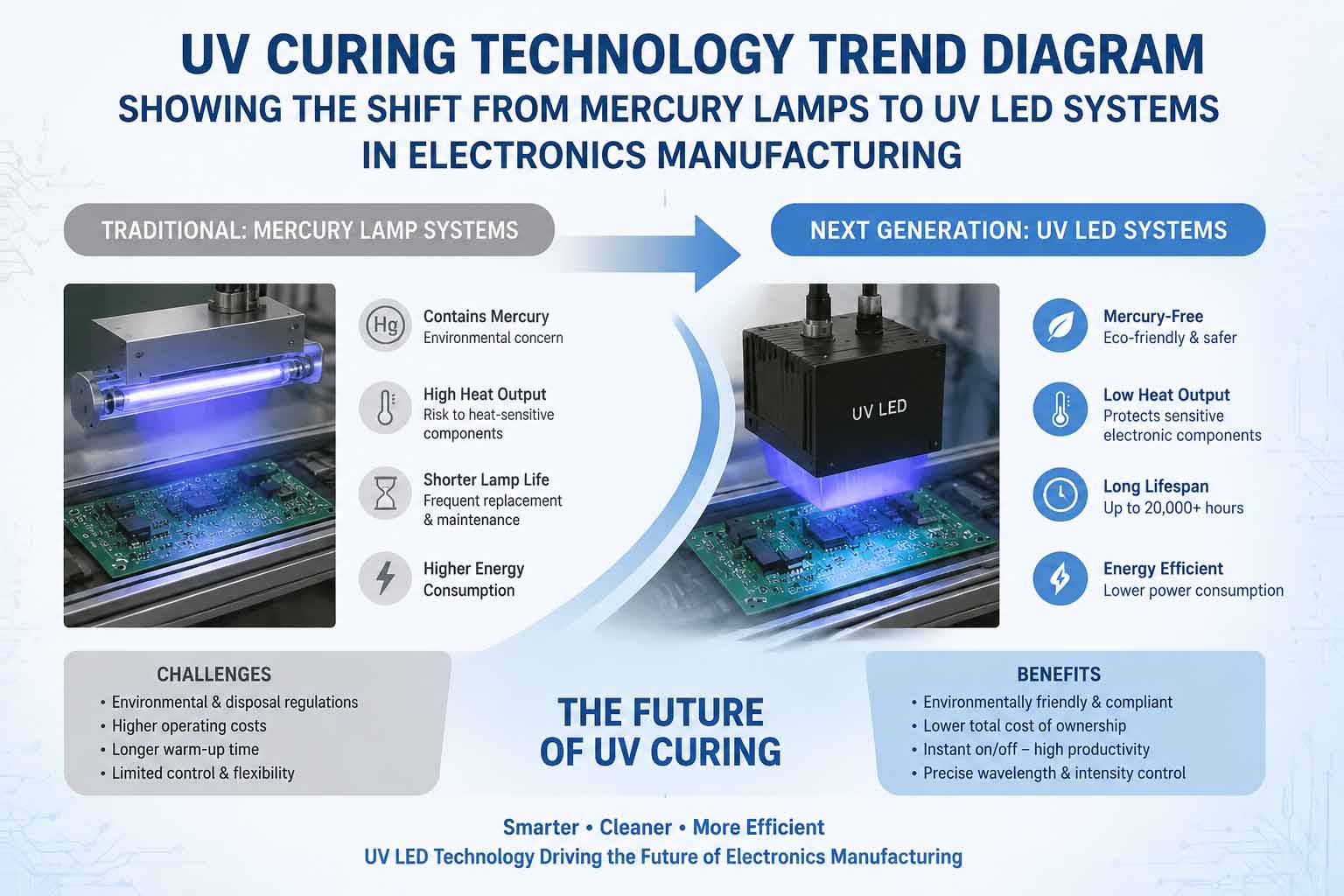
For decades, the workhorse of UV curing in electronics manufacturing has been the mercury vapor lamp — reliable, powerful, and well-understood. These lamps have served manufacturers across conformal coating, adhesive bonding, solder mask curing, and component fixation. However, the industry is now at a critical inflection point driven by converging forces: regulatory pressure, technology evolution, and market demand for greater efficiency.
The global UV curing system market reached $7.47 billion in 2025 and is estimated at $8.70 billion in 2026, with the Asia-Pacific region leading growth at a CAGR of approximately 10.0%. This expansion is not merely incremental — it represents a fundamental technology transition.
The electronics manufacturing sector faces five critical pain points that modern UV curing technology directly addresses:
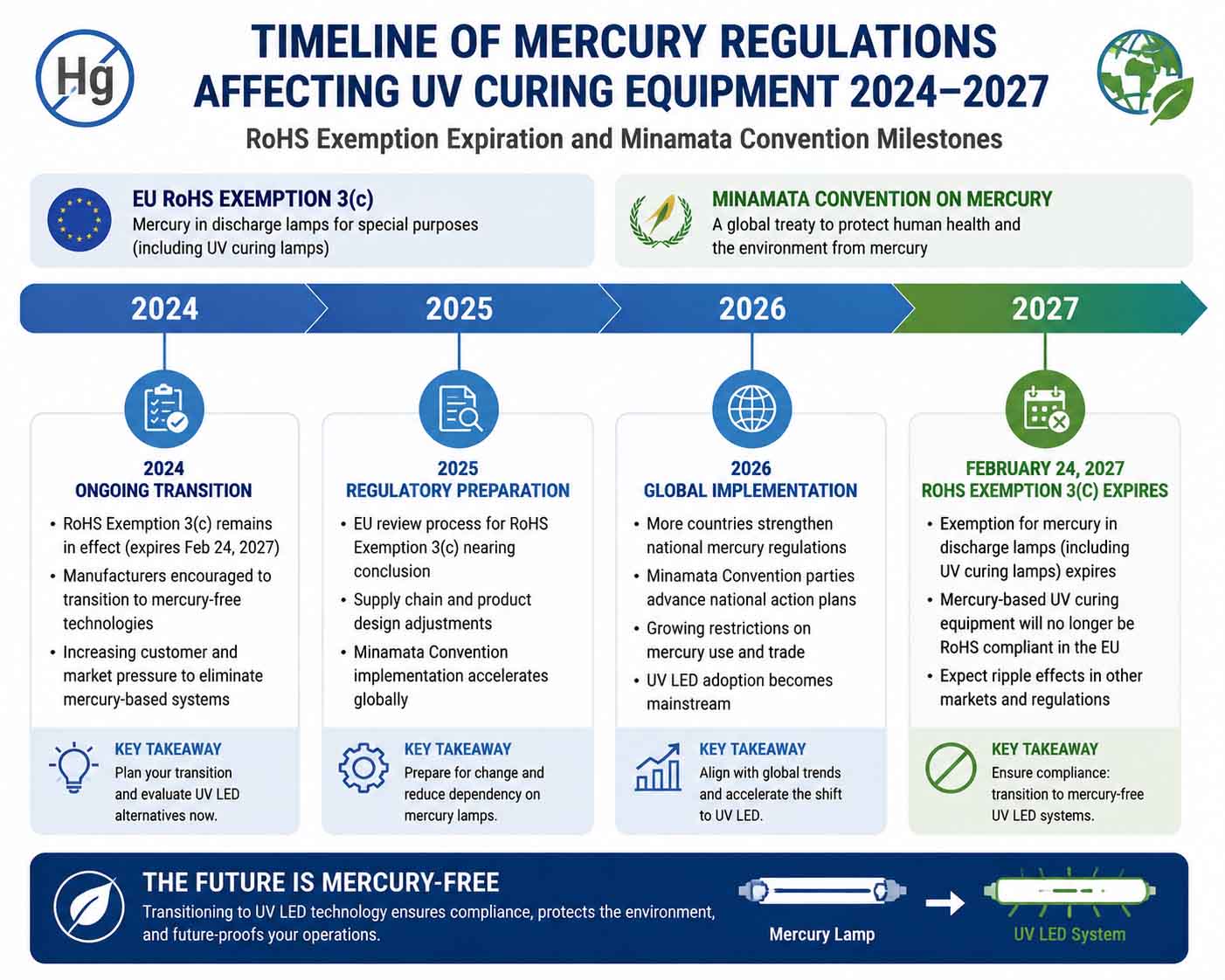
- Regulatory compliance pressure: The EU RoHS Directive's mercury exemption (Annex III, 4(f)-IV) expires on February 24, 2027. Additionally, the Minamata Convention — ratified by 151 countries — mandates global mercury phase-out. Manufacturing and export bans on specific mercury-containing lamps took effect in December 2025, with more categories facing restrictions by December 2026. Any manufacturer exporting to EU or mercury-restricted markets must transition now.
- Energy cost escalation: Mercury-based UV curing systems consume substantial electricity and waste significant energy as infrared radiation (heat). In regions with rising industrial electricity rates, this directly impacts production margins.
- Production downtime from lamp failures: Traditional mercury lamps have a typical lifespan of only ~800 hours, requiring frequent replacements that interrupt production lines and demand technician labor.
- Thermal damage to sensitive components: Mercury lamps emit intense infrared radiation, raising PCB surface temperatures and risking damage to heat-sensitive components, thin boards, and precision assemblies.
- Inconsistent curing quality: Mercury lamp output degrades over its lifetime, leading to variable curing results and increased rework rates — a costly problem for high-reliability electronics.
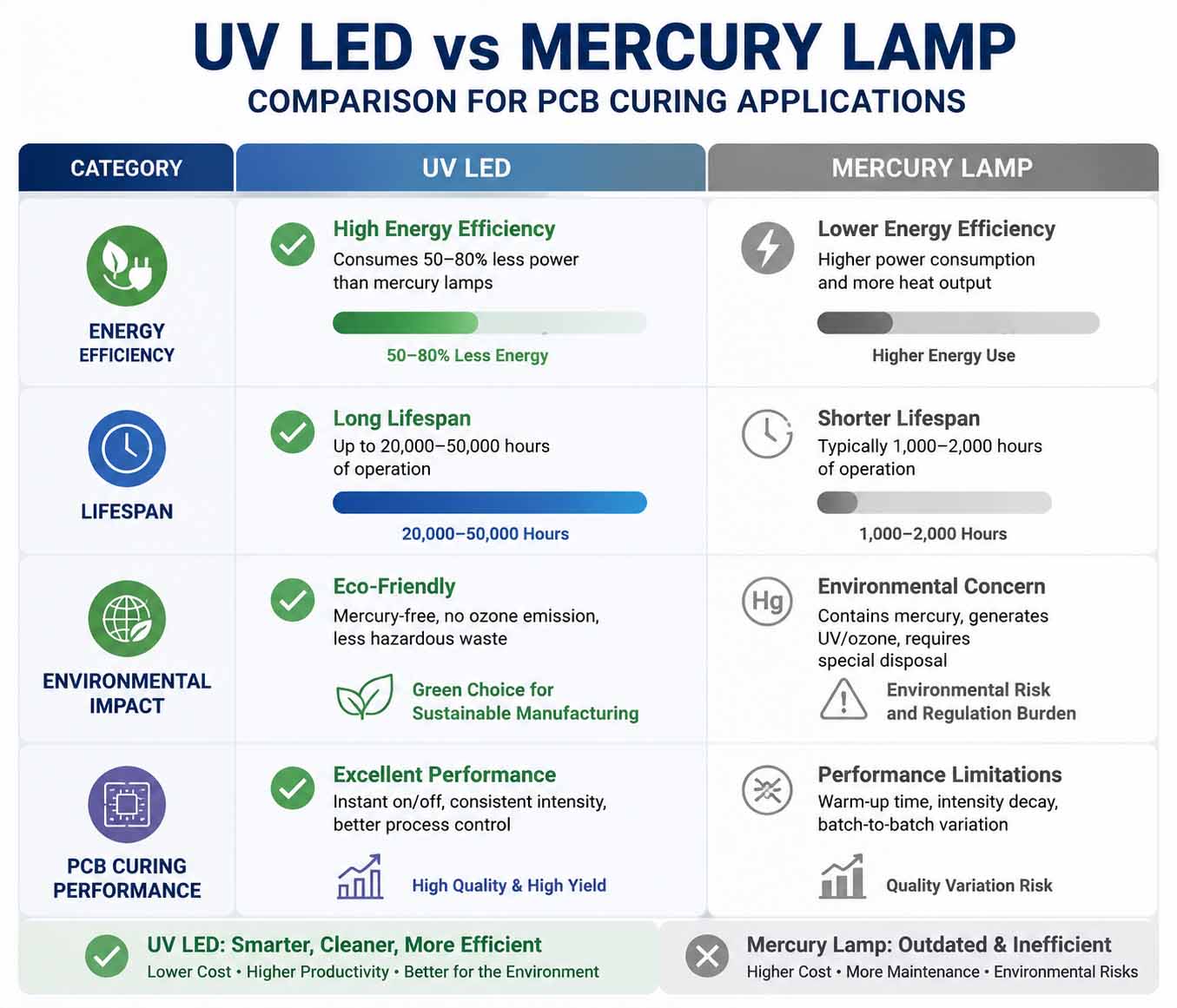
Figure 2: Regulatory timeline for mercury-based UV curing — the February 2027 RoHS deadline is the most critical date
UV Curing Machine Technology Breakthroughs and Innovative Solutions
The replacement for mercury-based UV curing is already mature and proven: UV LED curing technology. What was once considered a promising alternative has now become the industry standard for forward-thinking electronics manufacturers. The performance advantages are not marginal — they fundamentally change the economics and reliability of the curing process.
Modern UV curing machines leverage semiconductor-based LED arrays that emit precisely the wavelengths needed for photopolymerization — primarily UVA at 365nm — without the wasted energy, heat, and environmental burden of mercury lamps. These systems integrate seamlessly into SMT production lines, supporting conveyorized inline operation with real-time process monitoring. To explore JHIMS equipment compatible with these applications, see our full SMT equipment catalog.
Key Technical Parameters: UV LED vs. Mercury Lamp Comparison
The table below presents a direct comparison of the critical performance metrics that matter most to electronics manufacturers evaluating their curing technology options in 2026:
| Parameter | Traditional Mercury Lamp | 2026 UV LED (New Generation) |
|---|---|---|
| Typical Lifespan | ~800 hours | 20,000 – 40,000 hours |
| Power Consumption | High (continuous operation) | ~1/10th of mercury lamp |
| Energy Efficiency | Baseline | Up to 80% energy savings |
| Warm-up Time | 2 – 5 minutes | Instant on/off |
| Output Stability | Degrades over lamp life | Consistent throughout lifespan |
| Substrate Temperature Rise | Significant (IR radiation) | Minimal (<5°C) |
| Primary Wavelength | Broad spectrum (200-450nm) | Targeted UVA 365nm peak |
| Curing Intensity | Moderate, declining | 50-150 mW/cm² (up to 10,000 mW/cm² available) |
| Maintenance Frequency | Every few months | Every 3 – 5 years |
| Environmental Compliance | Contains mercury (regulated) | Mercury-free, RoHS compliant |
Quantified Analysis of Production Efficiency Improvements
The shift to UV LED curing systems delivers measurable production efficiency gains across multiple dimensions. These are not theoretical projections — they are results reported by manufacturers who have completed the transition:
- Cycle time reduction of 40 – 65%: The instant-on capability of UV LEDs eliminates the 2-5 minute warm-up period required by mercury lamps. Combined with higher effective intensity at the target wavelength, cure times for standard UV-curable acrylate conformal coatings drop to 5 – 20 seconds at 50-150 mW/cm². In continuous inline production, this translates to significantly higher throughput.
- Line uptime improvement of 15 – 25%: Eliminating mercury lamp replacements every 800 hours removes a recurring cause of unplanned downtime. With LED lifespans of 20,000-40,000 hours, maintenance interventions shift from monthly events to multi-year intervals.
- First-pass yield increase of 5 – 12%: Unlike mercury lamps that degrade progressively, UV LEDs maintain consistent output throughout their lifetime. This eliminates the "end-of-lamp-life" quality drift that causes under-curing, poor adhesion, and rework — directly improving process capability (Cpk values).
- Floor space optimization of 20 – 30%: UV LED systems eliminate the need for exhaust ducting, water cooling infrastructure, and bulky lamp housing required by mercury systems. The compact form factor frees valuable production floor space.
Cost Control and Maintenance Optimization
While UV LED curing machines often carry a higher upfront purchase price than legacy mercury lamp equivalents, forward-thinking manufacturers evaluate equipment decisions through the lens of Total Cost of Ownership (TCO). When all cost factors are considered over a standard 3-5 year operating horizon, the economics strongly favor UV LED:
- Energy cost reduction of 60 – 80%: With LED systems consuming approximately one-tenth the power of equivalent mercury setups, electricity savings alone can recover a significant portion of the initial investment. For factories running 24/7 multi-shift operations, annual energy savings often exceed five figures per curing station.
- Lamp replacement cost elimination: A typical mercury lamp replacement cycle of every 2-3 months at $200-$500 per lamp adds $800-$3,000 annually per curing station in direct material costs alone — before accounting for labor and downtime. UV LED arrays require no replacement for 3-5 years.
- Mercury disposal cost avoidance: Spent mercury lamps are classified as hazardous waste in most jurisdictions, requiring specialized disposal procedures with associated fees. UV LEDs carry zero hazardous waste burden.
- ROI example — typical mid-volume factory: A factory operating 6 mercury-based UV curing stations across two shifts can expect a payback period of 8-14 months when transitioning to UV LED, based on energy savings, lamp replacement elimination, disposal cost avoidance, and productivity gains from reduced downtime — after which all savings flow directly to the bottom line.
Typical Application Scenarios in 2026 Electronics Manufacturing
UV curing technology has expanded far beyond its original niche, now serving as a critical process step across multiple electronics manufacturing verticals. The following real-world applications represent the most active areas of UV curing adoption in 2026:
- LED Display Manufacturing (GOB Module Encapsulation): The rapid growth of fine-pitch LED displays — particularly for indoor commercial and command center applications — demands GOB (Glue-On-Board) encapsulation with precise, bubble-free UV curing. Modern UV curing ovens deliver the uniform intensity and controlled depth-of-cure essential for optical clarity and long-term reliability of LED modules. The process requires tight control of wavelength (365nm), intensity uniformity across the entire module surface, and conveyor speed matching the encapsulation station output.
- Automotive Electronics (ECU Protection and Sensor Assembly): Automotive electronic control units, ADAS sensors, and battery management systems operate in harsh environments — extreme temperatures, vibration, humidity, and chemical exposure. UV-curable conformal coatings provide the protection these components demand, with the added advantage of fast cure times that keep pace with high-volume automotive production lines. The thermal management advantage of UV LED is particularly valuable here, as many automotive sensors contain temperature-sensitive MEMS components.
- Consumer Electronics (Smartphone, Tablet, Wearable PCB Assembly): The relentless miniaturization of consumer electronics — thinner PCBs, tighter component spacing, flexible circuits — makes the precision and low thermal impact of UV LED curing essential. Applications include chip underfill curing, camera module adhesive bonding, flex circuit stiffener attachment, and waterproof seal curing for wearable devices. The ability to cure without warping thin substrates is a decisive advantage.
- Industrial Control and Power Electronics: High-reliability industrial PCBs — PLC controllers, motor drives, power supplies — rely on UV curing for conformal coating protection against dust, moisture, and chemical contaminants in factory floor environments. The consistent cure quality of LED systems reduces field failures and warranty claims.
- Medical Device and Aerospace Electronics: These sectors demand the highest reliability standards. UV curing provides the traceable, repeatable process control required for medical device PCB protection and aerospace electronics assembly. The elimination of mercury aligns with the sustainability mandates increasingly required by these industries.
Expert FAQ: UV Curing Technology in Electronics Manufacturing
Based on common questions from electronics manufacturers evaluating their UV curing technology options, here are detailed answers to the most frequently asked questions in 2026:
Q1: What are the key requirements for UV curing machines in 2026?
In 2026, modern UV curing machines must meet five critical requirements for electronics manufacturing. First, mercury-free operation using UV LED technology — essential for regulatory compliance and long-term viability. Second, energy efficiency of at least 60-80% improvement over legacy systems to reduce operating costs. Third, precise wavelength control at 365nm (UVA) matching standard photoinitiator absorption peaks in UV-curable coatings and adhesives. Fourth, conveyor integration capability for inline SMT production with speed synchronization to match line takt time. Fifth, smart factory connectivity with real-time intensity monitoring, closed-loop control, and MES/Industry 4.0 integration for process traceability. Equipment that meets all five criteria positions manufacturers for both immediate efficiency gains and long-term regulatory resilience.
Q2: How does UV LED curing compare to traditional mercury lamp curing?
UV LED curing outperforms mercury lamp technology across every metric that matters to electronics manufacturers. LED systems deliver 25-50x longer lifespan (20,000-40,000 hours versus ~800 hours), up to 80% energy savings, instant on/off with zero warm-up time, minimal substrate heating (temperature rise typically under 5°C), consistent output throughout LED life (eliminating the quality drift of aging mercury lamps), and complete elimination of mercury disposal requirements. The only dimension where mercury lamps retain an advantage is lower initial purchase cost — but this is more than offset by total cost of ownership savings within the first year of operation for most factories.
Q3: What wavelength is best for PCB conformal coating curing?
The industry standard for PCB conformal coating UV curing is UVA at 365nm. This wavelength aligns with the photoinitiator absorption characteristics of the most widely used UV-curable acrylate, epoxy, and urethane coating formulations. Typical curing parameters for conformal coating applications are 50-150 mW/cm² intensity with cure times of 5-20 seconds for standard coating thicknesses (25-75 microns). For thicker coating applications or high-speed production lines, higher intensity systems (up to several thousand mW/cm²) are available. It is critical to match the UV LED wavelength to the specific coating formulation's photoinitiator — most electronics-grade UV-curable coatings are optimized for 365nm, but always verify with your coating supplier.
Q4: How does the RoHS mercury exemption deadline affect UV curing equipment choices?
The EU RoHS Directive's mercury exemption for UV-emitting lamps under Annex III, entry 4(f)-IV expires on February 24, 2027. After this date, manufacturing and importing mercury-containing UV lamps into the EU market will face severe restrictions — effectively requiring all new equipment to be mercury-free and placing existing mercury-based systems under compliance pressure. This deadline is less than a year away. Combined with the Minamata Convention (151 ratifying countries) and 14 U.S. states with independent mercury lamp restrictions, the regulatory trajectory is unambiguous. Electronics manufacturers who export to EU markets should complete their transition planning during 2026. Even manufacturers serving only domestic markets should anticipate that similar restrictions will expand globally — making UV LED adoption a strategic resilience decision, not just a compliance exercise.
Q5: What is the typical ROI when switching from mercury to UV LED curing?
For factories operating multi-shift production, the ROI payback period for UV LED curing systems is typically 8-14 months. The payback is driven by four primary savings streams. First, energy cost reduction of 60-80% — LED systems consume roughly one-tenth the electricity of mercury lamps for equivalent curing output. Second, lamp replacement elimination — at $200-$500 per mercury lamp replaced every 2-3 months, a single curing station saves $800-$3,000 annually in lamp costs alone. Third, mercury hazardous waste disposal fees are eliminated entirely. Fourth, productivity gains from reduced downtime (no warm-up waiting, fewer maintenance interventions) and improved first-pass yield from consistent curing quality. A typical mid-volume factory with 4-8 curing stations achieves full payback within the first year, after which all savings contribute directly to operating margin.
Q6: How do I choose between inline and batch UV curing systems?
The choice between inline and batch UV curing systems depends primarily on your production volume and workflow characteristics. Inline UV curing conveyors integrate directly into the SMT production line, enabling continuous, automated processing without manual handling. They are ideal for high-volume production (typically >1,000 boards per shift) where every second of cycle time matters and where the curing step must not become a bottleneck. Inline systems synchronize conveyor speed with upstream and downstream processes for seamless flow. Batch/benchtop UV curing ovens are better suited for lower volumes, R&D prototyping, or mixed-product environments where production runs vary. They offer flexibility, smaller footprint, and lower upfront cost, but require manual loading/unloading. Key decision factors include current and projected throughput, available floor space, desired automation level, and whether your production is continuous-flow or batch-oriented.
Q7: What industries benefit most from UV curing technology in electronics?
UV curing technology delivers significant benefits across a broad range of electronics sectors in 2026. LED display manufacturing — particularly fine-pitch and GOB (Glue-On-Board) encapsulation — relies on precise UV curing for optical clarity and module reliability. Automotive electronics including ECUs, ADAS sensors, and battery management systems use UV-curable conformal coatings for protection in harsh operating environments. Consumer electronics (smartphones, tablets, wearables) benefit from the low thermal impact of UV LED for thin/flexible PCB assembly. Industrial control systems and power electronics use UV curing for reliable conformal coating in factory environments. Medical device electronics and aerospace electronics leverage UV curing's process traceability and consistency for their most demanding reliability requirements. Across all these sectors, the common thread is the need for fast, consistent, thermally gentle, and increasingly mercury-free curing processes.
2026 Outlook and Actionable Recommendations
The trajectory of UV curing technology in electronics manufacturing is clear and accelerating. Three trends will define the remainder of 2026 and beyond:
- Mercury phase-out becomes irreversible. With the February 2027 RoHS deadline approaching, 2026 is the final full year for electronics manufacturers to plan and execute their transition. Companies that delay will face equipment availability constraints, rushed decisions, and potential compliance gaps — while early movers capture efficiency gains immediately.
- Smart factory integration redefines curing. The next generation of UV curing machines goes beyond the light source. Real-time intensity monitoring with closed-loop feedback, AI-driven parameter optimization based on board type and coating material, and seamless MES/ERP integration are transforming curing from a standalone process into a data-rich, intelligent manufacturing node. This connectivity enables predictive maintenance, process traceability for quality audits, and continuous improvement analytics.
- Asia-Pacific drives market expansion. With the region's 10.0% CAGR, massive electronics manufacturing base, sustainability initiatives, and factory automation investment, Asia-Pacific — particularly China — represents both the largest growth opportunity and the most competitive landscape for UV curing adoption. Manufacturers in the region who invest in LED-based curing systems now position themselves for both export compliance and domestic cost competitiveness.
Ready to explore UV curing solutions for your PCB assembly line?
At JHIMS, we provide comprehensive SMT equipment including UV curing systems, automatic soldering machines, precision dispensing equipment, and AOI inspection solutions. Our team can help you evaluate the right curing technology for your specific production requirements — whether you are upgrading existing lines or building new capacity.
Discover more about JHIMS UV curing equipment solutions and how they integrate into modern electronics manufacturing workflows.
Key Takeaways for Electronics Manufacturers
- The February 2027 RoHS mercury exemption deadline makes 2026 the critical year to plan and execute your transition to UV LED curing
- UV LED systems deliver 80% energy savings, 25x+ longer lifespan, and consistent curing quality compared to mercury lamps
- The global UV curing market is growing at 17.22% CAGR, with Asia-Pacific leading at 10.0% — early adoption is a competitive differentiator
- Total Cost of Ownership (TCO) strongly favors UV LED — do not let upfront price comparisons mislead procurement decisions
- Smart factory integration and AI-driven curing are transforming the process into an intelligent, data-connected manufacturing node


 Teams
Teams
 whatsapp
 telegram
