
News
A refill is a materials operation before it is a machine operation. The two most common refill errors are both ratio errors in disguise: topping up with the wrong component, and changing the ratio to compensate for lost time. Neither is fixed by dispensing faster afterwards.
For the worked example used in this guide, JHIMS OPT315 is a two-component condensation-type silicone sealing material for indoor and outdoor LED displays, cured at room temperature. Its product page states a general weight ratio of A:B = 10:1, that more component B shortens both curing time and working time, that a higher ambient temperature speeds curing and shortens working time, and that heating to cure is generally not recommended because it can produce pinholes or bubbles. The same page states the preparation that the refill must respect: component A needs to be properly stirred, and component B should be shaken well in its container under sealed conditions before use. If the refill changes either component's handling, the ratio, or the temperature assumption, it has changed the material, and the batch after the refill is not the same process as the batch before it, even if the program name is unchanged.
Three refill rules follow from that, and they apply whether the material is OPT315 or another two-component material whose datasheet the plant is actually using:
First, refill components, not mixed glue, unless the machine's own procedure expressly provides for a mixed-glue top-up. Do not pour fresh mixed material on top of ageing mixed material in the feed and assume the working time resets. The older portion does not become younger because new material arrived.
Second, do not change the ratio to buy time. Adding more of one component to speed curing, or less to extend working time, changes both times together, as the OPT315 page states for its material, and it changes them in a direction the operator cannot verify by eye. If the ratio must change for any reason, that is a new process trial, with a test first, not a mid-batch adjustment.
Third, keep air out of the refill, and keep the refill out of the cured batch's record gaps. A refill that introduces bubbles, or that is not recorded with its component lots, ratio, and time, leaves the next inspection with no way to distinguish a refill defect from a dispensing defect. For OPT315, the product page adds a related warning that belongs in the refill check, not in a footnote: for potting thicker than 20 mm, natural defoaming is no longer assumed, and the mixture should be vacuum-defoamed for at least 5 minutes at 700 mmHg. Whether that threshold applies to a given GOB layer is a datasheet question for the exact material in use; the point for the refill is that defoaming, like ratio, is a material condition, not a step that can be skipped because the line is waiting.
Restarting is not pressing the same button again. It is re-establishing, one item at a time, the conditions that made the pre-interruption coating acceptable, and it should be signed off as a checklist, not assumed from the fact that the machine powers up. The GOB-LXS330 page gives the items that can be verified against that machine: the input pressure range of 0.5–0.8 MPa, the 400 × 400 mm fixture, the teaching program, and parameter storage. Each of those is a check, not a slogan.
Before the first post-refill module, confirm: the recalled program is the program for this module, not merely a program with a similar name; the fixture is seated in the same position and has not been disturbed during the refill; the supply pressure is within the machine's stated range; the anti-drip valve is behaving as it did before the interruption, with no dripping between modules and no starvation at the start of a path; and the batch record already shows the split, with the last pre-refill module identified and the first post-refill module left blank for its proof result. If any item cannot be confirmed, the line has not restarted. It is still interrupted, and the next module would be a trial, not production.
One item deserves emphasis because it is the easiest to skip: the fixture. A refill often involves hands, containers, and movement around the machine. A fixture nudged during that work, then restarted on a stored program, will coat in the wrong place with perfect repeatability — the machine's ±0.05 mm running accuracy, stated on the GOB-LXS330 page, reproduces the wrong position just as faithfully as the right one. Accuracy is not the same as correctness, and a restart check that only looks at the screen misses it.
The first module after a refill is not production. It is proof, and it should be treated as such until it passes. Run one module on the recalled program, then inspect it as a first article for this sub-batch: edge continuity with no step or seam where a path restarts, complete coverage with no thin or starved area at the start of a path, no bubble cluster that was not present before the interruption, and no drip marks between paths. Compare it against the last good pre-refill module, not against an ideal in someone's head. If the proof module does not match, the cause is still in the refill or the restart, and running more modules only multiplies the suspect quantity.
If the proof module passes, record it as the first post-refill module, with its result, and release the sub-batch to continue under the same program and the same recorded conditions. If it fails, hold the sub-batch, return to Sections 3 and 4, and do not release modules coated in the meantime as if the proof had passed. The distinction matters for traceability as well as quality: a customer or an acceptance inspector who later finds a defect in a post-refill module needs to know that the module belongs to the post-refill sub-batch, with its own refill record, rather than to an undifferentiated batch in which the interruption has been erased.
A related question is whether the proof module can be the module that was interrupted. In general, no: a module that was partly coated, then left while the supply was refilled, has a different coating and cure history from a module coated in one continuous run, and Section 2 already isolates such a module for disposition under the finished-module acceptance rules. The proof module should be a fresh module, coated in one run after the refill, so that its result actually proves the restarted process.
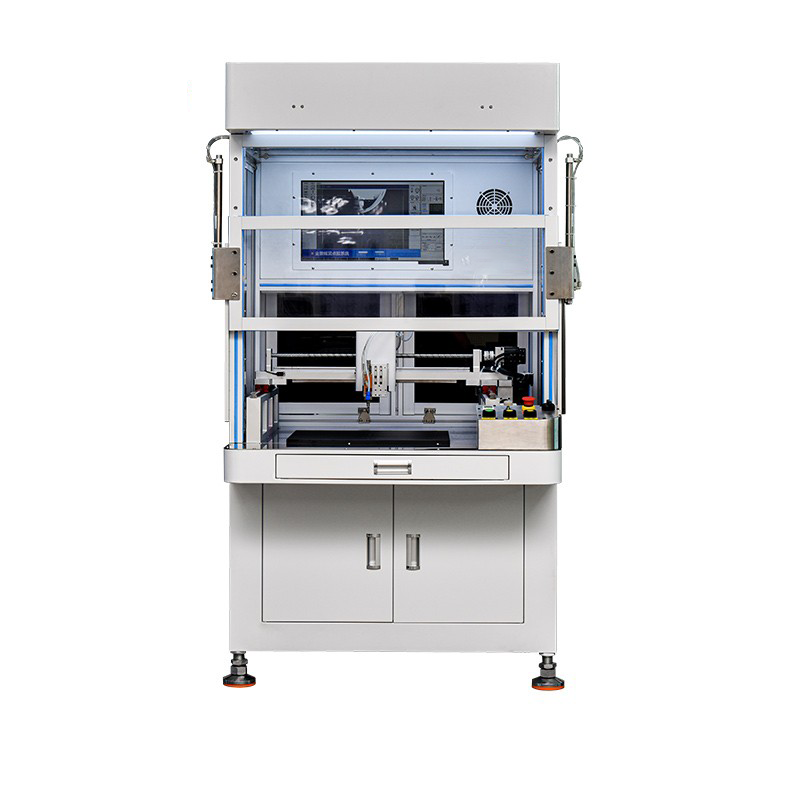
A CCD visual glue dispensing machine on its product page. It is not the GOB-LXS330; it illustrates a dispensing station of the kind whose program, fixture and supply must be re-verified before a restart (see Section 4).
| Mistake | What it costs | Do this instead |
|---|---|---|
| Starting a new module on a low supply to "use up" the material | A partly coated module and a seam that cannot be undone | Stop at the module boundary; the material saved is not worth the module lost |
| Topping up mixed glue with fresh mix of a different age or ratio | An unknown working time and an unknown cure for the whole sub-batch | Refill components as the procedure requires; record lots, ratio, and time |
| Changing the ratio to speed curing after a delay | Working time and cure time both move, in a way no eye check can verify | Keep the datasheet ratio; a delay is recovered by starting earlier next time, not by changing chemistry mid-batch |
| Restarting without checking fixture position or pressure | Perfectly repeatable coating in the wrong place, or starved at path starts | Run the Section 4 checklist and sign it before the proof module |
| Blending pre-refill and post-refill modules into one undated batch | A later defect cannot be traced to the interruption, and the whole batch becomes suspect | Keep the split on the traveller until acceptance closes it |
| Restarting on the interrupted module and calling it one coating | A seam and a mixed cure history hidden inside a "finished" module | Isolate the interrupted module; prove the restart on a fresh module |
An interruption that is not recorded will be repeated, and it will be repeated without its cause. The record does not need to be long. It needs to be complete enough that a different shift, or an inspector a week later, can reconstruct what happened without asking the operator who was there. Copy these fields onto the batch traveller at the time of the interruption, not from memory at the end of the shift:
Alarm time and module in progress — Last completed module before the stop — Decision taken (finish that module / stop at the boundary / isolate the interrupted module) — Component lots refilled, ratio used, and refill time — Shop temperature and supply pressure at restart — Program recalled and fixture check result — First post-refill (proof) module identity and inspection result — Sub-batch split: pre-refill modules listed separately from post-refill modules — Name and time of the person who released the restart.
If a field cannot be filled, that is itself a finding: the restart should not have been released on an incomplete record, and the gap should be closed before the sub-batch moves to curing and release. The curing and release procedure for the batch after coating is a separate step, covered by its own rules; the interruption record is what allows that procedure to treat the pre-refill and post-refill modules correctly, rather than as if they had never been separated.
A restart is only repeatable if the coating itself is repeatable, and that is where the dispensing machine earns its place in an interruption guide. The JHIMS GOB-LXS330 applies the coating with a running accuracy of ±0.05 mm, a 400 × 400 mm fixture, teaching programming, and parameter storage for different products — all verified on its product page. Repeatable application does not create supply, and it does not forgive a ratio error or a disturbed fixture, but it removes one variable: when the program, the fixture, and the supply are all restored as Section 4 requires, the proof module is a meaningful test of the restart instead of a test of everything at once.
For precision dispensing context only — not a GOB machine — the JHIMS D900 on jhims.net illustrates the same principle at a different scale: repeatable, controlled dispensing is what makes a downstream process window predictable. Do not confuse the two machines: the GOB coating step in this guide is the GOB-LXS330, and the D900 is cited only as a dispensing-precision reference. The GOB-LXS330 product page itself is at jhims.com, and the OPT315 material page used as the worked example is at jhims.com. After coating, the batch still faces its own curing and release decision, covered in the related guide at jhims.com.
Can we finish the module in progress after the alarm?
Only if flow is still normal and the operator can confirm the supply will last to the end of that module. If flow is already weakening, stop and isolate the module. A module that runs dry mid-way is not saved by a refill afterwards.
What if one component runs out before the other?
Stop. A two-component material without both components in the stated ratio is not the same material, and dispensing the remaining component alone, or changing the ratio to match what is left, creates a sub-batch with an unknown cure. Refill both components as the procedure requires and prove the restart.
Can fresh mixed glue be added to the mixed glue already in the feed?
Not as a routine refill, unless the machine's own procedure expressly provides for it. The older portion keeps its age, and the mixture's working time cannot be reset by adding new material. Refill components, record the refill, and prove the restart on a fresh module.
Does a refill change the curing decision for the batch?
It changes the batch record, and it may change the cure history of the interrupted module, which is why that module is isolated. For modules coated cleanly before or after the refill, curing and release still follow the material datasheet and the curing procedure; the refill does not shorten cure, and heating to recover lost time is not a substitute for the datasheet condition.
Do we need to re-teach the program after a refill?
Not if the program, fixture, and supply are all verified as in Section 4. Parameter storage means the program can be recalled, but recall is not verification. If any check fails, or if the fixture was disturbed, re-verify — and re-teach if the plant's procedure requires it — before the proof module, not after production has resumed.
Bottom line: A low-glue alarm is a short stop, not a batch failure — provided the stop falls at a module boundary, the refill respects the material's ratio and handling, and the restart is proved on one fresh module before the batch follows. Record the split, prove the restart, and let curing and acceptance judge the two sub-batches on their own records. For technical details on the machines and material in this guide, contact JHIMS at [email protected].


 Teams
 whatsapp
 telegram
