
News
Short answer: choose the machine whose screw range covers every screw in your BOM, whose driving speed beats your takt time with at least 30% headroom, and whose driver holds torque with closed-loop servo control. Then verify all three with your own modules and your own screws before you pay. The five checks below walk through it, with a worked calculation and verified specifications for three machines.
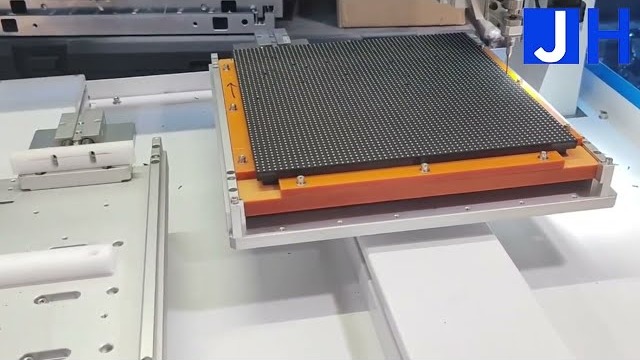
An LED module fixtured on the worktable of an automatic screw tightening machine. Video frame: JHIMS official YouTube channel (@jhims).
List every screw in the module BOM first: size, length, head type, and how many per module. LED module screws are small, and the three JHIMS machines compared below cover M0.6–M2.0 between them — but a machine only works for you if both your smallest and your largest screw sit inside its range.
Screw geometry decides the feeding method. As a screening rule from feeding practice, air-blow delivery is most reliable when a screw's overall length is clearly greater than its head diameter, because the screw has to travel through a tube without tumbling.
Very short, stubby screws may need a suction-type pickup instead. Treat that as a first filter, not a verdict — the feeding trial in check 4 is the verdict.
Required screws per hour = screws per module × modules per hour
Time budget per screw = 3,600 ÷ required screws per hour
Worked example, with the assumptions stated: a module with 10 screws, and a target of 200 modules per hour, needs 2,000 screws per hour — a budget of 1.8 seconds per screw. A driver that tightens in 1–1.2 seconds leaves 0.6–0.8 seconds per screw for positioning, indexing and board handling.
If that machine is rated "up to 2,800 screws per hour", your plan already runs at about 71% of its nameplate rate. That works, but there is little room for a larger module or a second product. This is the point where a dual-station machine — which loads the next board while the current one is being driven — starts to pay for itself.
Watch the units. Manufacturers quote speed three different ways: per screw, per 2 pieces (dual-station machines driving two screws in one cycle), and as a maximum hourly capacity. The comparison table in section 5 deliberately shows all three styles, because comparing two machines before the units match is the most common selection mistake we see.
LED modules are built on aluminum-substrate PCBs and plastic bosses. Both strip or crack when torque overshoots, and both work loose in the field when it undershoots. What to require:
Get the target torque from your module and screw supplier's joint specification, then validate on sample boards: screws seated, no stripped threads, no cracked bosses.
Locking mode matters as well — torque mode, revolution-count mode and depth mode solve different joint problems, and the 2P-LXS500 below offers all three.
The three machines below all feed screws from a vibratory disk or bowl with air-blow delivery, and JHIMS states feeding reliability above 99.8% for the ZM320 and ZM500. That figure is a manufacturer claim — treat it as something to verify, not something to repeat.
Bring your own screws, including a deliberately mixed handful of the wrong size, and watch a full run. A mixed-screw test shows whether the feeder rejects foreign screws or jams on them.
Also check what happens on a jam or a missing screw: the machine should detect it and stop or signal, never drive an empty hole and pass the module. Ask exactly what your candidate model detects — depth detection, for example, is a listed feature of the ZM500.
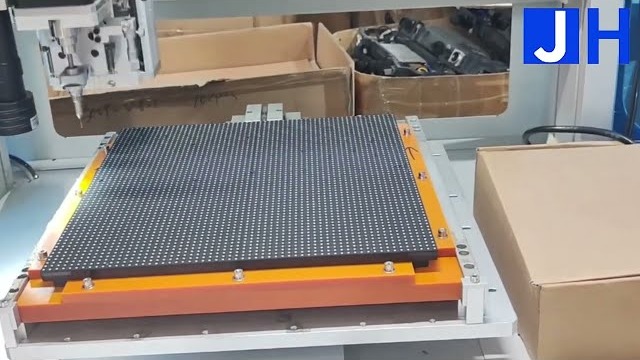
Close-up of an LED module on the carrier, driving head at the left. Video frame: JHIMS official YouTube channel (@jhims).
Measure your largest module, not your average one. Work areas: the desktop ZM320 covers 320×320 mm with dual stations; the ZM500 handles panels up to 500×500 mm; the floor-standing 2P-LXS500 covers 320×500 mm.
Then plan for the modules that come back. Rework is a certainty in LED production, and a tighten-and-remove dual-mode machine such as the ZM500 unscrews with programmable removal torque at the same station, instead of sending modules to a separate manual bench. If your rework volume is small, the bench may be enough — decide with your actual return rate, not with a guess.
For high-mix production, program storage matters: the ZM500 stores 1,000 programs, and the 2P-LXS500 stores 1,000 products × 2,000 points.
| ZM320 | ZM500 | 2P-LXS500 | |
|---|---|---|---|
| Screw range | M0.8–M2.0 | M0.8–M1.7 | M0.6–M2.0 |
| Driving speed | 1–1.2 s per screw; rated up to 2,800 screws/hour | 0.9–1.2 s per screw | 0.9–1.2 s per 2 pieces (dual station); max capacity 5,000 screws/hour |
| Positioning / repeat accuracy | ±0.02 mm | ±0.025 mm | ±0.02 mm (repeat accuracy) |
| Work area | 320×320 mm, dual station | 500×500 mm | 320×500 mm |
| Distinctive point | Desktop machine; camera teaching + CAD import | Tighten-and-remove dual mode for rework | Floor-standing six-axis machine for high-volume lines |
Manufacturer specifications from the JHIMS product pages linked below, checked on 21 October 2026. These are nameplate figures published by the manufacturer, not results measured on your product — validate them with your own modules before ordering.
Product pages: ZM320 desktop screw fastening machine · 2P-LXS500 automatic screw tightening machine · ZM500 screw tightening and removal machine. For general buying questions — machine categories, service life and warranty — see our earlier notes on buying an automatic screw locking machine; this guide focuses on the LED-module engineering checks.
What screw sizes do LED modules use?
Module screws are small; the machines compared above cover M0.6–M2.0 between them. Check your BOM — both the smallest and the largest screw must fall inside the machine's range.
Is a higher screws-per-hour rating always better?
No. Ratings mix units — per screw, per 2 pieces, maximum capacity — and assume continuous driving. Do the takt calculation with your module first; a machine planned at 60–70% of its rating leaves room for handling, changeovers and the occasional jam.
Blow feeding or suction feeding?
Blow feeding is fast and standard for screws with enough length to travel through the feed tube. Suction pickup suits very short screws and delicate surfaces. Decide from your screw geometry and a feeding trial, not from the brochure.
Can one machine both tighten and remove screws?
Yes. Dual-mode machines such as the ZM500 add a programmable removal torque for rework at the same station. If your rework volume is low, a separate manual bench can be the cheaper answer.
Sizing a machine for your modules? Send your screw sizes, module dimensions and target output to [email protected], and the checklist above can be run against your numbers.


 Teams
 whatsapp
 telegram
